Most B2B drip campaigns miss because they treat every lead the same. I’d fix that by building each sequence around 4 parts: trigger, signal, sequence, and goal.
Here’s the short version:
- Start with a trigger, like a demo completed, a trial started, or product usage crossing a set threshold
- Use a small set of signals to shape the email - role, company size, and last key action are enough for most teams
- Pick one sequence path based on the job to be done - demo follow-up, trial nurture, content path, high-converting sales funnels, or expansion
- Set one goal per sequence, such as booked meetings, trial activation, paid conversion, or expansion revenue
- Measure business results, not just opens - look at reply rate, meeting conversion, activation rate, opportunity creation, and time to conversion
The article’s main point is simple: triggered, signal-based drips beat generic batch sends. It also shows where personalization pays off most in B2B - especially in demo follow-up, trial nurture, and expansion. Stats in the piece point to stronger click-through rates, more opportunities, and better conversion when teams act on behavior instead of sending the same path to everyone.
If I were putting this into practice, I’d start with the highest-intent flows first, keep the rules simple, and make sure CRM and automation data stay in sync.
The Building Blocks of Effective B2B Drip Personalization
Effective B2B drips rely on five core inputs: firmographics, role, funnel stage, account intent, and behavior. Those inputs shape the trigger, the message, and the pacing for each drip use case.
Firmographics set the proof points. Role sets the angle.
Industry changes what kind of proof matters. A transportation prospect may care about logistics. A healthcare buyer may look for HIPAA proof. Company size changes the ROI story too. Mid-market teams often want cost savings. Enterprise teams tend to care more about revenue protection. Role changes the CTA. A VP of Marketing wants to see pipeline contribution. A RevOps leader wants data integrity. An IT admin wants SOC 2 details. Put together, these layers sharpen demo follow-up, trial nurture, and expansion messaging.
Funnel stage and intent determine when someone should enter a drip and how fast that drip should move. A top-of-funnel prospect who downloaded a guide may get educational emails spaced 3-7 days apart. A high-intent signal, like a second visit to the pricing page or a competitor comparison download, calls for follow-up within 24-48 hours. That’s the point where dynamic content and branching start doing the heavy lifting with marketing funnel software.
Dynamic content and branching turn personalization from a nice idea into something you can actually run. Dynamic content swaps blocks inside one template, like the headline, case study, or CTA, based on role and industry. So the same trial-nurture email can show a manufacturing use case to plant operations leaders and a SaaS ARR story to marketing leaders. Branching logic works at the sequence level. If a contact clicks a pricing link in Email 2, they move into a high-intent track. Branching also moves someone from a content path into demo follow-up, or from trial nurture into an expansion flow. If engagement drops, slow the sequence down or pause it. The same logic should apply to date, currency, and spelling formats.
For U.S. contacts, use dates like 09/30/2026, values like $1,250 or $250,000, and spellings like optimization, behavior, and personalization. Handle those through dynamic fields, so localization sits inside the personalization rules instead of outside them.
sbb-itb-a84ebc4
1. Trigger
Triggered vs. Batch Email Performance in B2B Drip Campaigns
Once your signals are set, the next step is simple: decide what event starts the sequence.
A trigger is the event that moves a contact into a drip sequence. It can come from an action - or from no action at all.
These triggers line up with the main B2B drips: demo follow-up, trial nurture, and expansion.
Here are three high-value B2B triggers:
- Demo completed When a prospect finishes a demo, they've already spent time with your team and shown serious intent. That's the moment to start a follow-up sequence that recaps the demo, handles objections, and shares role-based proof points like ROI calculators or security docs. Move fast - ideally within 1-2 hours after the demo - while the conversation is still fresh.
- Trial started or stalled A trial signup should kick off a product-led onboarding drip. But the better move is to react to milestones, not just the calendar. If a user creates their first dashboard or invites a teammate, shift the sequence toward deeper feature use, team collaboration, and upgrade prompts. If activity stalls for 3 days, send a rescue email instead with a short checklist or a setup call. The point is to let behavior drive the next email.
- Usage spike or seat threshold crossed For current customers, expansion triggers should fire when usage hits a meaningful point - say, 50 active users or 10 new workspaces added in a month. That opens the door for a drip focused on multi-team use cases, volume discounts, and enterprise features, ending with a CTA for a larger plan or add-on modules.
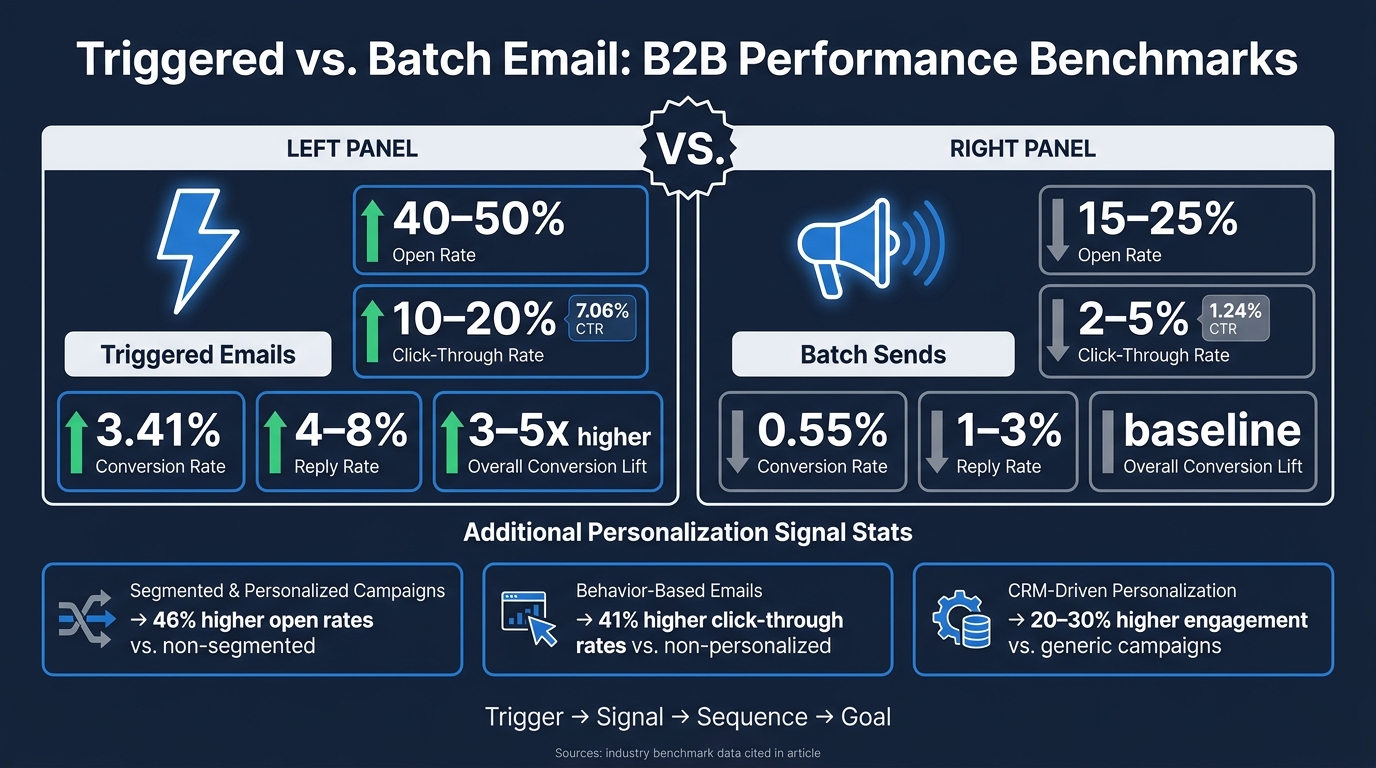
This is why triggered sends outperform batch sends. Benchmark data shows triggered emails averaging 40-50% open rates and 10-20% click rates, compared with 15-25% opens and 2-5% clicks for standard batch sends, with 3-5x higher conversion overall.
2. Personalization Signals
A trigger starts the sequence. The signals decide the proof point, CTA, and branch. Put simply, the trigger opens the door, and the signal mix decides what the first email should say.
In B2B drips, three signal types do most of the heavy lifting.
Firmographic & Role Context
Role and company size shape the angle of the message and the proof you use. A RevOps leader at a mid-market SaaS company does not need the same proof as a marketing manager at a small services firm. Role shapes the value story. Company size shapes the examples.
This works best in demo follow-up and expansion flows, where the right case study or ROI frame helps move someone from interest to action. Segmented, personalized campaigns show 46% higher open rates than non-segmented sends. CRM context like industry and company size can also drive 20-30% higher engagement than generic campaigns.
Behavioral & Intent Signals
Pages visited, assets downloaded, and emails clicked show where a contact is in their content journey - and when sales should step in. If someone visits pricing or comparison pages, the email should shift fast: stronger proof, shorter copy, and a direct CTA.
These signals help route contacts into the right content path or a high-intent follow-up track. Behavior-based, segmented emails deliver 41% higher click-through rates than non-personalized campaigns.
Tech Stack Signals
If you know a prospect uses Salesforce or HubSpot, you can swap in integration-specific content without rebuilding the whole sequence. A Salesforce user can get a Salesforce-native implementation checklist. A HubSpot user can see lifecycle alignment examples built on HubSpot workflows.
This kind of message works best in trial nurture and rep-free buying, where setup friction can slow conversion. When buyers think, Will this fit with what we already use?, stack-aware copy answers that right away.
For most mid-market B2B teams, start with role + company size + last key behavior. That mix is usually enough to choose the first email, the next branch, and the CTA. Add tech stack signals after role, size, and behavior are working well. From there, those signals can shape cadence, branching, and stop rules.
3. Sequence Structure
Use the trigger and signal mix to pick the right arc. Then build one clear email arc for one goal. In most B2B drip programs, three patterns handle the bulk of use cases.
Problem–Solution–Proof–Decision
This four-email arc works well for demo follow-up and rep-free buying. The flow is simple.
- Email 1: confirm the buyer’s specific problem
- Email 2: show the solution through their role or industry lens
- Email 3: add proof with customer results and real numbers
- Email 4: support the decision with implementation steps, an ROI calculator, or a next step
Activation–Engagement–Expansion
This pattern fits trial nurture and early customer lifecycle flows. The first email helps users get to their first meaningful win - importing data, inviting a teammate, or finishing a key workflow. The second points to more advanced features tied to their role or use case. The third introduces collaboration or governance features. The fourth brings in expansion outcomes, like adding more teams or moving to an annual plan, once usage passes a defined threshold. Use in-product milestones to move the sequence ahead.
Content-Path Sequence
This structure fits content nurture and rep-free buying. Email 1 delivers a high-intent asset and asks one simple preference question. Emails 2 and 3 split based on that answer and send deeper content in the chosen track. Email 4 offers a next step that matches the path, such as a working session to review the buyer’s funnel.
Match the arc to the use case - demo follow-up, trial nurture, content nurture, or expansion. Send the first 2 to 3 emails within the first 3 to 5 business days, when intent is highest. After that, slow the pace to every 3 to 5 days. Set exit conditions up front: book a meeting, convert, or show disinterest.
None of this works if the setup is sloppy. Data, branching, and stop rules need to be wired the right way.
4. Conversion Goal
Once the trigger, signals, and sequence arc are in place, set the conversion goal. One sequence, one goal. Decide on the target before you write the copy or build the branches using an all-in-one marketing platform. If you stack in secondary goals, the signal gets muddy and measurement gets harder.
The goal should match the stage of the journey. Lead nurture sequences should push toward demos or replies. Trial drips should push activation and conversion to paid. Expansion drips should push retention and expansion ARR.
For expansion, route contacts based on usage thresholds. When someone hits the next threshold, send them to the next offer and point them to an upgrade CTA in dollar terms with a clear reason to act now.
Track the primary KPI that fits the goal: meetings booked, activation and conversion to paid, or expansion ARR and net revenue retention. Open rates alone don't show expansion impact. That main KPI should shape your automation rules and reporting.
Data, Automation, and Measurement Essentials
The triggers, signals, and sequence rules above only do their job if your data and automation setup is clean.
Keep your CRM and marketing automation platform in sync in near-real-time on lifecycle stage, owner, account tier, consent, and opportunity data. That applies across demo follow-up, trial nurture, and expansion automation. Set field ownership up front: let the marketing automation platform handle engagement and behavioral scoring, and let the CRM handle accounts, contacts, and pipeline.
You also need to track the events that matter. That includes pricing-page visits, demo clicks, trial activation, logins, feature use, and replies. From there, segment using the drivers already in place - role, company size, behavior, lifecycle stage, and intent. So a high-fit, high-intent contact goes to sales, while a high-fit, low-engagement contact stays in nurture. Once those inputs are clean, you can map them into content blocks and branch rules.
Use modular blocks for industry proof, role pain points, and CTA variants. Then swap those blocks based on persona, stage, and segment. In practice, that means setting rules like these:
- If a contact clicks pricing, move them to a high-intent path
- If no one engages after three emails, move them to re-engagement
- If an opportunity is created, pause the top-of-funnel drip
One benchmark source reports 4% to 8% reply rates for signal-triggered sends versus 1% to 3% for cold, non-triggered sends.
For measurement, don't stop at opens. Track reply rate to judge message fit, activation rate for trial and product adoption, meeting conversion for sales handoff quality, opportunity creation for pipeline impact, expansion revenue for post-sale nurture, and time to conversion to see how personalization changes the pace of the buying process.
Conclusion
Effective B2B drip personalization starts with trigger events, not first-name tokens. That idea comes through most clearly in five B2B drip motions.
The highest-value flows are demo follow-up, trial nurture, content nurture, self-serve buying support, and expansion. At their core, they run on the same setup: trigger, signal, sequence, and goal. Signal-based drips beat generic batch campaigns. Triggered emails average a 7.06% click-through rate versus 1.24% for batch sends, and a 3.41% conversion rate versus 0.55%. But those use cases only work when the setup underneath them is clean.
Most teams do not need a CDP or an AI stack to get started. They need clear triggers, clean data, and a shared Trigger → Personalization Signals → Sequence Structure → Conversion Goal framework. Once that is in place, the next move is simple: launch the highest-intent flows first.
Start with demo follow-up and trial nurture. Then build into content paths, self-serve buying support, and expansion automation once the first flows hit target KPIs. Marketing Funnels Directory can help teams compare funnel and RevOps tools.
FAQs
How do I choose the best trigger to start a drip?
Choose a trigger based on specific user actions, not a fixed schedule. When someone starts a trial, downloads a piece of content, or visits your pricing page a few times, that’s a clear signal they’re interested.
Tie the trigger to your goal - whether that’s nurturing, re-engagement, or driving conversion. And set an exit rule so people stop getting messages once they convert or book a demo.
Which personalization signals matter most for B2B email drips?
The strongest signals come from firmographic data paired with live behavior.
- Firmographics: industry, job role, and lifecycle stage
- Behavior: visits to pricing pages or demo requests
- Engagement: interactions with white papers, webinars, or past emails
Put those signals together, and your messaging stays tied to where the buyer is right now - and what they care about most.
What should I measure besides open rates?
Focus on metrics that show behavior and business impact - not just opens.
Track CTR and conversion rates to see whether people are engaging and taking action, such as booking a demo or making a purchase. It also helps to watch bounce and unsubscribe rates, since they can point to deliverability issues or a mismatch between the message and the audience.
Beyond that, look at engagement time, sequence completion, revenue per email, and customer lifetime value. Those numbers give you a clearer view of how email affects performance across the full customer journey.