If I had to boil it down, tourism boards share leads well when they collect the right details up front, send each inquiry to the best-fit partner, set reply deadlines, and track what happened after.
In plain terms, the system usually looks like this:
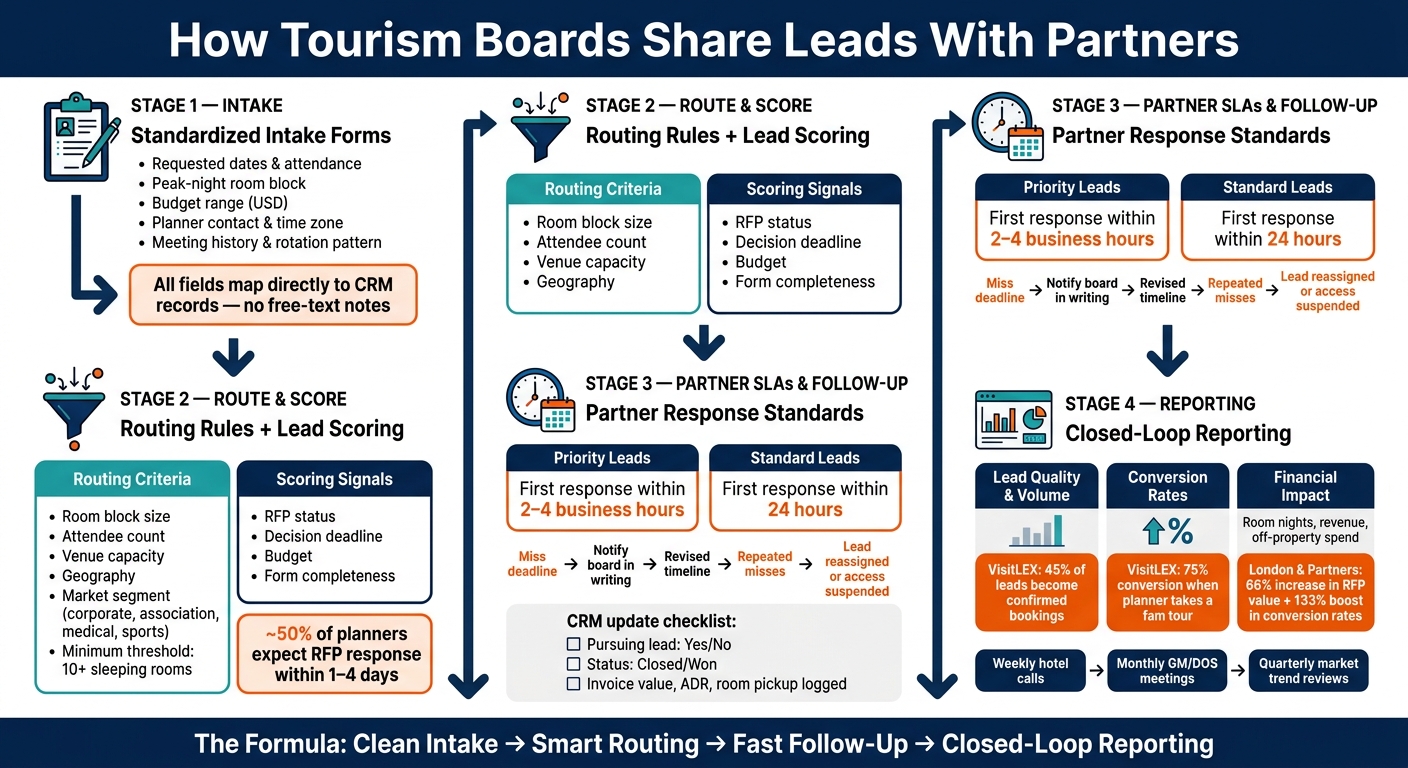
- Standard intake forms collect dates, attendance, room block, budget, location, and planner details
- CRM fields store those details in set categories instead of scattered notes
- Routing rules send leads by fit, geography, and capacity
- Lead scoring sorts requests by deadline, budget, RFP status, and form completeness
- Partner SLAs set reply times like 2 to 4 business hours for priority leads and 24 hours for standard ones
- Reporting tracks conversion, response time, room nights, and revenue
I also noticed one clear pattern in the article: boards are not just forwarding inquiries. They are screening them first. For example, some programs only send hotel leads when the request meets a room threshold, such as 10 or more sleeping rooms. And reported outcomes can be strong - VisitLEX says about 45% of generated opportunities turn into confirmed bookings, with 75% conversion when planners take a familiarization tour.
So if you want the short answer, it’s this: good lead-sharing depends on clean intake, clear match rules, fast follow-up, and closed-loop reporting.
What stood out to me most is how simple the logic is once the setup is right:
- Collect the same booking details every time
- Map each field to one CRM status or record
- Send the lead only to partners that can handle it
- Track who replied, when, and what the result was
- Report room nights, revenue, and off-property spend
That’s the whole system in one view.
How Tourism Boards Share Leads With Partners: The Complete System
Build standard intake forms and CRM fields
Once a lead comes in, the board needs a standard intake form using marketing funnel software before sending it to partners. That sounds simple, but it matters. Routing only works when the intake data is complete. If key details are missing, the lead stalls, gets sent to the wrong places, or needs manual cleanup later.
The fix is straightforward: require the critical fields before submission.
Use forms that collect booking-critical details
At a minimum, the form should collect requested dates, expected attendance, peak-night room block, meeting space needs, budget range in USD, destination area, accessibility requirements, planner contact details, preferred contact time and time zone, and meeting history - past host cities and rotation pattern.
These are the details partners need to decide whether a lead fits. They should also flow straight into the CRM so every partner sees the same record, not slightly different versions passed around by email or buried in notes.
Map every form field to CRM records and statuses
Each form field should map to one CRM record or status field - not several free-text notes. Free-text fields are where routing errors creep in, and they also make reporting messy.
Here’s the core mapping structure many tourism boards use:
| Form Field | CRM Record / Status Field |
|---|---|
| Inquiry source (Cvent, direct, referral) | Lead Source |
| Organization type | Market Segment (NAICS/NTEE) |
| Event type | Lead Type |
| Preferred partner category or destination zone | Partner Category or Zone |
| Submission date | Inquiry Status (New) |
| Date sent to partners | Distributed Date |
| Partner response received | Proposal Status |
| Final outcome | Outcome |
| Confirmed room nights | Attributed Room Nights |
| Contract value | Estimated Revenue (USD) |
Use standardized picklists wherever possible. Industry-standard classifications help here too. NAICS codes work for for-profit organizations, and NTEE codes work for non-profits. That keeps segmentation consistent across partners and makes it easier to match leads to the right properties.
With clean intake data in place, routing rules and lead scoring can run without manual cleanup.
sbb-itb-a84ebc4
Route and score leads before sending them to partners
Once intake fields are clean, the CRM should route leads on its own instead of relying on manual handoffs. Each lead should go only to the partner type that has a real shot at converting it - hotel, venue, operator, or travel brand.
That match should come from the intake data itself: room block size, attendee count, venue capacity, market area, and market segment such as corporate, association, medical, or sports. For smaller groups, many boards set minimum thresholds so partners don't get leads that were never a fit in the first place. The San Diego Tourism Authority's Sales Leads program is a good example. It matches group specifications - including a minimum of 10 sleeping rooms - against a vetted database of hotel partners.
Some boards also layer in automated fit scoring using those same intake fields. That can include checks like prior host city and rotation pattern as routing fields. Once the route is set, the CRM should kick off the partner follow-up workflow right away.
Apply routing rules by fit, geography, and capacity
Route each lead to hotels, venues, operators, and travel brands based on room block needs, attendee count, venue capacity, sub-region, and market segment. Then log that routing decision in the CRM against those same fields.
That matters for a simple reason: every partner should see the same match logic. Not a manual judgment call. Not a one-off exception. Just a clear record of why the lead went where it did.
Score lead quality using intent, timing, and budget
After routing, score each lead by urgency. Use four signals:
- RFP status
- Decision deadline
- Budget
- Form completeness
About half of planners expect an RFP response within 1 to 4 days. So timing matters. A complete request with a near-term deadline should move to the top of the queue. An incomplete inquiry should wait until the missing details are collected.
Record both the routing reason and the lead score in the CRM. That way, partner follow-up starts from the same set of facts, and the score can trigger the next response step and the right priority queue.
Set partner SLAs and follow-up workflows
After routing and scoring, SLAs set the rules for who replies first, how fast they need to move, and what happens if a lead goes quiet.
Define response-time standards and escalation paths
Priority leads should get a first response within 2 to 4 business hours, while standard inquiries should be answered within 24 hours. The tourism board handles intake and qualification. The assigned hotel or venue handles the response and proposal.
If a partner misses the deadline, it should notify the board in writing, explain why, and share a revised timeline. If a partner keeps missing communication standards, the board can suspend or block that partner’s access to the lead-sharing platform. It can also reassign the lead if the original partner is unresponsive or simply not the right fit.
Standardize the first follow-up and proposal steps
Once the first response goes out, partners should update the CRM with the outcome and next-step status. At a minimum, that includes:
- Recording Pursuing lead: Yes/No
- Updating the status to Closed/Won once the deal is finalized
- Entering invoice value, ADR, and room pickup
Internal notes should also be used to log why a lead was not pursued or to flag internal concerns. Those notes stay hidden from the prospect. That data then feeds partner reporting and attribution.
Report outcomes to partners, leadership, and stakeholders
Once your CRM status fields and SLA timestamps are set, the next step is simple: turn that data into reports people can use. Hotels care about lead quality. Leadership cares about revenue. Government teams care about economic impact.
Track conversion, speed-to-lead, and attributed revenue
Use the same CRM fields and SLA timestamps you already rely on for routing and follow-up. The main metrics fit into a few buckets: lead quality and volume, conversion rates, response speed, and financial impact.
VisitLEX in Lexington, KY, reports that about 45% of the leads or business opportunities they generate become confirmed bookings. That figure climbs to 75% when a planner takes a familiarization tour of the city. London & Partners saw a 66% increase in RFP value and a 133% boost in conversion rates after using targeted advertising and sourcing tools.
Define each metric once, then stick with it everywhere. If "qualified lead" means one thing in a monthly report and something else in a quarterly review, your trend lines stop being useful. The same goes for "confirmed booking." Keep those definitions fixed across monthly reports, quarterly reviews, and partner dashboards so month-over-month comparisons hold up.
Don't stop at room nights and revenue. Report off-property spend and attendee economic impact too. That gives leadership and public-sector stakeholders a clearer picture of what each win means beyond the hotel block.
A simple reporting rhythm helps keep everyone aligned:
- Weekly calls with full-service hotels
- Monthly GM and Director of Sales meetings to track pacing
- Quarterly meetings to review market trends and economic impact
Ask partners for post-program reporting so you can capture actual room nights and spend. That's how you close the loop. It also helps build long-term trust with leadership.
"I am transparent to a fault, and I will not sugarcoat a bad pace report... I have found that repetition is the key, and I can with high confidence tell you that if you were to randomly survey anyone of our hotels, they would be able to tell you what our need years and months are." - Nathan Hermiston, Senior Vice President of Sales and Services, Visit KC
These reports show whether routing and follow-up are doing their job.
Conclusion: The basic system every tourism board needs
A working lead-sharing system needs standardized intake forms, clean CRM fields, clear routing, simple scoring, and closed-loop reporting.
FAQs
What makes a lead qualified?
A lead is qualified when it matches the destination group’s ideal buyer and is ready to book. That usually means the trip type and dates line up, the group size and budget make sense, and the buyer has a clear role in the decision - or the authority to make it.
This lets the sales team spend time on serious opportunities instead of low-quality inquiries, such as requests that don’t fit capacity, buyers looking for the wrong service tier, or people who are just checking prices.
How should a tourism board choose which partner gets a lead?
A tourism board should act as a filter, matching each lead with the partner that best fits the planner’s needs, preferences, and decision criteria.
The goal isn’t just more leads. It’s better matches. When boards gather planner insights, they can send the most relevant RFPs to the hotels and venues most likely to fit the brief - and give the destination a better chance to win.
Which metrics matter most after a lead is shared?
Focus on metrics that point to revenue - not vanity stats. The big ones are conversion rates, lead response time, and planner satisfaction.
You should also track attribution data like room nights generated, off-property spend, attendee economic impact, direct-booking ratio, and past-guest reactivation. The best-performing boards use these numbers to sharpen performance and help partners win more business.