If your media plan leans on YouTube, GA4, and CM360, I’d pick DV360. If you need open-web scale, premium CTV, and more identity options, I’d pick The Trade Desk.
That’s the short answer. For most U.S. advertisers, this choice comes down to 6 checks:
- Setup and access
- Audience data
- Inventory reach
- Reporting
- Workflow
- Pricing style
I’d also pressure-test the choice against team size and funnel goal.
- Small teams: usually better off with Google Ads before either DSP
- Mid-market teams: can use either, but only with media support
- Enterprise teams: often have the scale for both
- Awareness: DV360 for YouTube, The Trade Desk for CTV
- Consideration and conversion: depends on where your data and measurement live
Both platforms often need $10,000-$50,000+ per month in spend and a team that knows programmatic. So this is not just a feature choice. It’s also a people, process, and budget choice.
DSP Showdown: The Trade Desk vs. DV360 vs. Amazon DSP (Which is Best for You?)
sbb-itb-a84ebc4
Quick Comparison
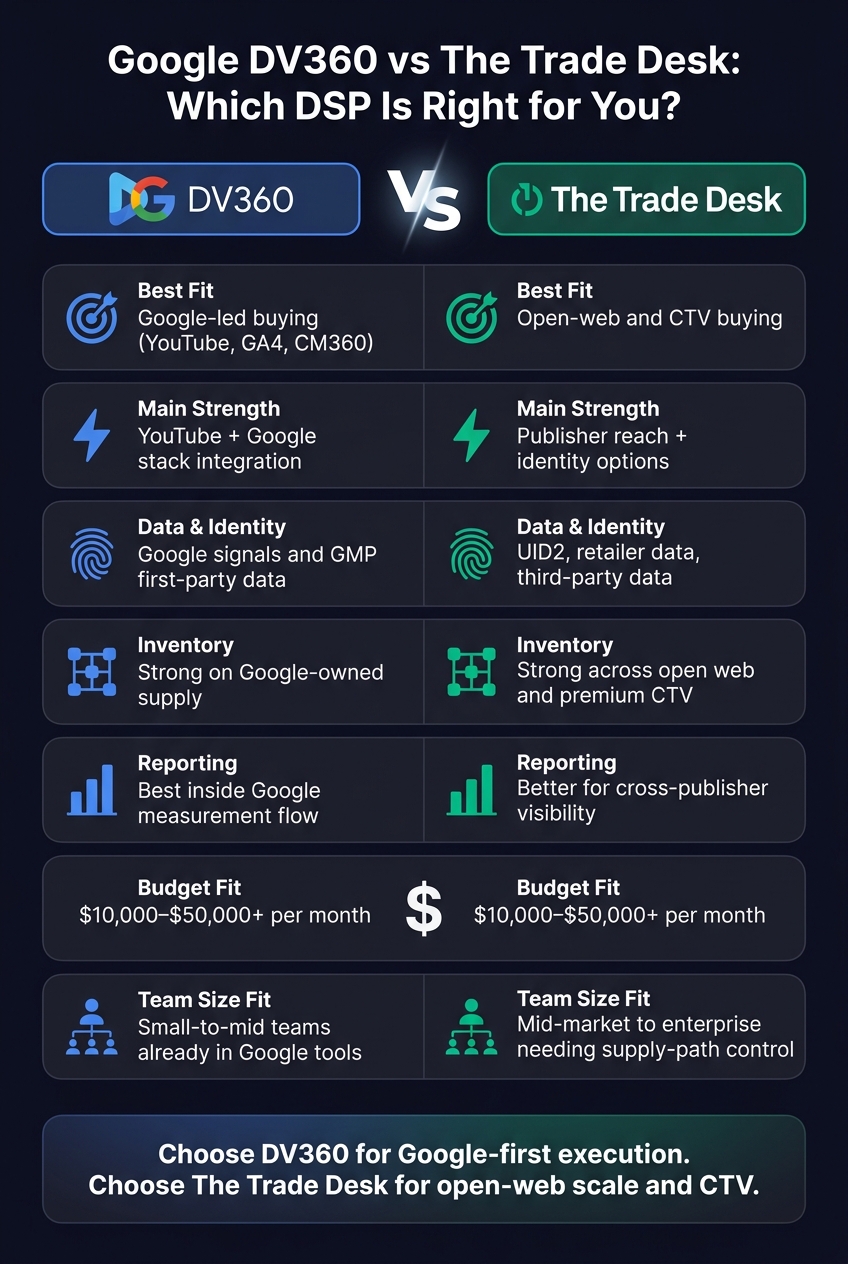
Google DV360 vs The Trade Desk: DSP Comparison Chart
| Criteria | Google DV360 | The Trade Desk |
|---|---|---|
| Best fit | Google-led buying | Open-web and CTV buying |
| Main strength | YouTube + Google stack ties | Publisher reach + identity options |
| Data angle | Google signals and GMP data | UID2, retailer data, third-party data |
| Inventory | Strong on Google-owned supply | Strong across open web and premium CTV |
| Reporting | Best inside Google measurement flow | Better for cross-publisher visibility |
| Workflow | Best for teams already in Google tools | Best for buyers that want more supply-path control |
| Team fit | Mid-market to enterprise | Mid-market to enterprise |
| Budget fit | Usually $10,000-$50,000+ / month | Usually $10,000-$50,000+ / month |
If I had to sum it up in one line, it’s this: DV360 fits Google-first execution, while The Trade Desk fits channel breadth and more control outside Google.
Google DV360: Best Fit for Google-Centric Display and Video Buying

DV360 is a strong fit for Google-led awareness buys. The main draw is simple: inventory, data, and workflow all sit in the same Google stack. That alignment matters a lot for teams already running YouTube, GA4, and CM360.
Setup, audience tools, and inventory access
DV360 tends to work best for teams that already buy YouTube, Google Display, and other Google inventory from one place. It makes the most sense when audience targeting leans on Google signals and first-party data that already lives inside the Google ecosystem.
Reporting, workflow, and pricing style
DV360 stands out when you want YouTube, Display, GA4, and CM360 to line up inside one workflow. On pricing, the pitch is not just low-cost access. It is more about getting efficient execution inside the Google stack. That makes DV360 the clearer pick when your media plan is built around Google tools, which leads into the comparison with The Trade Desk’s broader open-web reach.
The Trade Desk: Best Fit for Open-Web Reach, CTV, and Identity Flexibility
Where DV360 leans toward Google-native buying, The Trade Desk is built for broader open-web execution. It tends to fit advertisers that want open-web reach, premium CTV, and more say over identity and supply paths. That gap shows up most clearly in identity, channel mix, and supply-path control.
Setup, audience data, and channel coverage
UID2 gives buyers more flexibility around identity across the open web. It also supports a broader set of identity partnerships. In practice, those options affect how buyers plan, target, and measure campaigns across publishers and devices.
Reporting, workflow, and pricing style
Its workflow centers on placement controls, audience rules, creative assets, and tracking. Open Path can give buyers a clearer route to publishers and cut down on intermediaries, which means more transparency into the supply path than in a closed platform.
Side-by-Side Comparison: Setup, Data, Inventory, Reporting, Workflow, and Cost
The gap between DV360 and The Trade Desk gets easier to see when you line them up across the areas that shape day-to-day media buying: setup, data, inventory, reporting, workflow, and cost.
This is the practical lens to use. Not theory. Not vendor pitch. Just the six factors that tend to drive platform choice in live campaigns.
A simple decision framework also helps pressure-test each platform against the parts of execution that matter most:
- Audience fit
- Funnel stage
- Offer angle
- Creative format
- Landing page
- Team owner
- Spend cap
Those criteria make the differences show up fast in actual buying environments. One platform may fit a team’s process better. Another may line up better with the media mix, data sources, or budget controls already in place.
Start with setup and day-to-day management, because that’s often where teams feel the contrast first.
Which Platform Fits Your Team Size and Funnel Goal
Once setup, data, and inventory are sorted out, the choice usually comes down to two things: team capacity and where you need help in the marketing funnel.
Best choice by team size: small, mid-market, and enterprise
Small teams usually don't have the budget or time to run either DSP well. In most cases, both need $10,000-$50,000+ per month in spend, plus someone who knows programmatic inside and out. For that reason, small teams should start with Google Ads first.
Mid-market teams and private equity-backed portfolio companies can make the move when open-web reach or CTV turns into a main growth channel. But there's a catch: you still need either an in-house media team or a specialized agency to manage the work.
Enterprise teams are usually the best fit for both platforms. DV360 makes more sense when deep Google Marketing Platform ties matter, especially with GA4 and Search Ads 360. The Trade Desk tends to fit better when identity options matter more, with UID2 and premium CTV inventory outside the Google stack.
From there, the choice gets even tighter once you look at campaign goals.
Best choice by funnel goal: awareness, consideration, and conversion
| Funnel Stage | DV360 | The Trade Desk |
|---|---|---|
| Awareness | Strong for YouTube-led campaigns and Google Display | Strong for premium CTV and broad open-web reach |
| Consideration | Google's first-party intent data | Retailer data (e.g., Walmart Connect) and third-party audiences |
| Conversion | Best when measurement and reporting stay within Google Marketing Platform | Often stronger for lower-funnel attribution across multiple third-party data providers |
DV360 is the better pick when Google inventory and Google-based measurement shape the plan. The Trade Desk is the better pick when open-web scale, CTV, and outside data sources matter more.
Conclusion: How to make the final call
Choose DV360 for Google-led buying. Choose The Trade Desk for open-web reach, CTV, and non-Google data activation.
In both cases, the final call should rest on four concrete factors: team capacity, data needs, reporting requirements, and budget structure.
FAQs
Do I need an agency to run either DSP?
It depends on your team’s know-how and budget. The Trade Desk comes with a steep learning curve, so teams without strong in-house skills may need an agency to run campaigns well.
Google DV360 is often easier to get into, especially for brands already using Google. Even so, plenty of teams still work with managed partners to get better campaign results.
Which DSP is better for CTV campaigns?
There’s no single best pick here. The right platform comes down to your data plan, inventory needs, and the ecosystem you want to work in.
Google DV360 makes sense for brands that want one place for video buying and close ties to Google tools, including GA4 and YouTube. The Trade Desk is a better match for brands that want a platform-agnostic setup, more transparency, open-web scale, and a neutral position outside walled gardens.
How should I choose if I use both Google and non-Google data?
It comes down to your team’s setup and how you measure performance.
If most of your work happens inside the Google Marketing Platform - including Google Analytics and YouTube - DV360 usually gives you a smoother workflow for audience lists and conversion data.
If you want a more neutral, omnichannel setup that blends third-party data with your CRM data, The Trade Desk is often the better choice.