If I had to boil it down to one line: HubSpot is the better pick for most lean B2B teams, while Marketo makes more sense for larger teams that need more rules, more scoring depth, and deeper attribution.
Here’s the short answer:
- Pick HubSpot if you want to launch in days to weeks, keep sales and marketing in one system, and avoid heavy admin work.
- Pick Marketo if you run a more complex funnel, use Salesforce as the center of your stack, and can handle a 4- to 8-week setup plus higher Year 1 cost.
- Budget beyond software. The article shows Year 1 implementation at about $20,000 to $40,000 for HubSpot and $30,000 to $60,000 for Marketo.
- Base pricing is only part of the bill. HubSpot starts at $800/month for Marketing Hub Professional and $3,600/month for Enterprise. Marketo often starts around $1,250/month and can move into the $3,000 to $10,000+/month range.
- The core tradeoff is simple: ease and shared CRM visibility vs. more depth and more setup work.
If you want the fastest path to live workflows, lead scoring, and sales handoff, HubSpot usually wins. If you need more layered nurture logic, account-based scoring, and attribution models like U-shaped, W-shaped, and full-path, Marketo usually wins.
HubSpot vs Marketo: B2B Funnel Automation Comparison 2024
HubSpot vs Marketo Engage - Which One Is Better?
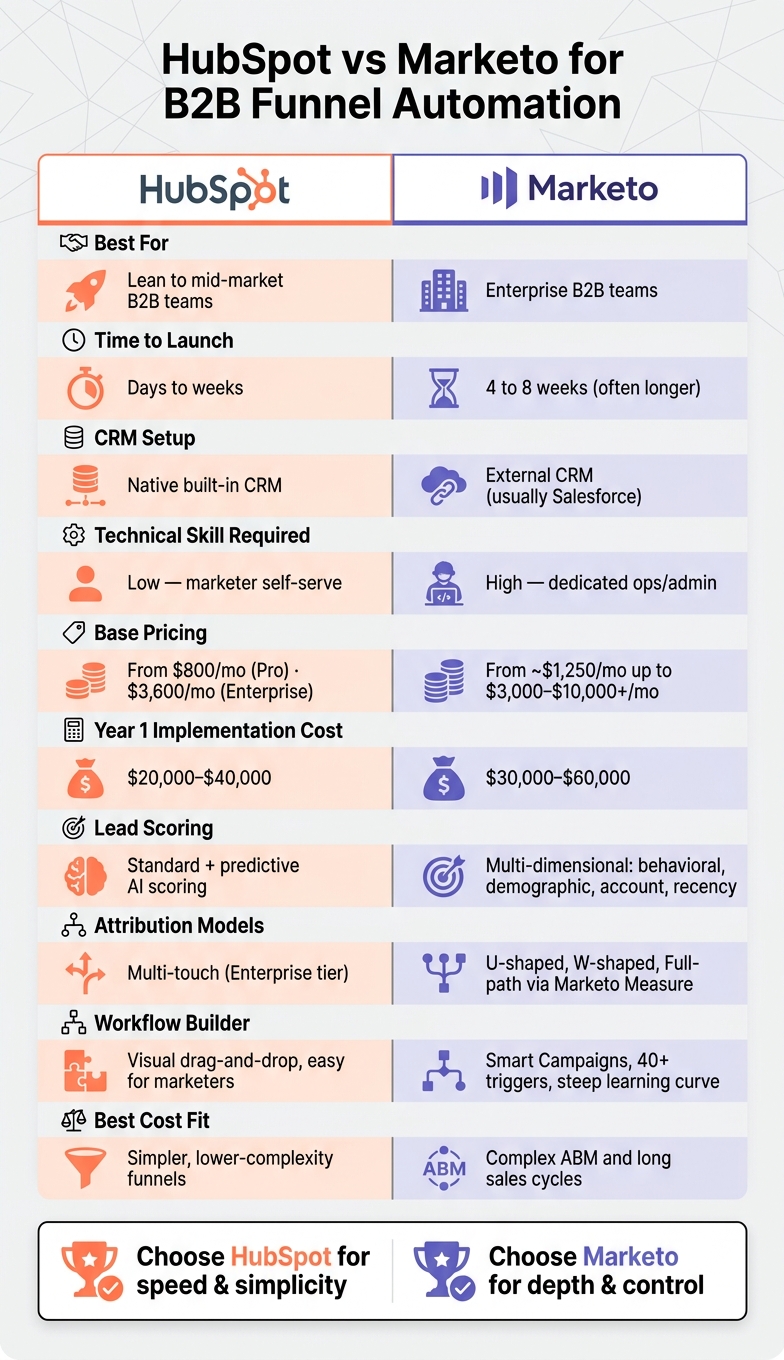
Quick Comparison
| Criteria | HubSpot | Marketo |
|---|---|---|
| Best for | Lean to mid-market B2B teams | Enterprise B2B teams |
| Main strength | Fast setup and built-in CRM | Deeper automation control |
| CRM setup | Native HubSpot CRM | External CRM, often Salesforce |
| Time to launch | Days to weeks | 4 to 8 weeks, often longer |
| Workflow use | Easier for marketers | More depth, more admin work |
| Lead scoring | Standard plus AI scoring | More detailed scoring models |
| Attribution | Available in Enterprise | Deeper with Marketo Measure |
| Year 1 implementation | $20,000 to $40,000 | $30,000 to $60,000 |
| Cost fit | Lower-complexity funnels | Higher-complexity funnels |
My read: don’t buy for the funnel you hope to have 12 months from now. Buy for the one you run today. That’s the cleanest way to avoid overpaying or ending up with a tool your team won’t use well.
What each platform is built for
HubSpot and Marketo can both handle B2B automation. But they were built for different kinds of teams. If you miss that, it's easy to pick the wrong system and pay for it later.
HubSpot: faster setup with native CRM alignment
HubSpot is built for speed. It's an all-in-one setup with native CRM sync and automation that marketers can use without much friction. The CRM and marketing tools share a two-way sync, which cuts out the manual field mapping problems that often show up when you connect automation to pipeline data.
That matters a lot for teams that don't have a dedicated marketing ops person. HubSpot's drag-and-drop workflow builder is geared toward marketer self-service. A non-technical demand gen manager can build nurture flows, set up lead scoring, and track deal stage changes without building funnels without technical expertise. Sales reps can also see marketing engagement history inside the contact record in real time.
HubSpot tends to fit teams that want to get up and running fast without adding much admin work. That's a big deal when the next job is simple: build workflows and launch them.
Marketo: deeper automation for mature ops teams
Marketo is built for control. It goes deeper on automation for long, multi-touch B2B journeys. It's a better match for organizations with complex lead lifecycles, global operations, and long sales cycles.
The trade-off is pretty clear. Marketo is a pure automation platform, not a CRM. It has to connect to an outside system such as Salesforce, and that setup usually takes 4 to 8 weeks if you want it done right. Implementation usually runs $30,000 to $60,000, and first-year cost often lands at 1.5x to 2x the sticker price. Most teams also need a dedicated marketing ops admin or an outside consultant to keep it running well.
You can see the split in practical terms below:
| HubSpot | Marketo | |
|---|---|---|
| CRM | Native, built-in | External, usually Salesforce |
| Setup time | Days to weeks | 2-4 months |
| Technical skill required | Low, marketer self-serve | High, dedicated ops/admin |
| Implementation cost | $20,000-$40,000 | $30,000-$60,000 |
Those choices show up later in workflows, scoring, and sales handoff. That's where the comparison gets more tactical.
sbb-itb-a84ebc4
Feature comparison: workflows, scoring, and pipeline visibility
The biggest gap between these platforms shows up in day-to-day automation.
Workflow builders and nurture logic
HubSpot keeps workflow building simple. Its visual, drag-and-drop builder lets teams set up complex branching logic without developer help. You can trigger workflows from email clicks, form submissions, page views, deal stage changes, and property updates. Because the branching is visual, marketers can build, tweak, and manage nurture flows on their own.
Marketo goes deeper. Its Smart Campaigns support more than 40 behavioral triggers and allow highly specific, multi-stage nurture logic. The tradeoff is the interface. It takes more effort to learn, especially if your team doesn't have dedicated marketing ops support. Put plainly, HubSpot leans toward speed. Marketo leans toward control.
That same split shows up in scoring and sales handoff.
Lead scoring and qualification models
HubSpot supports both positive and negative lead scoring based on demographic and behavioral signals. On the Professional and Enterprise tiers, it also adds predictive AI scoring, which helps surface purchase intent without forcing teams to build every rule by hand.
Marketo offers more granular scoring. It supports multi-dimensional models that account for behavioral data, demographic fit, account-level engagement, and recency weighting. If your buying journey involves more people, more touchpoints, and more nuance, Marketo gives you more room to model that.
Pipeline views and sales handoff
This is where speed can matter a lot. In HubSpot, sales reps can see a contact's full engagement history - opens, visits, and form fills - inside the contact record in real time. That makes handoff pretty direct.
Marketo handles pipeline visibility through the connected CRM, most often Salesforce, and does its best work here when paired with Marketo Measure.
| Feature | HubSpot Marketing Hub | Adobe Marketo Engage |
|---|---|---|
| Workflow Builder | Visual, drag-and-drop; intuitive | Smart Campaigns; 40+ triggers; steep learning curve |
| Branching Logic | Visual branching; easy to build | Highly sophisticated; supports complex multi-stage paths |
| Lead Scoring | Standard + predictive AI options | Multi-dimensional: behavioral, demographic, account, recency |
| CRM Dependence | Native; built on HubSpot CRM | Requires external CRM, typically Salesforce |
| Pipeline Visibility | Native pipeline views and unified reporting | Lives in CRM; strongest with Bizible attribution |
Reporting, pricing, and total cost of ownership
Reporting and attribution
Once workflows are set and handoffs are working, reporting is what shows which platform can tie activity to pipeline.
HubSpot is simpler to use for reporting. You get visual dashboards, real-time CRM sync, and less technical setup. Because marketing and sales data sit in one system, the dashboards are easier to read and easier to act on. Its multi-touch attribution is available at the Enterprise tier, which starts at $3,600/month for 10,000 contacts. For teams that want fast visibility without a lot of setup, HubSpot is usually the easier fit. Marketo tends to work better for teams that need deeper attribution across longer, multi-stage buying cycles.
Marketo makes the opposite tradeoff. It supports deeper attribution through Marketo Measure, including U-shaped, W-shaped, and full-path models. That extra depth often means more admin work.
That difference matters. But the main call is simpler than it sounds: does the platform's cost line up with how you build a profitable sales funnel for your business?
Pricing and scaling costs
Pricing only makes sense when you look at the operating model behind it. HubSpot tends to reward simpler setups. Marketo can earn its higher cost when the funnel is more complex.
HubSpot's pricing is public and tiered. Marketing Hub Professional starts at $800/month for 2,000 contacts, and Enterprise starts at $3,600/month for 10,000 contacts, both billed annually. Marketo uses custom pricing. Entry-level plans often start around $1,250/month and can climb to $3,000-$10,000+/month for enterprise contracts.
The subscription fee is only part of the spend. First-year agency implementation often lands at $20,000-$40,000 for HubSpot and $30,000-$60,000 for Marketo.
| Factor | HubSpot (Pro/Enterprise) | Adobe Marketo Engage |
|---|---|---|
| Reporting Clarity | High; visual dashboards and native CRM sync | Moderate; powerful but requires technical expertise |
| Attribution Depth | Multi-touch available in Enterprise | Deepest attribution through Marketo Measure |
| Pricing Transparency | High; tiered, publicly listed | Low; custom pricing only |
| Implementation Cost | $20,000-$40,000 | $30,000-$60,000 |
| U.S. Budget Fit | Best for simpler mid-market funnels | Best for larger teams with complex ABM or long sales cycles |
HubSpot charges for marketing contacts, not the full database. If you grow to 50,000 contacts, that can add about $600/month on top of the base Professional price. In plain terms, HubSpot fits simpler funnels. For those seeking a different balance of ease and power, ActiveCampaign offers another alternative for marketing automation. Marketo fits teams that can take on higher setup and admin costs in exchange for more control.
Which platform fits your buyer journey and final recommendation
Best fit by funnel maturity
After looking at workflows, scoring, reporting, and cost, the choice comes down to funnel maturity. Pick based on where your funnel is today, not where you hope it will be next year. That lines up with the main tradeoff in this comparison: speed vs. control.
HubSpot fits early- to mid-market B2B teams that need speed and simple CRM alignment. If you don't have dedicated technical staff, HubSpot's marketer-friendly setup and shared CRM will usually be the better match.
Marketo fits enterprise teams with complex buying committees, long sales cycles, and a Salesforce-centered stack. If you need account-level scoring, advanced segmentation, and multi-touch attribution that ties marketing influence to closed revenue, Marketo is the stronger choice.
Conclusion: the short answer for U.S. B2B teams
That tradeoff runs through the whole comparison: speed and simplicity vs. depth and control.
HubSpot wins on usability, faster deployment, and shared CRM visibility. Its native CRM makes it easier for sales reps to see marketing activity without extra integration work.
Marketo wins on automation depth and enterprise customization. Its multi-dimensional scoring, advanced lifecycle logic, and Marketo Measure attribution are a better fit for complex funnels with longer sales cycles.
FAQs
Which platform is easier to manage without a dedicated ops team?
HubSpot is usually easier to run without a dedicated operations team. The main reason is simple: its all-in-one platform and native CRM cut down on admin work and make integrations less of a headache.
Marketo, on the other hand, is built for enterprises with more complex lead lifecycles. That usually means a steeper learning curve and more day-to-day upkeep. Without specialized technical or operations support, it can be harder to manage well.
That said, HubSpot still benefits from expert setup. If the initial setup is sloppy, scaling later can get messy fast.
How do contact growth and implementation costs affect total Year 1 budget?
In Year 1, total costs often land at 1.5x to 2x the sticker price. Why? Because the software fee is only part of the bill. Setup, staff training, and system integrations can add a lot on top.
HubSpot, for example, usually comes with mandatory onboarding fees of $3,000 to $7,000. Marketo is often far more expensive to get up and running, with implementation costs of $30,000 to $60,000.
Costs can also climb over time with contact-based pricing as your database grows. On top of that, extra user seats and advanced add-ons can push the total even higher.
When does advanced attribution justify choosing Marketo?
Choose Marketo if your B2B team needs enterprise-grade multi-touch attribution and native Salesforce integration.
It tends to fit more complex setups - often companies with $50M+ ARR - where account-based marketing is a big part of the motion, buying cycles are long, and multiple stakeholders shape the deal.
That’s where Marketo stands out. It helps teams tie marketing activity back to final P&L results across departments, not just within marketing. HubSpot works well for mid-market attribution, but Marketo goes deeper when revenue tracking gets more complex.