Your marketing needs to work everywhere your customers are. From monitoring social media to email to your website, each touchpoint should tell the same story without confusing your audience. Cross-channel storytelling ensures your brand message stays consistent, creating a smooth, connected experience. Using an email marketing and automation tool can help maintain this consistency across touchpoints.
Here’s why it matters:
- Brands using 3+ channels see 287% higher conversion rates.
- Consistent messaging can boost revenue by 23%.
- Yet, only 15% of businesses achieve a unified customer view.
This guide breaks down how to align your story, choose the right platforms, and measure success. From defining your brand narrative to mapping customer journeys and tracking performance, every step helps you deliver a seamless experience that builds trust and drives sales. Ready to make every interaction count?
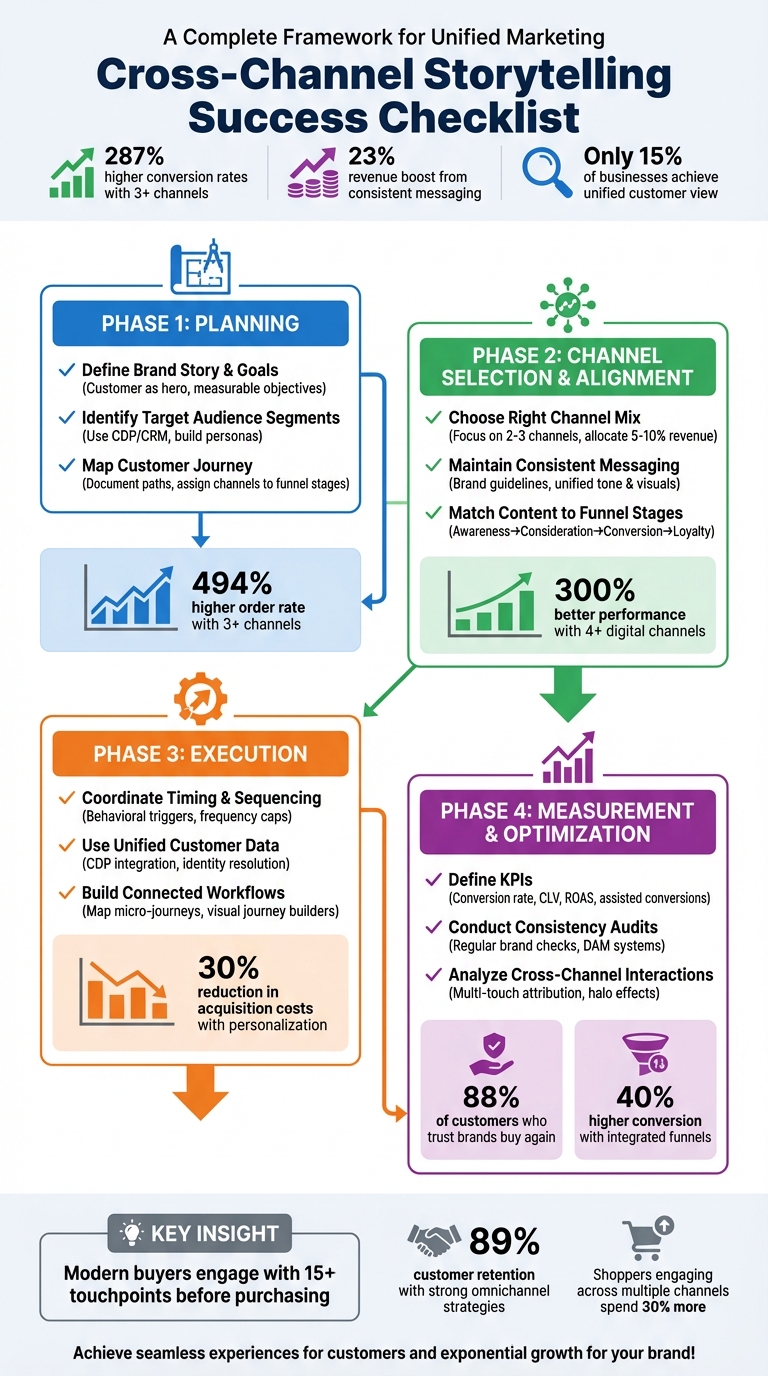
Cross-Channel Storytelling Implementation Checklist: 4-Phase Framework
How to Build a Multi-Channel Content Engine That Actually Works | Field Notes
sbb-itb-a84ebc4
Planning Phase Checklist
A well-thought-out planning phase ensures your brand story aligns with your business goals, clearly defines your audience, and maps out customer journeys to avoid disjointed messaging.
Define Your Brand Story and Goals
Your brand story isn’t just a tagline - it’s the narrative that communicates your purpose, values, and the emotional connection you create with your audience. The twist? Your customer is the hero of the story, and your brand plays the role of the guide (imagine Yoda guiding Luke Skywalker). Every impactful story includes three core elements: a Character (your customer), a Conflict (their challenge), and a Conclusion (how your product or service solves their problem).
For example, if you’re a project management software company, your story might focus on a stressed-out team lead struggling to meet deadlines. Your product becomes the solution that helps them streamline tasks and hit every deadline with ease. Once you’ve nailed down your story, connect it to measurable goals - whether it’s increasing conversions, raising brand awareness, or improving customer retention. This ensures every piece of content you create has a clear purpose.
Identify Your Target Audience Segments
To craft a story that resonates, you need to know exactly who you’re speaking to. Start by consolidating customer data from all touchpoints - email, social media, website activity, and even offline interactions - into a single platform like a Customer Data Platform (CDP) or CRM. From there, use analytics tools to identify engagement trends. Which formats - blogs, videos, or podcasts - capture their attention? Which platforms are they most active on? For instance, decision-makers might frequent LinkedIn, while potential customers in the early stages of research may spend more time on Instagram.
Gathering direct feedback through surveys, webinars, or Q&A sessions can help you build detailed personas, capturing key details like demographics, interests, and behavioral triggers. Finally, segment your audience based on their intent and where they are in the funnel. For example, you’d use different messaging for someone just discovering your brand compared to someone ready to make a purchase.
"Understanding your audience is the first step in crafting a story that resonates."
- Charlie Clark, Liinks
Here’s something to think about: Marketers who use three or more channels see a 494% higher order rate compared to those relying on a single channel. With a deep understanding of your audience, you can map their journey and ensure every interaction feels intentional.
Map the Customer Journey Across Channels
Without a clear map of the customer journey, your messaging can feel scattered - one team might push for a hard sell while another focuses on awareness, confusing your audience and wasting resources. Start by documenting actual customer paths using behavioral data rather than relying on assumptions. Keep in mind that customer journeys are rarely linear; people often jump between devices and platforms. Your goal is to gently guide them, not bombard them with sales pitches.
Assign specific channels to different funnel stages. For example, platforms like Meta, TikTok, and YouTube work well for building awareness, while Google Search and LinkedIn are better for consideration. For conversion, focus on email campaigns and retargeting ads. A possible sequence might include educational content during Days 1–3, testimonials and social proof from Days 4–7, and direct offers from Days 8–14.
To track the entire journey, use UTM parameters on all links and integrate your CRM with analytics tools like GA4. Consider investing in identity resolution tools that connect anonymous website visitors to known email subscribers, ensuring your messaging stays seamless across devices.
"Consistency doesn't mean uniformity - it means alignment. When every channel supports the same core story, your brand becomes easier to understand and much easier to trust."
Brands with strong omnichannel strategies retain about 89% of their customers, and shoppers who engage across multiple channels tend to spend 30% more than those who stick to just one.
For additional tools and resources to enhance your cross-channel storytelling, check out the Marketing Funnels Directory at https://topmarketingfunnels.com.
Channel Selection and Alignment Checklist
Selecting channels for your marketing efforts isn’t about being everywhere at once - it’s about being where your audience is and delivering messages that resonate. Modern buyers interact with multiple touchpoints before making decisions, so your approach needs to be thoughtful and strategic.
Choose the Right Mix of Channels
Start by identifying where your audience spends their time. For example, if you’re targeting B2B decision-makers, LinkedIn is likely your best bet. If your audience skews younger, platforms like TikTok and Instagram might be more effective. Dig into your engagement data to see which channels bring the most traffic, conversions, and revenue for your business.
Each platform has its strengths. SEO offers lasting value, social media provides broad reach, and email excels at nurturing leads. Align your channel choices with your goals - for instance, use Search Engine Marketing (SEM) for quick conversions or programmatic display ads to boost brand visibility.
Instead of trying to juggle too many platforms, focus on mastering 2–3 channels. This approach helps you allocate your budget and resources more effectively. As a general rule, businesses should invest 5–10% of their total revenue in marketing, though larger companies may allocate up to 14%. Research shows that brands using three or more marketing channels experience a 287% higher conversion rate - provided those channels work cohesively. For example, combining search marketing with social media can create a ripple effect, leading to more searches and engagement later.
"Cross-channel marketing isn't about bombarding customers everywhere - it's about showing up strategically, consistently, and with real value."
- Vaishnavi Manjarekar, Content Strategist, Netcore Cloud
Once you’ve chosen your channels, consistency is key. Stick to your brand’s guidelines to ensure your messaging, tone, and visuals remain unified across platforms.
Maintain Consistent Messaging, Tone, and Visuals
After selecting your channels, make sure your brand’s voice and identity are instantly recognizable, no matter where customers encounter you. Consistency builds trust and reinforces your message.
Start by creating detailed brand guidelines that outline your tone, personality, and visual elements like logos, colors, and fonts. These guidelines act as a reference point for anyone working on your content - whether it’s your internal team, freelancers, or agency partners. Develop a message map that connects your audience’s needs and motivations to your core brand message, backed by facts, testimonials, and key points.
While your delivery may vary by platform - think casual and energetic on social media versus professional in email campaigns - the underlying story should remain the same. Use tools like shared content calendars and centralized campaign briefs to make sure all teams (marketing, sales, and service) are aligned on goals and messaging.
Campaigns using four or more digital channels often outperform single-channel efforts by up to 300%. However, 87% of consumers feel frustrated when they have to repeat information across different touchpoints. To address this, consider using a Customer Data Platform (CDP) or an integrated CRM. These tools help unify customer interactions across channels, ensuring your messages are relevant and personalized.
"An omnichannel content strategy goes beyond simply publishing the same message in multiple channels. Instead, it adapts your messaging to fit the context of each touchpoint while maintaining brand coherence."
Match Content to Funnel Stages
Once your channels and messaging are aligned, focus on tailoring your content to each stage of the customer journey. Different stages require different approaches, and each channel plays a unique role in guiding prospects forward.
At the awareness stage, prioritize platforms like Meta, TikTok, YouTube, and Reddit to share educational blog posts and short-form videos that spark curiosity without pushing for a sale. For the consideration stage, shift to high-intent channels like Google Search or LinkedIn, offering resources like webinars, whitepapers, and comparison guides to establish authority.
When it’s time for conversion, use case studies, live demos, and personalized emails or SMS messages with clear calls-to-action. After the purchase, focus on loyalty by creating onboarding sequences, sharing in-app tips, and offering exclusive content to encourage repeat business and brand advocacy.
Assign specific roles to each channel to avoid wasting your budget. Coordinate your messaging to guide prospects naturally through the funnel and use frequency caps to prevent overwhelming them with repetitive messages.
One effective tactic is sequential retargeting. Instead of showing the same ad repeatedly, deliver a timed sequence of messages. For example:
- Days 1–3: Focus on education.
- Days 4–7: Highlight social proof and testimonials.
- Days 8–14: Present direct offers.
This approach keeps your messaging fresh and helps move prospects steadily toward conversion.
For tools and resources to optimize your cross-channel funnel, check out the Marketing Funnels Directory.
Execution Phase Checklist
Once your strategy is set and channels are chosen, it's time to bring your plan to life. This is the moment where your cross-channel storytelling either clicks into place or falls apart. The key? Coordinating timing, leveraging customer data, and syncing workflows effectively.
Coordinate Timing and Sequencing of Touchpoints
Timing isn’t just about when you send a message - it’s about responding to customer actions in the moment. Static schedules won’t cut it; instead, use behavioral triggers to deliver messages tailored to what your customers are doing right now. For instance, if someone browses your pricing page but doesn’t take action, follow up with educational content or social proof rather than another generic ad.
A great example comes from TicketSwap, a European event ticketing platform. In 2025, they tackled purchase abandonment caused by technical glitches. By analyzing user behavior and syncing this data with their paid social and CRM systems in real time, they delivered targeted ads and personalized emails. The result? A 15% increase in sales funnel completion.
Timing also involves designing a progression that builds trust gradually. For example:
- Start with educational content during the first three days.
- Shift to testimonials and social proof over the next few days.
- Wrap up with direct offers in the following week.
To avoid overwhelming your audience, use frequency caps and suppression rules. If someone converts through one channel, remove them from other active campaigns. For high-value abandoned carts, consider a tiered approach: start with a soft email reminder, move to dynamic product ads emphasizing urgency, and reserve SMS for the most engaged customers.
Keep everything aligned with a centralized orchestration calendar. This ensures marketing, sales, and customer success teams are on the same page, avoiding conflicting messages or redundant efforts.
Once timing is locked in, the next step is personalizing those messages with unified customer data.
Use Personalization with Unified Customer Data
Personalization isn’t just about adding someone’s name to an email - it’s about understanding and addressing their unique preferences across all devices and channels. This approach works hand-in-hand with your cohesive messaging strategy.
Start by creating a unified customer profile through a CDP (Customer Data Platform) or integrated CRM. This profile updates in real time, pulling data from every interaction - whether online or offline. Without this, you risk treating the same person as multiple users, which can lead to disjointed experiences.
Identity resolution is key here. It connects fragmented data points like email addresses, phone numbers, and cookies into a single record. This way, you can recognize a customer whether they’re scrolling on their phone during lunch or shopping on their desktop later.
Rappi, a Latin American delivery service, used this approach in 2025 to improve their first-time user experience. By grouping new users into behavioral cohorts and delivering tailored messaging through push notifications, emails, and in-app prompts, they reduced customer acquisition costs by 30%.
Focus on zero-party and first-party data - information customers willingly share or that you collect directly. This builds trust and ensures relevance, especially as the digital world shifts away from cookies. Real-time suppression logic is another must-have. For example, if a customer makes an in-store purchase, stop sending cart-abandonment emails immediately.
Don’t limit personalization to text. Use dynamic images and content blocks that reflect a user’s history or preferences. Predictive intelligence can also help prioritize high-value segments by scoring purchase intent, engagement likelihood, and churn risk.
"A unified profile is the difference between seamless revenue and wasted spend."
- Macro Webber
Build Connected Campaign Workflows
To tie everything together, create workflows that ensure smooth transitions between channels. The goal is to make every touchpoint feel like part of a continuous conversation, so customers never feel like they’re starting over.
Start by mapping out micro-journeys for key segments. Instead of relying on one massive funnel, focus on specific paths - like converting a first-time visitor into a trial user or re-engaging a dormant customer. Identify common breakdowns in these journeys and design workflows to address them.
Use visual journey builders in your automation platform to map triggers, decision points, and delays across channels. For example:
- If a user downloads a whitepaper, trigger a three-day email sequence.
- If the second email goes unopened, switch to a LinkedIn ad showcasing social proof.
- If the ad gets clicked but doesn’t convert, follow up with an SMS offering a limited-time deal.
Jersey Mike’s provides a great example here. By integrating their CDP with digital analytics and the Iterable marketing platform, they connected online ordering with in-store loyalty programs. Coordinating messages across email, SMS, and push notifications based on real-time behavior helped them more than double their online ordering volume.
Break down silos between teams managing email, mobile, social, and sales channels. Assign a multi-channel strategist to oversee the entire funnel, and create playbooks that outline who sends what, where, and when. Tailor content to fit each platform’s tone - professional on LinkedIn, casual on TikTok - while keeping the overall message consistent.
"Whether it's seeing an ad on Facebook, opening an email, or landing on your website, everything should feel connected. The idea is to keep your message consistent and relevant as people jump from one platform to another."
- Nathaniel Miller, Head of Marketing, HarvestIQ
For more tools and tips to optimize your cross-channel workflows, check out the Marketing Funnels Directory.
Measurement and Optimization Checklist
Launching your campaign is just the beginning. The real magic happens when you track, analyze, and refine your efforts. This part of the process ensures you're not just guessing but making informed adjustments to improve every aspect of your cross-channel storytelling.
Define Key Performance Indicators (KPIs)
Focus on the metrics that matter most. For example, Conversion Rate tells you how many people take action, while Customer Lifetime Value (CLV) highlights the long-term worth of those relationships. Return on Ad Spend (ROAS) shows whether your investment is yielding results, and Incremental Lift measures the extra conversions tied directly to your marketing efforts.
Don’t stop there - journey-based metrics can provide deeper insights. Assisted Conversions help you see how channels work together, like how a Facebook ad might lead someone to convert later through email. Conversion Paths uncover the common sequences users follow, and Time Lag measures how long it takes to move from the first interaction to a final conversion. Considering that modern buyers engage with more than 15 touchpoints before purchasing, understanding these pathways is critical.
Tailor KPIs to each stage of the funnel. At the top, track metrics like reach and engagement. In the middle, focus on email open rates and content downloads. At the bottom, monitor cart abandonment rates and sales conversion rates to measure how well you're sealing the deal.
Finally, regularly evaluate your assets to ensure your messaging stays on point.
Conduct Regular Consistency Audits
Even a great strategy can drift over time. Regular audits help keep your visuals, messaging, and tone consistent across all channels. Start by setting clear benchmarks based on your brand’s goals and core message.
Check everything - logos, colors, typography, messaging, and interactions - for outdated or inconsistent elements. Look for instances where different teams might interpret brand guidelines differently. Gather feedback from both stakeholders and customers to identify any gaps in perception.
Why is this important? 88% of customers who trust a brand are likely to buy again, and trusted brands can outperform their competitors by up to 400% in market value. Consistency builds trust. Tools powered by AI can help you scan your digital properties for mismatched tone, voice, or visuals, streamlining the audit process.
Centralize all your assets in a Digital Asset Management (DAM) system, so teams always have access to updated versions. Use UTM parameters on links to track performance across touchpoints. Remember, you’re not just auditing individual pieces of content but the flow - does your awareness ad naturally lead to educational content and then to direct offers?
Once you've ensured consistency, dive deeper into how your channels interact for further optimization.
Analyze Cross-Channel Interactions
The real insights come from understanding how your channels work together. Since 73% of customers engage with multiple touchpoints before purchasing, mapping their journeys is essential. Behavioral data can help you spot friction points where users drop off or where your messaging fails.
Identity resolution is key here. By connecting fragmented data - like linking a user’s mobile and desktop activity - you can create a single, unified profile. This avoids treating one person as multiple users, which can lead to fragmented experiences.
Watch for the "halo effect", where investing in one channel boosts the performance of others. For example, increasing your social media budget might enhance search ad results. Multi-touch attribution (MTA) models can help you move beyond last-click metrics, offering a complete view of the touchpoints that lead to conversions. Companies with integrated funnels see 40% higher conversion rates compared to those using isolated strategies.
To refine further, try incrementality testing with geographic holdouts, comparing performance across control groups. Use correlation analysis to discover how spending in one channel affects another - like whether increasing Facebook ad spend impacts search conversions. Time series analysis can also reveal seasonal trends and lag effects between channels.
For more tips on fine-tuning your cross-channel measurement strategy, check out the Marketing Funnels Directory.
Conclusion
Cross-channel storytelling is not about repeating the same message across platforms - it’s about alignment. When each channel amplifies a unified narrative while playing to its individual strengths, your brand becomes easier for audiences to connect with and trust. This approach helps eliminate silos, streamline workflows, and transform scattered metrics into a clear picture of how your entire marketing ecosystem is performing.
The proof is in the numbers: higher conversion rates, stronger customer retention, and increased spending from multichannel shoppers all highlight the impact of a well-executed, integrated strategy. By aligning your planning, execution, and optimization efforts, you create a marketing system that tells one cohesive and compelling story.
Start by mapping out your customer journey and focusing on 2–3 key channels to showcase ROI. Use an anchor asset - like a long-form blog post or webinar - as the foundation for creating platform-specific content. Incorporate multi-touch attribution to measure the full impact of your storytelling efforts, beyond just the last click. Finally, centralize your reporting with a unified dashboard to track engagement across all touchpoints.
FAQs
How do I pick the best 2–3 channels to start with?
To connect with your audience effectively, begin by pinpointing where they spend the most time and are open to engaging. Concentrate on platforms that align with your team’s abilities and allow you to stay consistent in your efforts. Look for channels that support your objectives, whether it’s fostering trust, encouraging interaction, or both. Examples of such platforms include social media, blogs, email marketing, and video platforms. Narrow your focus to 2–3 channels where you can consistently share genuine and impactful stories.
What’s the simplest way to unify customer data across channels?
The easiest way to bring customer data together from different channels is to centralize it into a single platform. This approach provides a clear, unified view of the customer journey, making it possible to deliver real-time personalization and consistent messaging. By pulling data from email, social media, SMS, and other systems into one place, you can ensure every interaction feels connected, actionable, and aligned with your cross-channel storytelling efforts.
How do I measure cross-channel impact beyond last-click?
To go beyond last-click attribution and truly understand cross-channel impact, consider using multi-channel attribution models like linear, time decay, or data-driven attribution. These approaches distribute credit across various touchpoints, giving you a clearer picture of how each channel plays a role in driving conversions.
To dive deeper, take advantage of tools like Google Analytics 4, Customer Data Platforms (CDPs), or Marketing Mix Modeling (MMM). These platforms help consolidate data and provide a comprehensive view of the customer journey, enabling more accurate analysis of cross-channel performance.