I judge social proof by the buyers it helps qualify, not the clicks it generates. Before publishing a review, count, or deadline, I check its source, disclose paid relationships, and confirm that it helps buyers assess fit.
There’s a reason to check: BrightLocal’s 2025 survey found that 42% of consumers trust online reviews as much as personal recommendations, down from 79% in 2020.
I focus on 7 risks:
- Fake proof: Invented reviews, testimonials, or activity counts.
- Vague popularity claims: Customer counts that say little about product fit.
- Hidden incentives: Rewards that make reviews look independent.
- Selective feedback: Success stories without context or criticism.
- Hidden relationships: Insider or affiliate endorsements without clear labels.
- False urgency: Fake scarcity or deadlines that pressure buyers.
- Wrong-stage proof: Evidence that doesn’t answer the buyer’s current question.
My rule: <u>verify the claim, explain its limits, and match it to the decision</u>. Then track qualified opportunities, win rate, and 30-, 60-, and 90-day retention - not just form fills. I apply the same checks when reviewing funnel tools.
Match Social Proof to the Buyer Funnel Stage
I took a deep dive into Social Proof. Here's what you need to know
sbb-itb-a84ebc4
Why More Conversions Can Produce Weaker Pipeline
Clicks, sign-ups, and purchases measure activity, not fit or retention. A qualified opportunity needs a real problem, a known buying process, budget, and a realistic path to close. Lasting revenue depends on customers getting value and staying active after refunds and cancellations.
Social proof can distract buyers from integration, security, implementation effort, and total cost. Be clear about supported use cases, company size, limits, and setup requirements. Otherwise, sales may receive contacts who felt reassured but cannot use the product. Checks need to cover the full buying cycle, not just the first click.
Track how many marketing leads sales accepts, why it rejects others, and how many become real opportunities. Sales acceptance rate is the share of marketing leads sales accepts. Rejection reasons include poor fit, no budget, or no active project. Set one definition for qualified-opportunity rate, then track progress from discovery through proposal and close.
Compare buyers who saw the proof with a control group across the full buying cycle, rather than measuring only the initial conversion lift. Check 30-, 60-, and 90-day retention, refunds, and cancellations by campaign and proof element. Use one attribution model, but do not confuse influence with causation: viewing a testimonial does not prove it caused a purchase. Once pipeline quality is defined, the first risk to examine is easy to miss: proof that is not real.
1. Fake Reviews, Testimonials, and Activity Counts
Fake proof can inflate demand fast while distorting measurement.
Acquisition ads, landing pages, and checkout widgets can show fake endorsements, inflated counts, or simulated purchases.
Moving a false claim later in the buying process does not make it true. Fake proof damages trust and measurement, not just content quality.
Conversion quality
Fake proof attracts unqualified buyers and inflates early demand.
Trust and pipeline effects
When buyers discover fabricated proof, they may doubt the company’s other claims. Reporting also becomes unreliable when scripted purchase events or duplicate visitors enter analytics as real conversions.
Keep widget events separate from verified transactions. Before forecasting demand, reconcile purchases with billing records and distinct customer IDs.
Controls
The FTC’s Consumer Reviews and Testimonials Rule, effective October 21, 2024, bans creating, selling, buying, or spreading fake reviews, testimonials, and fake social-media influence claims. It applies when a business knew or should have known they were fake.
Protect buyer trust and forecast accuracy with 3 actions:
- Verify sources and use: Require genuine experiences. Keep records of reviewer identity, actual product use, consent, and approval.
- Define verifiable counts: Document each count’s source, time window, exclusions, and update date. Link activity notices to real, time-stamped actions.
- Screen vendors: Investigate identical reviews, unexplained spikes, or guaranteed five-star ratings. The FTC does not require auditing every review, but vendors cannot ignore obvious signs of fabrication.
2. Vague Popularity Claims
Real proof can still be too broad to support a buyer’s decision.
Funnel placement
Claims like ‘trusted by thousands’ grab attention in ads and hero sections, but they do not prove fit.
On pricing pages, demo forms, and sales presentations, popularity claims can suggest more than adoption. A customer count shows adoption, not suitability or expected business value. Pair it with evidence tied to the buyer’s industry, company size, and needs. Popularity cues can trigger herd behavior without showing whether the product fits.
Conversion quality
Broad popularity claims can drive demo requests from buyers who confuse common use with product fit. Measure downstream fit and retention, not just form fills.
Trust and pipeline effects
If the count includes free, inactive, or historical accounts, buyers may doubt the vendor’s claims. These claims can also weaken forecasts by attracting poor-fit leads. Track closed-won revenue, sales cycle, and retention by campaign to check whether those leads turn into lasting business.
Controls
Keep these 4 measures separate so buyers can tell adoption apart from evidence of fit:
- Customer volume: Distinct purchasers during a stated period.
- Active usage: Accounts meeting a defined activity threshold.
- Market share: Revenue, units, or customers divided by the corresponding market total.
- Customer outcomes: Results with a baseline, sample size, timeframe, and measurement method.
Disclose each measure’s definition, period, source, calculation, and exclusions. For fastest-growing claims, specify the comparison group, geography, and metric. Assign an owner and a review date.
The FTC requires a reasonable basis for objective advertising claims before publication. Testimonials alone generally do not substantiate those claims.
3. Undisclosed Review Incentives
Incentivized reviews can be real and still bias buyer judgment. Unlike fake proof, they may reflect actual customer experiences while making agreement look stronger than it is.
Funnel placement
Disclose incentives next to the review on pricing pages, at checkout, on demo forms, and in sales collateral. Footer disclosures come too late. Buyers often decide before they read policy pages.
Conversion quality
Hidden rewards can make incentivized reviews look like independent customer feedback. Buyers may convert without fully weighing product limitations. Compare incentivized and organic reviews by tracking qualified-opportunity rate, win rate, refunds, and retention.
Trust and pipeline effects
When buyers discover hidden incentives, expect skepticism, more objections, and more post-purchase complaints.
Controls
Reward participation, not sentiment. The FTC’s Consumer Reviews and Testimonials Rule, effective October 21, 2024, allows rewards that aren't tied to positive or negative sentiment. It prohibits rewards expressly or implicitly conditioned on either. Disclosure does not make a prohibited payment acceptable.
- Keep solicitation terms, incentive value, reviewer identity, product-use evidence, submitted reviews, disclosure text, edits, removals, and complaints.
- Keep records showing that negative reviews received the same reward and treatment as positive reviews.
- Have marketing, legal/compliance, customer success, and RevOps review the program before launch.
Even disclosed incentives can skew which reviews get published. The next risk is selective suppression.
4. Cherry-Picked Testimonials and Suppressed Criticism
Funnel placement
Selective publishing can mislead even when every review is real.
On pricing, demo, checkout, and proposal pages, show results alongside the conditions behind them: company size, baseline performance, scope, staffing, and measurement window. Buyers need this context to judge likely outcomes, not just what is possible.
Conversion quality
A real success story can still suggest that buyers should expect the same result. State the expected result in the same context. A vague ‘results not typical’ line is not enough.
Trust and pipeline effects
Suppressing recurring criticism hides product limits and drives refunds, implementation escalations, early churn, and weaker expansion. For cohorts exposed to testimonials, track qualified-opportunity rate, cancellations, and expansion.
Controls
Moderation is not the problem. Using it to create a false consensus is. Selective curation buries objections that affect fit, close rate, and retention.
Keep a claim record that includes the baseline, metric definition, measurement window, supporting data, and limits. Review both the testimonial and nearby copy for implied promises. Place material conditions beside the claim, and route unusually strong claims through analytics and legal review.
Moderate only under stated rules for fraud, irrelevance, abuse, or personal data. Retain the original review, log the reason for removal, and provide an appeal route.
5. Hidden Insider and Affiliate Relationships
Even real testimonials can mislead when the reviewer has a hidden stake in the outcome.
Funnel placement
A real reviewer may still have ties to the company. In marketing, sales, and procurement materials, disclose any business, family, employment, or financial relationship that could affect how buyers judge the endorsement. Buyers need to know who’s speaking. Otherwise, they may mistake relationship-based proof for independent evidence.
Conversion quality
Affiliate reviews and partner case studies provide context, not independent validation. The damage often comes later, when procurement checks the source.
Trust and pipeline effects
Undisclosed referral fees or shared investors can prompt more diligence, delay deals, or kill them. Assess qualified pipeline by tracking objections, requests for new references, stage movement, and sales-cycle length by proof source.
Controls
The FTC’s Consumer Reviews and Testimonials Rule prohibits undisclosed insider reviews and knowing dissemination of undisclosed insider testimonials. It also sets disclosure requirements for solicited reviews from employees, agents, and immediate relatives.
Maintain a relationship register. Next to each claim, label insider ties, affiliate commissions, referral fees, ownership or portfolio ties, and family relationships. Keep those labels on every reused asset and audit quarterly. A vague “partner” label hides the relationship. Disclosure does not make a company-controlled review independent.
Once relationships are disclosed, the next risk is pressure disguised as urgency.
6. False Scarcity and Buyer Pressure
After disclosure, the next risk is pressure that pushes buyers to act before they assess the offer.
Funnel placement
Pressure often appears on pricing pages, plan-selection screens, checkout, sales booking pages, and post-demo follow-ups. False stock limits and resetting timers create artificial urgency. A preselected higher-priced plan is a default, not social proof. It pressures the buyer’s choice without showing peer approval.
A Princeton study of about 53,000 product pages found that countdown timers and limited-quantity prompts were common. Their frequency alone does not prove deception.
Conversion quality
Artificial pressure can lead buyers to skip plan comparisons, implementation checks, or budget approval. Initial purchases and demo bookings may increase while activation falls and cancellations, refunds, chargebacks, or unqualified opportunities grow.
Track qualified conversions, activation, demo attendance, cancellations, chargebacks, and 30-, 60-, and 90-day retained revenue - not just completed forms.
Trust and pipeline effects
When a timer resets or an expired offer stays available, buyers may question other claims. The FTC describes false countdown timers and misleading limited-time claims as tactics that can manipulate consumers into purchases they might not otherwise make.
Pressure-driven bookings can inflate pipeline without confirmed buying intent. Flag campaign-generated opportunities, then compare their opportunity-to-close rate, no-shows, cancellations, and forecast variance with cohorts that received transparent messages.
Controls
Tie inventory claims to actual stock or capacity. Give deadlines a fixed date, time, and time zone. State what changes after the deadline, then test that the change happens. Remove timers when nothing expires, and keep budget, security, and procurement checks intact.
Make decline and defer options equally visible, with neutral labels. Don’t bury alternatives in low-contrast text or behind extra steps. Assign an owner to each urgency claim and retain its source data and expiration rule. Stop campaigns that increase disputes, cancellations, or unqualified opportunities.
If the deadline is real, the next risk is placing proof before the buyer has enough context.
7. Social Proof at the Wrong Funnel Stage
Funnel placement
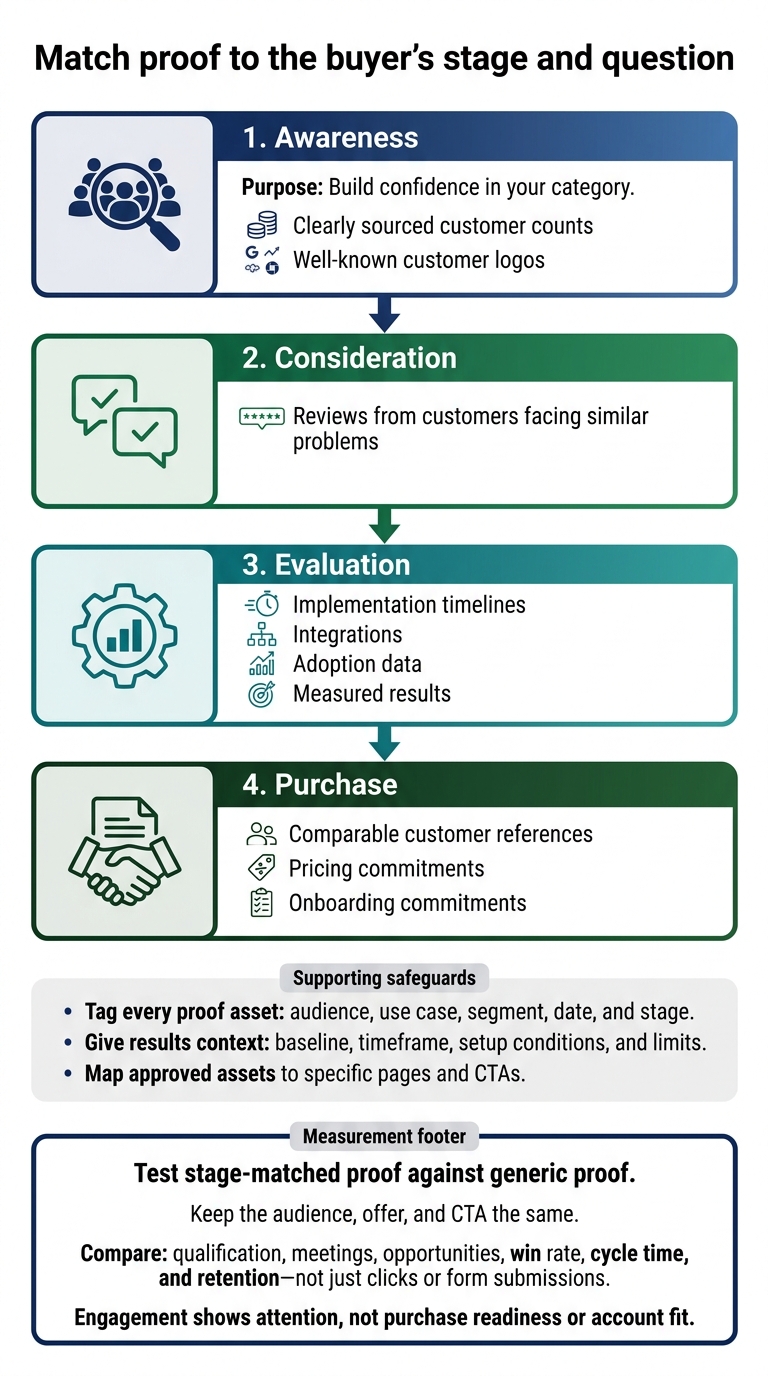
Match proof to the buyer’s stage and question. Even real customer proof falls short when it answers the wrong question. At awareness, use clearly sourced customer counts or well-known customer logos to build confidence in your category. At consideration, show reviews from customers facing similar problems. At evaluation, share implementation timelines, integrations, adoption data, and measured results. At purchase, pair comparable customer references with pricing and onboarding commitments. Proof at the wrong stage can increase clicks while reducing qualified demand.
Conversion quality
Engagement shows attention, not purchase readiness or account fit. Before prioritizing sales outreach, combine content activity with industry, company size, tech stack, use case, and buying role.
Trust and pipeline effects
Stage mismatch hurts qualification, stalls deals, and weakens retention. Generic proof leaves buyers at evaluation without evidence that fits their environment. Technical proof can overwhelm buyers who are still defining the problem. Include each result’s baseline, timeframe, setup conditions, and limits so buyers can judge whether it applies to them.
Controls
Tag every proof asset by audience, use case, segment, date, and stage. Map approved assets to specific pages and CTAs instead of placing the same testimonial everywhere.
Test stage-matched proof against generic proof while keeping the audience, offer, and CTA the same. Compare qualification, meetings, opportunities, win rate, cycle time, and retention, not just clicks or form submissions. Fewer submissions can be a better outcome if more turn into qualified opportunities and retained customers. The next section puts these risks into a quick reference.
Social Proof Risks at a Glance
Use this quick scan to spot where social proof can weaken buyer fit, trust, or pipeline quality.
| Risk | Typical proof signal | Buyer impact | Pipeline consequence | Control |
|---|---|---|---|---|
| Fake reviews, testimonials, and activity counts | Fabricated reviews, reviewer identities that can't be verified, or inflated counts | Buyers convert based on false assumptions | Inflated lead counts and lost trust | Verify reviewer identities and reported counts. |
| Vague popularity claims | Popularity claims with no defined audience, date, or measurement basis | Buyers submit forms without checking fit | More low-fit leads | State what was counted, when, and how. |
| Undisclosed review incentives | Reviews linked to compensation that isn't disclosed | Buyers overestimate reviewer independence | Trust drops when incentives come to light | Disclose incentives, and don't tie rewards to review sentiment. |
| Cherry-picked testimonials and suppressed criticism | Only favorable reviews appear, without context | Buyers convert with unrealistic expectations | Stalled deals and weaker retention | Publish selection rules that preserve criticism and explain the limits of reported results. |
| Hidden insider and affiliate relationships | Company-linked reviewers presented as independent | Buyers mistake commercial interest for independent proof | Discovered ties weaken deal confidence | Clearly disclose the reviewer's role and relationships where buyers will see them. |
| False scarcity and buyer pressure | Resetting timers or fake scarcity claims | Buyers purchase before checking fit | More cancellations and objections | Use only documented scarcity and deadlines. |
| Social proof at the wrong funnel stage | Popularity proof appears before fit proof | Engagement is mistaken for buying readiness | Weak-fit opportunities stall | Match proof to the buyer's stage and question. |
Use this checklist to audit claims, disclosures, and urgency before reviewing tools.
Resources for Evaluating Funnel Tools
After auditing the seven risks, vet tools that claim to manage them. The Marketing Funnels Directory lists funnel tools, software, and vendors. Use it for discovery only. A listing does not prove effectiveness, compliance, or capability.
Ask vendors to show how they log and verify proof claims. Request a sample record with the source, date, owner, approval status, and supporting documentation for each claim. Check that the record stays attached when the claim is reused across funnel assets.
Next, check disclosure controls. Request a live walkthrough of incentive logging, relationship disclosures, and publishing permissions. Have the vendor show edit, removal, and version logs.
Reporting should measure qualified pipeline, not just activity. Require a sample dashboard that connects form submissions to sales-accepted leads, opportunities, pipeline value, and closed-won revenue. Ask vendors to define each metric’s denominator, date range, attribution window, and CRM data-quality rules.
Request implementation requirements, security and privacy materials, data-export rights, and at least 2 customer references with a similar sales motion. Ask those customers about reporting reliability and implementation effort. Run a controlled pilot before a broader rollout.
Conclusion: Use Verifiable Proof Without Buyer Pressure
Good social proof is genuine, verifiable, disclosed, and representative. Across the seven risks, the lesson is the same: show who achieved a result, under what conditions, and over what period - not just the strongest outcome. Disclose incentives and insider relationships, and keep relevant limitations and critical feedback visible.
Match the proof to the buyer’s next question. Use case studies during evaluation, then references and implementation details when the buyer is ready to purchase. Neither calls for invented countdowns, fake activity, or pressure.
More form fills don’t mean a better pipeline. Qualified demand, trust, retention, and forecast reliability matter more than clicks. Proof should reduce doubt, not pressure buyers.
FAQs
How can I build social proof with few customers?
Focus on quality and honest customer experiences, not volume. Invite existing customers to share detailed feedback, photos, or videos about their experiences. Loyalty perks or customer spotlights can give them a reason to participate.
Use specific success metrics or case studies to show measurable results, even with a small sample. Endorsements from industry figures and partnerships with trusted brands can also help build trust.
Which social proof risks should I fix first?
Prioritize risks that weaken trust and distort buying decisions. Start with fake or manipulated reviews: use purchase confirmations and anomaly detection to help identify them. Then reduce negativity bias by responding openly to critical feedback and explaining the context behind common complaints.
Follow FTC requirements by clearly disclosing paid partnerships, free products, and material connections. For complex funnel optimization, DevriX helps mid-market and PE-backed companies build a reliable pipeline.
How should I respond after publishing misleading proof?
Be transparent and act right away to rebuild trust. Publicly acknowledge the error, explain how you fixed it, and update your materials with accurate data and context for any discrepancies. Show that you listen to criticism and take action.
Going forward, use honest feedback, confirm that all social proof is genuine, and regularly audit reviews and other proof to keep your claims reliable and compliant.