Sentiment analysis helps brands understand the emotions behind customer interactions on social media. It categorizes content as positive, negative, or neutral, offering deeper insights than traditional metrics like likes or shares. This emotional intelligence is key for managing reputation, improving campaigns, and refining products. For example, the Atlanta Hawks used sentiment analysis to grow their Facebook audience by 170% in just three months.
Key Takeaways:
- Real-Time Reputation Management: Detect and address negative feedback early to prevent crises.
- Campaign Optimization: Measure emotional responses to content and adjust strategies for better results.
- Product Development Insights: Identify recurring issues or preferences to improve offerings.
With 54% of businesses already using these tools, sentiment analysis is becoming a must-have for competitive social media strategies. Tools like Mention leverage AI and NLP to analyze text, visuals, and audio from platforms like Facebook, Instagram, and TikTok. While challenges like sarcasm and evolving language exist, brands that integrate sentiment insights across teams see measurable benefits, including higher revenue and customer retention.
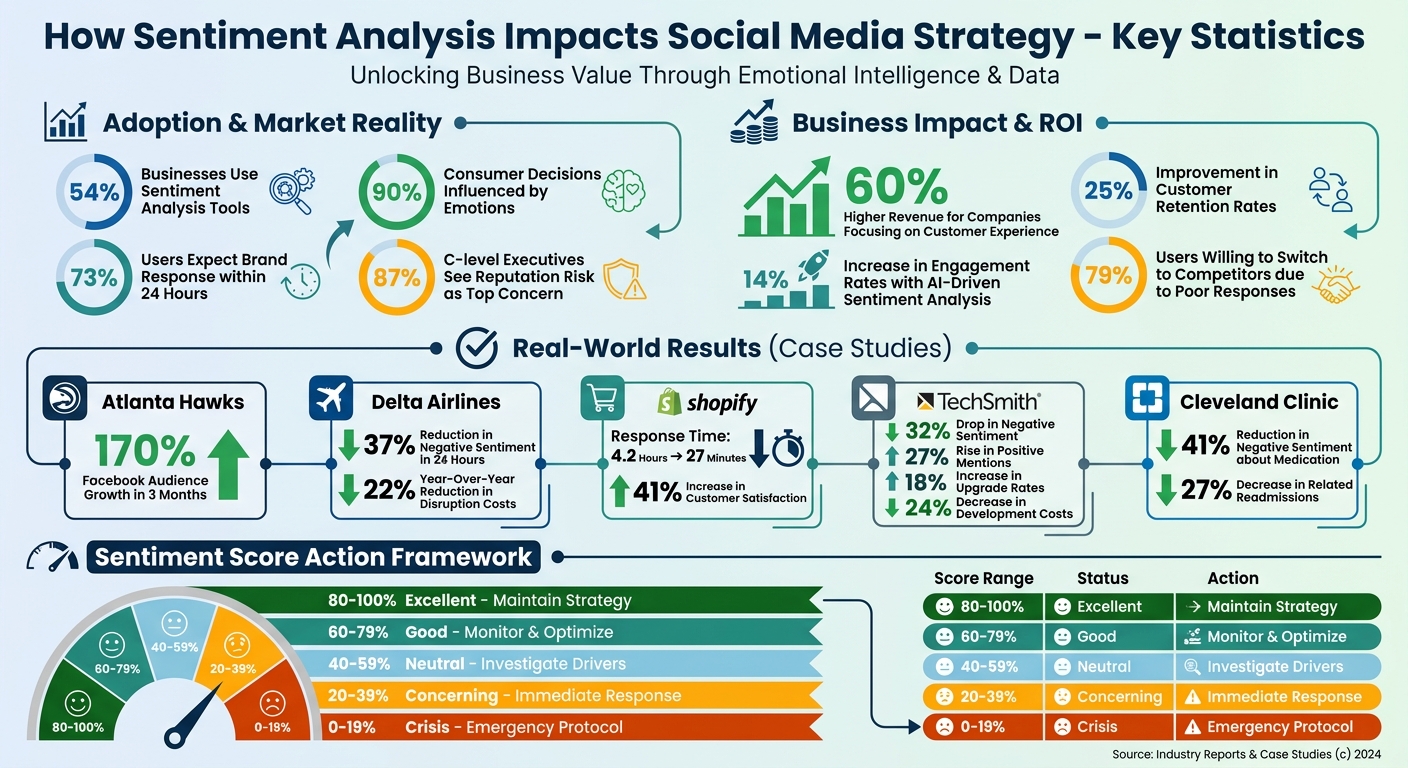
Sentiment Analysis Impact on Business Performance: Key Statistics and ROI Metrics
How to Use Sentiment Analysis to Drive Business and Social Strategy
To implement these insights effectively, choosing the right marketing funnel software and tools is essential for tracking customer sentiment across your entire sales process.
sbb-itb-a84ebc4
How Sentiment Analysis Changes Social Media Strategy
Sentiment analysis is reshaping how brands handle social media by digging deeper into the emotions behind user interactions. While traditional metrics focus on numbers like likes or shares, sentiment analysis uncovers how people feel - and that insight drives three key changes in social media strategy.
Real-Time Reputation Management
Think of sentiment analysis as an emotional radar for your brand. It alerts teams to sudden spikes in negative feedback before they spiral into full-blown crises. By categorizing messages as positive, negative, or neutral, brands can quickly address frustrated customers or urgent issues. This is especially important since 73% of social media users expect brands to respond within 24 hours, and 87% of executives see reputation risk as their top concern.
"87% of C-levels have pointed to reputation risk as the most significant risk area." - Deloitte
Smart brands use sentiment scores to guide their responses. For example, a score between 20% and 39% signals the need for immediate attention, while anything below 20% might call for emergency measures.
Prioritizing mentions from influential accounts - like verified users or viral creators - can also amplify impact. Tracking competitors’ reputation blunders provides another advantage, offering lessons on what to avoid and where opportunities might lie. This proactive approach not only safeguards a brand’s image but also creates a foundation for better campaign results.
Campaign Performance and ROI Optimization
Sentiment analysis does more than monitor reputation - it fine-tunes campaigns for better results. Instead of just looking at reach or clicks, it measures the emotional response to your content. For instance, if a campaign gets high visibility but triggers negative sentiment, it could signal a looming PR issue. Monitoring campaign-specific hashtags in real time makes it easier to tweak messaging on the fly.
Brands using AI-driven platforms for real-time sentiment analysis have even seen engagement rates jump by 14%. Take the example of a snack bar company that used Sprout’s Listening Topic Themes to analyze consumer feedback. They discovered that chocolate flavors generated more positive buzz because people loved "chewy" textures over "crunchy" ones. This insight shaped their product launches and marketing strategy.
"When you tie your strategy to specific KPIs, sentiment analysis stops being a simple listening exercise. It becomes a measurable tool for boosting performance, justifying the investment, and proving its value to the rest of the company." - ForumScout
By identifying which social channels spark the most positive reactions, brands can allocate ad budgets more effectively using all-in-one marketing platforms. Plus, pre-launch sentiment analysis of campaign ideas can highlight potential risks before they escalate.
Customer Perception and Product Development Insights
Beyond managing reputation and campaigns, sentiment analysis can guide product development. It highlights recurring frustrations or unmet needs, helping businesses adjust their offerings before small issues lead to customer churn. For example, aspect-based analysis focuses on specific product features - like design or sizing - giving development teams clear priorities for improvement.
This emotional intelligence doesn’t just improve products; it boosts the bottom line. Companies that actively incorporate customer feedback into their strategy can see revenue growth of up to 60% and improve customer retention by 25%. That’s critical when 79% of social media users say they’d switch to a competitor if their feedback is ignored.
How Sentiment Analysis Works
To make the most of sentiment analysis for social media strategies, it’s important to understand the technical processes behind it. At its core, sentiment analysis relies on a mix of AI, natural language processing (NLP), and data collection methods to turn raw online conversations into actionable insights.
Natural Language Processing (NLP) and AI Techniques
The process starts with cleaning up raw data. This involves stripping out hashtags, stopwords, and other noise while applying techniques like Named Entity Recognition, semantic search, and Part-of-Speech tagging to make sense of multilingual content.
Different classification methods are used to analyze sentiment:
- Rule-based lexicons: These are quick and efficient, relying on predefined dictionaries of words and their associated sentiments.
- Machine learning models: These excel at understanding complex sentences and implied meanings, as they learn directly from real-world examples of human communication.
- Hybrid systems: By combining rule-based and machine learning methods, these systems often achieve accuracy rates between 80% and 90%.
"ML models are brilliant at catching the subtleties that rule-based systems miss. Because they learn from actual human chatter, they're much better at understanding complex sentences and picking up on implied sentiment." - ForumScout
Most tools assign a sentiment score on a scale from -1 (very negative) to +1 (very positive). This is often calculated using approaches like word count ratios or sentence structure analysis.
Once the text is analyzed and classified, the next step involves collecting data from a variety of online sources.
Multi-Source Data Collection
Sentiment analysis tools gather data from a wide range of platforms. These include major social networks like Facebook, X (formerly Twitter), Instagram, LinkedIn, TikTok, and YouTube, as well as review sites such as Google Reviews, Yelp, and TripAdvisor. Social listening APIs and query builders are used to track specific mentions, keywords, and hashtags.
Modern tools also go beyond text by incorporating multimodal analysis, evaluating visual and audio content from platforms like TikTok and Instagram. To ensure accuracy, many companies use a human-in-the-loop approach, where analysts periodically review AI-classified data to correct errors and fine-tune models to account for evolving slang and sarcasm.
While this broad approach provides richer insights, it also introduces some interpretation challenges.
Challenges in Sentiment Analysis
Even the most advanced AI systems face hurdles when interpreting social media content. Sarcasm and irony are particularly tricky. For example, a comment like "Great, another software update" could be misclassified as positive without proper context.
Other issues include:
- Evolving language: Slang terms like "sick" can mean something positive or negative depending on the situation, and emojis like 🔥 might signify excitement or something literal, like a fire.
- Short-form content: Platforms like X often limit context due to their character constraints, making it harder to distinguish between literal and figurative meanings.
- Multilingual and cultural nuances: Direct translations can miss regional expressions or idioms, leading to skewed sentiment scores. For global brands, training models with native-language data improves accuracy.
- Industry-specific terminology: Words like "bug" or "crash" might seem neutral in casual conversation but have negative implications in technical contexts.
- Bot interference: Fake accounts and bots can distort genuine sentiment by injecting artificial opinions into online discussions.
These challenges highlight the complexity of accurately interpreting sentiment, especially in dynamic and diverse online environments.
Practical Applications and Business Impact
Cross-Functional Use of Sentiment Insights
Sentiment analysis becomes far more impactful when its insights are shared across the entire organization rather than staying siloed within marketing. For example, customer support teams can use sentiment analysis to automatically categorize feedback. Negative mentions can be flagged for immediate attention, while positive feedback can be routed to advocacy teams to amplify brand loyalty.
Product development teams benefit from aspect-based sentiment analysis, which highlights specific areas of user satisfaction or frustration. Take TechSmith, for instance: they used sentiment analysis to identify issues with their documentation. By improving their help guides and timeline features, they achieved some impressive results - negative sentiment dropped by 32%, positive mentions rose by 27%, upgrade rates increased by 18%, and development costs fell by 24%.
Sales teams can combine sentiment data with intent signals to focus on accounts with the highest potential. Meanwhile, marketing teams can track sentiment trends to fine-tune messaging and pinpoint the types of content that resonate most with their audience. These examples highlight how sentiment analysis, when applied across departments, can lead to actionable insights and measurable outcomes.
Measuring the Impact of Sentiment Analysis
The impact of sentiment analysis is evident in real-world applications, where it drives operational improvements and measurable results. For instance, companies that prioritize customer experience can see revenue boosts of up to 60%. Sentiment analysis also plays a role in improving customer retention rates by as much as 25%. Additionally, real-time sentiment tracking helps businesses mitigate financial risks during operational disruptions.
Consider Delta Airlines during an IT outage. They processed 30,000 daily mentions and discovered that customer frustration stemmed more from a lack of updates than the delays themselves. By shifting their focus to frequent, transparent updates, they reduced negative sentiment by 37% within just 24 hours. This change also contributed to a 22% year-over-year reduction in the financial impact of such disruptions.
Shopify provides another example. By using sentiment-based triage, they reduced critical support response times from 4.2 hours to just 27 minutes. This improvement led to a 41% increase in customer satisfaction scores.
Cleveland Clinic took a different approach, identifying that patients with negative sentiment about their discharge instructions were 34% more likely to be readmitted within 30 days. In response, they launched a personalized medication reminder app, which reduced negative sentiment around medication management by 41% and decreased related readmissions by 27%.
| Sentiment Score Range | Status | Action Required |
|---|---|---|
| 80-100% | Excellent | Maintain current strategy |
| 60-79% | Good | Monitor trends, optimize messaging |
| 40-59% | Neutral | Investigate negative drivers |
| 20-39% | Concerning | Immediate response strategy needed |
| 0-19% | Crisis | Emergency response protocol |
Resources for Implementation
To achieve similar results, it’s essential to have the right tools in place. The Marketing Funnels Directory is an excellent starting point. It provides a curated list of sentiment analysis tools, vendors, and guides to help you integrate these insights into your social media and broader business strategies.
Conclusion
Sentiment analysis has become a crucial component of modern social media strategies, serving as the emotional intelligence backbone for brands. With research showing that 90% of consumer decisions are influenced by emotions rather than logic, understanding audience sentiment isn’t just helpful - it’s essential. It can mean the difference between managing a crisis before it spirals out of control or addressing it too late, once it’s already gone viral.
The benefits of sentiment analysis go beyond crisis management. Companies that focus on customer experience by leveraging these insights report up to 60% higher revenue and a 25% increase in retention rates. These figures highlight how sentiment analysis impacts every corner of an organization. It helps product teams refine features, enables sales teams to identify high-potential leads and leverage ChatGPT for sales copywriting, and allows support teams to prioritize urgent issues. By tapping into real-time sentiment insights, businesses can improve campaigns, develop better products, and provide exceptional customer service.
Zuza Kumorek from Brand24 perfectly summarizes this shift:
"Most teams still treat sentiment like a vanity metric... real sentiment work is about emotional strategy. It's not just reacting to noise - it's about reading the room at scale."
This statement underscores how sentiment analysis elevates strategies from gut-driven decisions to data-backed emotional intelligence, ensuring every customer interaction is meaningful.
As the technology advances - with innovations like multimodal analysis, predictive sentiment, and improved sarcasm detection on the horizon - the core idea remains the same: brands that actively listen to their customers and respond quickly will build stronger connections and thrive. In a world where 79% of users are willing to switch to a competitor due to poor responses, sentiment analysis isn’t a luxury - it’s a necessity for staying competitive.
FAQs
How accurate is sentiment analysis on social media?
Sentiment analysis on social media has become increasingly precise due to advancements in AI and natural language processing. But it’s not without its challenges. For instance, sarcasm often flies under the radar, and posts with mixed emotions can be tricky to classify accurately. These limitations underscore the need for careful interpretation of the results, especially when using them to guide social media strategies.
What KPIs should I pair with sentiment to prove ROI?
To get a clear picture of ROI and campaign success, combine sentiment analysis with key performance indicators (KPIs) such as engagement, impressions, conversions, media mentions, share of voice, and crisis response time. Together, these metrics offer a well-rounded understanding of how sentiment influences your social media strategy and results.
How do I handle sarcasm, slang, and emojis in sentiment data?
Handling sarcasm, slang, and emojis in sentiment analysis can be tricky, but with the right approach, you can improve accuracy significantly. Emojis, for instance, often convey emotions that go beyond words - think of a simple 😊 or 😢. Incorporating them into your analysis can add depth to your understanding of sentiment.
Sarcasm and slang, on the other hand, are more challenging. Their meanings can shift based on context, making them harder to interpret. This is where advanced natural language processing (NLP) tools come into play. They can help identify the subtle nuances in tone and meaning.
To make your sentiment detection even more reliable, train your models on diverse datasets that include a wide range of slang, sarcasm, and emoji use. Pair this with manual validation to ensure your results align with real-world interpretations. These steps can help you capture sentiment more effectively, even in complex or unconventional language.