Emotions drive up to 95% of buying decisions, with positive feelings like joy, trust, and excitement playing a huge role in shaping consumer behavior. Why? Positive emotions release dopamine, making purchases feel rewarding and encouraging repeat behavior. Emotional connections with brands also translate to higher spending - customers who feel emotionally tied to a brand spend up to twice as much. Ads focused on emotions outperform logical ones, often utilizing AI-powered sales copywriting to trigger specific feelings, boosting sales by 23% through high-converting sales funnels.
Negative emotions, on the other hand, can block purchases. Fear, doubt, and anxiety often lead to decision paralysis or avoidance. For instance, during uncertain times, consumers lean on familiar brands for comfort, avoiding new options. Addressing these emotional hurdles is key to keeping customers engaged.
The takeaway: Align specific emotions with each stage of the buying journey. Use humor or surprise to grab attention, build trust during consideration, and create a sense of belonging for loyalty. Emotional marketing isn't just about short-term sales - it builds lasting customer relationships.
Emotions Drive 95% of Buying Decisions - Harvard Business School
sbb-itb-a84ebc4
Why Negative Emotions Stop People from Buying
Positive emotions can be a powerful motivator for purchases, but negative emotions like fear, anxiety, and doubt often act as barriers, preventing customers from moving forward. These emotional hurdles can disrupt your sales funnel at every stage. Understanding how these negative triggers work is key to addressing them and creating a more effective emotional connection with your audience.
How Negative Emotions Prevent Decisions
Negative emotions can cloud judgment, making it harder for consumers to make decisions. For example, research has shown that during times of heightened fear - such as during a contagious disease outbreak - sales for familiar brands like Campbell's rose by 1.6%, while less familiar brands only saw a tiny 0.1% increase. This happens because fear drives people to seek control, and disgust pushes them away from unfamiliar options.
"The fear pushes us to take action in order to reestablish some semblance of control, while the disgust makes us want to withdraw, and pulls us away from more novel brands and products."
– Gregory Carpenter, Professor of Marketing, Kellogg School of Management
A bad mood can also make it difficult for customers to imagine enjoying a product or experience. As Aparna Labroo, Professor of Marketing at Kellogg School of Management, notes:
"When we are in a bad mood, it is difficult to simulate the experience of doing something enjoyable - and we attribute the difficulty of simulating to the enjoyable activity itself. It doesn't feel right anymore, and then we become more likely to avoid that activity".
Another common issue is the Fear of Messing Up (FOMU). This fear of making the wrong choice can create decision paralysis, leaving customers stuck and unable to move forward.
Examples of Emotional Obstacles in Marketing Funnels
Negative emotions can creep into various stages of the marketing funnel, creating obstacles that derail the customer journey.
- Consideration Phase: Trust is often a major issue at this stage. When brands fail to deliver on promises or engage in practices like "sustainability washing", customers become skeptical and hesitant to proceed. Overly complex or exclusive messaging can also alienate potential buyers by making them feel inadequate or unwelcome.
- Evaluation Stage: Here, cognitive friction becomes a significant barrier. Studies show that 60% to 70% of consumer research happens before buyers even contact a vendor. Negative perceptions, such as poor reviews or confusing onboarding processes, can form early and create hesitation. In B2B settings, while buyers may claim to prioritize rational factors like features or scalability, the fear of professional embarrassment often leads them to choose safer, less risky options. Additionally, overusing urgency tactics, like fake scarcity, can erode trust when customers recognize the manipulation.
- Post-Purchase: After buying, customers often experience cognitive dissonance - a lingering doubt about whether they made the right choice. This feeling not only discourages repeat purchases but also reduces the likelihood of recommendations. Customers who second-guess their decision are less likely to advocate for the product or return in the future.
The Psychology Behind Positive Emotions and Buying
Positive emotions are powerful motivators. When customers experience feelings like joy, trust, or enthusiasm, their outlook broadens, making decisions feel easier and less risky. Research shows that emotions play a dominant role in shaping buying behavior. But the influence of positive emotions doesn’t stop at a single purchase - they reshape how buyers perceive value, manage risk, and connect with your brand.
Psychological theories, such as the Broaden-and-Build Theory and other top marketing strategies, help explain why positive emotions have such a profound impact on consumer behavior.
Broaden-and-Build Theory and Positive Emotions
Psychologist Barbara Fredrickson’s Broaden-and-Build Theory sheds light on how positive emotions work in marketing. While negative emotions tend to narrow focus - like fear prompting attention to immediate threats - positive emotions expand a person’s "momentary thought-action repertoire," opening up new possibilities and ideas.
"Positive emotions broaden one's awareness and encourage novel, exploratory thoughts and actions." - Barbara Fredrickson
This broadening effect can influence every stage of the customer journey. For example:
- Joy can encourage customers to step outside their comfort zones and try something new.
- Interest inspires curiosity, prompting them to explore your product or service further.
- Pride motivates customers to share their experience and envision future successes with your brand.
Another key concept tied to this theory is the "undoing effect." Positive emotions can counteract the lingering effects of negative emotions. For instance, if a buyer feels stressed about making a high-stakes decision, introducing positive triggers - like an unexpected discount or a reassuring testimonial - can ease that tension. Research even suggests that these positive emotional sparks can create lasting resources, like stronger brand loyalty, that extend far beyond the initial interaction.
"Happiness, then, is not only the result of success and high-functioning behavior, but also a precondition for it." - Barbara Fredrickson
By fostering creativity and exploration, positive emotions also influence how buyers evaluate risk.
How Positive Emotions Lower Perceived Risk
Trust, built through transparency and reliable delivery, can evoke emotions like nostalgia, which shift a buyer’s focus from the potential cost to the anticipated reward. This emotional shift turns hesitant browsers into confident buyers - and, over time, into loyal advocates.
At the heart of this dynamic is the fact that emotional engagement drives behavior. When customers feel understood, inspired, or connected to your brand, these emotions often outweigh purely rational considerations, like product specs or price points. Emotionally resonant ads, in particular, are far more likely to generate lasting brand loyalty and viral engagement than neutral, fact-driven content. Why? Because they break down psychological barriers and make taking action feel natural.
Specific Positive Emotions That Drive Purchases
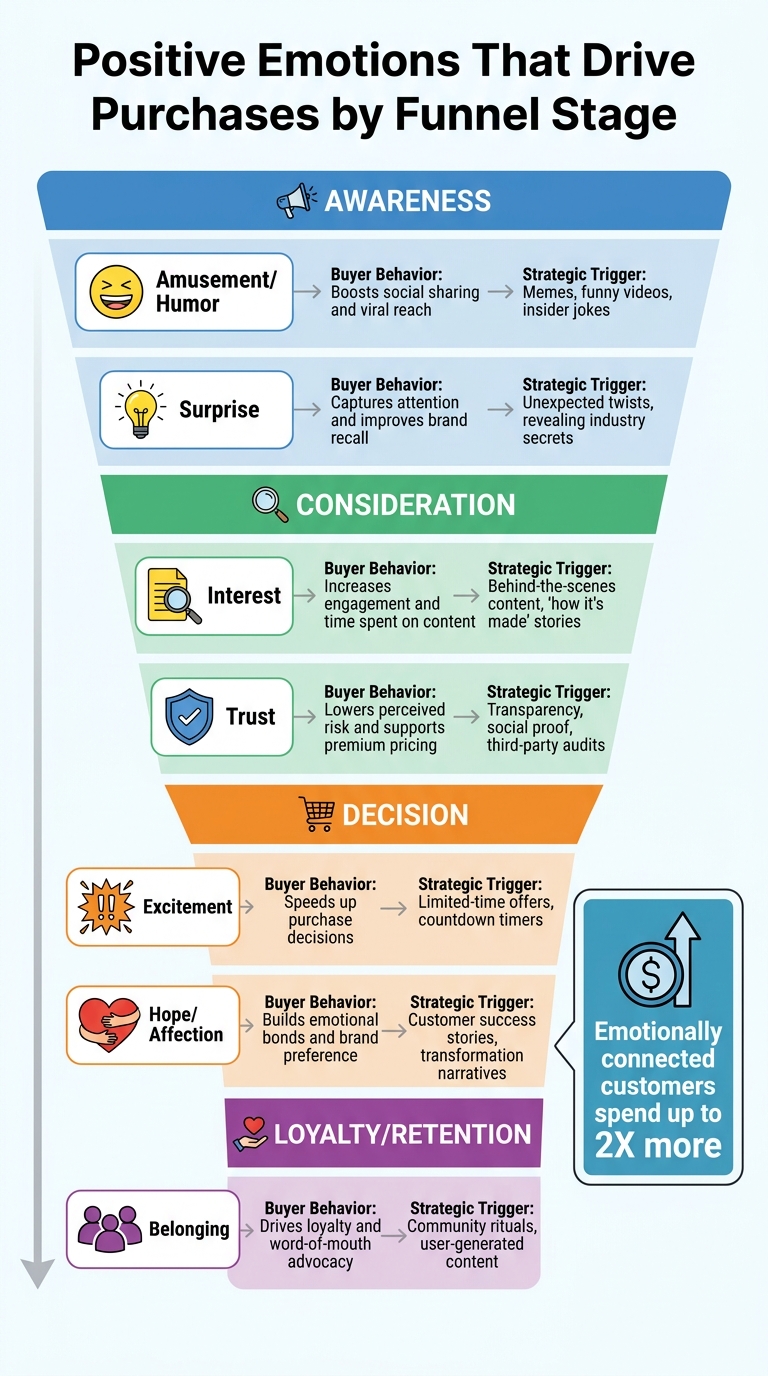
Positive Emotions That Drive Purchases by Funnel Stage
The Broaden-and-Build Theory helps us understand how positive emotions influence consumer behavior at various stages of their journey. By aligning specific emotions with the right moments - like using humor to grab attention, trust to maintain engagement, or a sense of belonging to build loyalty - you can significantly enhance your marketing impact.
Connecting Positive Emotions to Buyer Actions
Different emotions lead to different actions. For instance, curiosity encourages exploration, while trust makes buyers more comfortable with higher prices and minor flaws. Excitement, on the other hand, can drive quick decisions by skipping lengthy comparisons.
Emotions are a dominant force in purchase decisions. In fact, customers who feel a strong emotional connection to a brand spend up to twice as much compared to those who don't.
| Emotion | Buyer Behavior | Funnel Stage | Strategic Trigger |
|---|---|---|---|
| Amusement/Humor | Boosts social sharing and viral reach | Awareness | Memes, funny videos, insider jokes |
| Surprise | Captures attention and improves brand recall | Awareness | Unexpected twists, revealing industry secrets |
| Interest | Increases engagement and time spent on content | Consideration | Behind-the-scenes content, "how it's made" stories |
| Trust | Lowers perceived risk and supports premium pricing | Consideration | Transparency, social proof, third-party audits |
| Excitement | Speeds up purchase decisions | Decision | Limited-time offers, countdown timers |
| Hope/Affection | Builds emotional bonds and brand preference | Decision | Customer success stories, transformation narratives |
| Belonging | Drives loyalty and word-of-mouth advocacy | Loyalty/Retention | Community rituals, user-generated content |
Emotional Triggers for Different Funnel Stages
At the awareness stage, humor and surprise are your best tools to stand out. These emotions are highly shareable and help your brand stick in people's minds. For instance, Liquid Death’s use of edgy humor has made their campaigns go viral on social media.
In the consideration stage, trust and interest take center stage. Transparency is crucial here - sharing details like cost breakdowns or third-party audits can build credibility. Behind-the-scenes content also works well; Rocky’s Matcha, for example, uses unique packaging to reflect its individuality while piquing curiosity.
When customers reach the decision stage, excitement and hope are key drivers. Tactics like limited-time offers or countdown timers create urgency, a strategy often referred to as "engineered scarcity". Polar Monkeys, for example, markets cold plunges as transformative wellness tools, making their higher price point feel justified and emotionally resonant.
Finally, for retention and loyalty, belonging is essential. Black Travel Box focuses on fostering a sense of community and shared identity among its customers. Through rituals and user-generated content, they create a feeling of being part of something bigger, turning customers into advocates.
For more strategies on how to apply these emotional triggers effectively, visit the Marketing Funnels Directory (https://topmarketingfunnels.com).
Practical Ways to Use Positive Emotions in Marketing
Now that you understand how emotions drive purchases, it’s time to put them into action. The key is aligning the right emotional trigger with each stage of your funnel.
Using Storytelling to Create Emotional Connections
Storytelling isn’t about rattling off product features - it’s about tapping into human experiences. A great story follows a simple structure: Setup (a relatable scenario), Tension (an emotional challenge), Resolution (how your product helps), and CTA (turning emotions into action).
Take Always’s "Like a Girl" campaign as an example. By addressing gender stereotypes through a powerful narrative, they racked up over 90 million views and reshaped their brand image. Similarly, Google’s "Loretta" Super Bowl ad focused on love and loss, showing an elderly man using Google Assistant to remember his late wife. It wasn’t about the tech - it was about the emotions. Extra Gum’s "Origami" campaign also resonated deeply by telling a love story through gum wrapper origami, earning multiple advertising awards.
When crafting your own stories, focus on emotional outcomes like joy, pride, or relief. Real customer transformations can be especially impactful. For instance, Oreo’s behind-the-scenes content showcasing how to make Oreo Cookie Balls generated 10x the engagement of their usual posts. Match your storytelling format to the emotion you want to evoke - longer videos work well for nostalgic themes, while shorter, punchy clips are great for humor or surprise.
Creating Surprise Elements to Generate Curiosity
Surprise grabs attention by defying expectations, making it a powerful tool for increasing shareability. Research shows it’s one of the top 10 emotions associated with viral content. The trick is "playful subversion" - doing something your audience doesn’t see coming.
Metro Trains Melbourne’s "Dumb Ways to Die" campaign nailed this approach. By pairing a serious safety message with quirky animations and humorous lyrics, they garnered over 113 million views in three years. Beyond storytelling, you can weave surprise into your visual branding or messaging. For example, reveal unexpected industry secrets, use bold colors or packaging that stand out, or demonstrate how your product solves problems in ways people wouldn’t expect.
Leverage Emotional Contagion in Customer Interactions
Emotional contagion is the idea that people "catch" emotions from others. In marketing, this means showcasing the passion of your employees and the happiness of your customers. Research shows that emotionally engaged customers spend up to twice as much as less connected ones.
The ASPCA’s animal rescue ads are a great example of this. By appealing to empathy, they’ve generated over $30 million annually in donations. When using testimonials, focus on the emotional transformation - like the relief or joy customers feel - rather than just listing product features. Behind-the-scenes content featuring your team can also help humanize your brand and build trust.
Create shared experiences to strengthen emotional ties, such as user-generated content challenges or personalized summaries. Visuals are especially effective for conveying emotion since they’re easier for the brain to process. For brands that emphasize transparency, consider publishing third-party audits or detailed reports to back up your emotional claims. As SocialRails puts it:
"People don't buy products. They buy feelings."
These strategies tie back to the article’s core message: positive emotions don’t just influence purchases - they turn casual shoppers into loyal fans.
For more resources to help you integrate these emotional marketing strategies, check out the Marketing Funnels Directory. It’s packed with courses, books, and tools to help you create emotionally resonant customer journeys.
Conclusion
Positive emotions play a huge role in influencing purchasing decisions. In fact, research suggests that emotions drive between 70% and 95% of consumer choices, leaving logical reasoning as a secondary factor. When customers feel joy, nostalgia, relief, or even a sense of belonging, they’re far more likely to make a purchase and stick around as loyal advocates.
To make the most of this, align emotional triggers with each stage of your sales funnel. At the top, surprise and humor are great for grabbing attention. During the consideration phase, position your product as a tool for transformation. After purchase, build loyalty by fostering a sense of community. Emotional campaigns consistently outperform rational ones, with studies showing that emotionally driven content has a 31% success rate compared to just 16% for feature-based messaging.
There’s also a big opportunity here: 85% of consumers feel that brands aren’t meeting their expectations when it comes to emotional marketing. This gap presents a chance to stand out. Successful brands like Always and the ASPCA don’t just offer products - they deliver feelings, identities, and meaningful transformations.
Start by figuring out which emotions your customers are looking for. Use A/B testing to compare emotional storytelling with more rational messaging, and track the results with tools like sentiment analysis, Net Promoter Score, and customer lifetime value. Make sure your emotional promises are backed up by your operations to build trust that lasts.
If you’re looking for resources to help you create emotionally engaging customer journeys, check out the Marketing Funnels Directory. It’s packed with tools and strategies to help turn casual shoppers into loyal fans - one positive emotion at a time.
FAQs
How do I pick the right emotion for each funnel stage?
To match the right emotion with each stage of the funnel, think about the goal of that stage:
- Early stages: Tap into emotions like curiosity or excitement to grab attention and encourage interaction.
- Mid stages: Build connections by focusing on feelings such as trust, happiness, or pride.
- Later stages: Strengthen decisions and loyalty by evoking confidence and fulfillment.
How can I reduce buyer anxiety without sounding pushy?
To help ease buyer anxiety without coming across as pushy, focus on creating a calm and understanding experience. Be upfront and transparent - share clear information about your product, set realistic expectations, and avoid overpromising. Address potential concerns with empathy, offering personalized assistance when needed.
Instead of fixating on the sale, emphasize how your product can meet emotional needs. For instance, explain how it can provide comfort, build confidence, or resolve a specific worry. This approach not only reduces uncertainty but also fosters trust, making buyers feel more secure in their decision.
What metrics show if emotional marketing is working?
Metrics that showcase the success of emotional marketing include a 50% increase in customer retention driven by personalized touches like handwritten thank-you notes. Additionally, emotional marketing influences consumer decisions, with 65% of buyers considering how a company treats its employees when making purchases. These numbers highlight the power of emotional connections in fostering loyalty and driving sales.