Most B2B referral programs fail for one simple reason: teams ask the wrong people, for the wrong accounts, at the wrong time.
If I were planning a referral motion, I’d keep it simple:
- Choose who can refer - customers, partners, and employees
- Score which accounts matter - based on ICP fit, intent, and source strength
- Ask only after a clear win - not on a fixed schedule
- Track referrals at the account level - not just the contact level
- Measure funnel performance - from referral submitted to closed-won
The article makes one point clear: referrals can drive stronger pipeline, but only if the process is tied to CRM rules, routing, and payout logic. It also shows why timing matters. For example, referral asks tied to success events can convert 3-5x higher, and referred buyers often move through the funnel with less friction. On top of that, 84% of B2B decision-makers start with a referral, and referrals make up 54% of B2B leads.
What I take from this is simple: referrals are not just “extra leads.” They need the same planning discipline as outbound, ABM, and lifecycle work - maybe more, because every ask uses someone’s reputation.
A few points stand out:
- Customers should usually be asked after product wins, renewals, or expansion
- Partners should be filtered by overlap, sales capacity, and stack fit
- Employees should be limited to people with strong buyer networks
- Tier A accounts should go straight to senior sales
- Low-fit referrals should be routed to nurture, not reps
- Hot readiness scores should trigger the ask, while low scores should block it
- Incentives should match deal size, tax rules, and buyer seniority
I’d sum it up like this: good referral planning protects rep time, keeps source data clean, and turns warm introductions into trackable revenue.
B2B Referral Audience Planning: From Segmentation to Closed-Won
Do referral programs actually work for B2B?
sbb-itb-a84ebc4
Segment referrers and target accounts
Not everyone in your customer base or partner network is likely to send qualified referrals. Put your time on the people most likely to create pipeline you actually want - and on the accounts most likely to close.
Referrer segments: customers, partners, and employees
Your best customer referrers are usually the ones already getting good results from the product. Start with accounts that have hit an "aha moment", like finishing a first project or completing a successful integration. Expansion history can make that signal even stronger.
Partners are a different group, so score them differently. The main signals here are ICP overlap, active alliance programs, and tech stacks that fit well together.
For employees, start with customer-facing roles and technical team members who have strong networks in your ICP.
Use those signals to connect each referrer segment to the data you need for filtering and activation using marketing funnel software:
| Referrer Segment | Core Data Fields | System of Record | Key Filtering Criteria |
|---|---|---|---|
| Promoter Customers | NPS Score (9–10), Tenure, Product Usage Milestones, Expansion History | NPS platform, Product Analytics, CRM | High-usage "aha" moments, long-tenure accounts |
| Channel/Agency Partners | ICP Overlap, Sales Capacity, Integration Status, Service Margin | PRM platform, CRM, partner data platform | Active partner page, recent alliance activity, complementary tech stack |
| Employees | Department (CS/Sales/Eng), Network Strength, Tenure | HRIS, CRM, LinkedIn | Customer-facing roles, relevant professional network |
Target account tiers based on ICP and account scoring
Once you know who can refer, the next step is figuring out who is worth referring. Score referred accounts across three areas: ICP fit for firmographics, intent signals for buying behavior, and source quality for the strength of the referrer relationship.
For U.S. B2B teams, the usual ICP fields are industry, headcount, annual revenue in USD, geography, and tech stack. Then add intent data to spot accounts that are actively researching tools in your category. After that, increase the weight when the referral comes from a promoter customer or a long-tenure partner. Partner-sourced deals close 53% more often and carry 40% higher Average Opportunity Value (AOV) than direct-sourced deals.
To route follow-up cleanly, split accounts into three buckets:
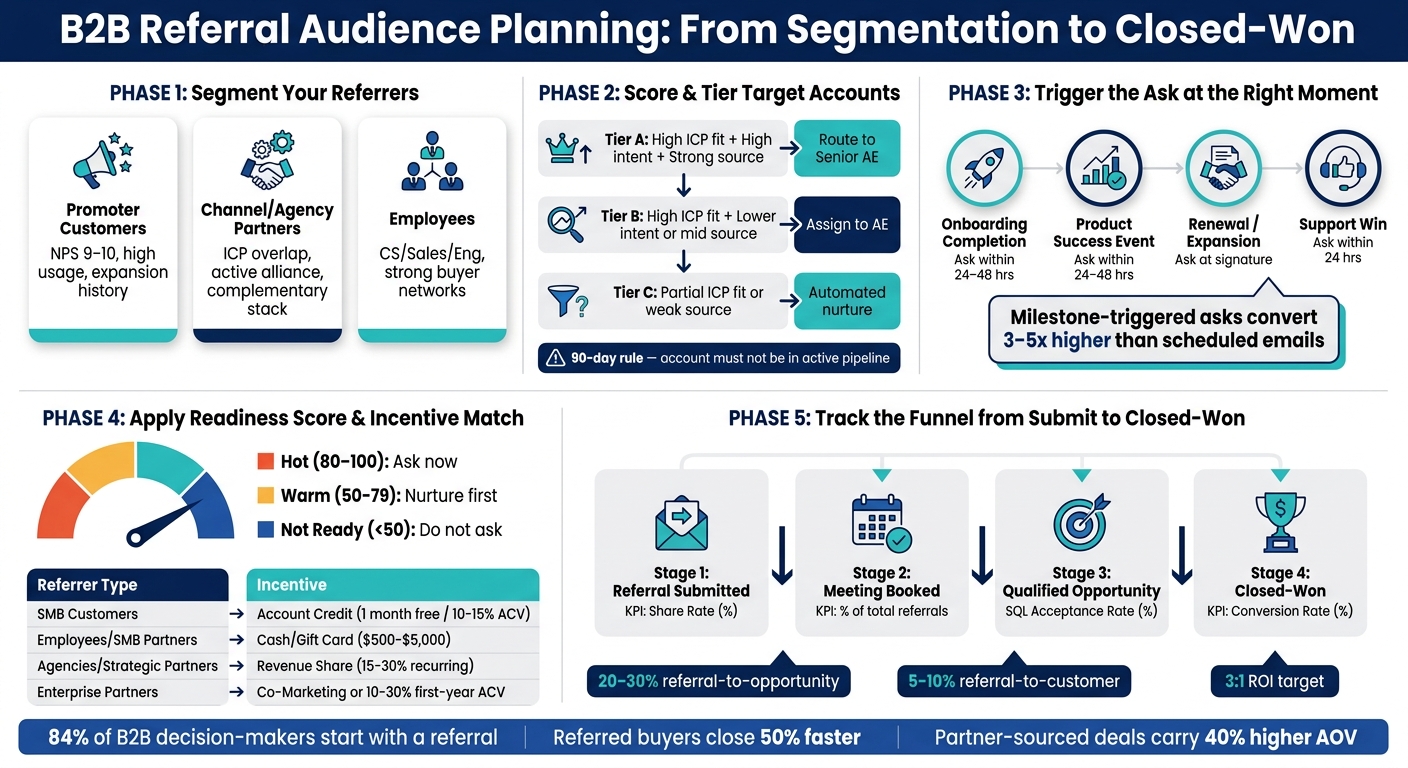
- Tier A - High ICP fit, high intent, strong source quality, and high estimated ACV. Route these straight to a senior AE.
- Tier B - High ICP fit, but lower intent or a middling source signal. Assign these to an AE for follow-up.
- Tier C - Partial ICP fit or a weak source signal. Send these into an automated nurture flow.
There’s also one rule that saves a lot of friction: a referred account should not have been in active pipeline for at least 90 days before the referral counts as a new source opportunity. That keeps sales and referrers from arguing over credit.
Track referrals at the account level, not the contact level. In most B2B deals, the person who gets introduced is not the economic buyer. If you only track the contact, the referrer can lose credit when the deal closes through a different stakeholder.
These segments and scores shape when to ask for a referral, what to offer, and how each referral should be routed.
Set referral triggers, readiness scoring, and incentive fit
Use milestone-based triggers, readiness scoring, and incentive design to decide when to ask and what to offer.
Referral triggers tied to customer milestones
The best time to ask for a referral is right after a customer has had a meaningful win - not because a calendar says it’s time. Referral nudges tied to specific success events convert 3-5x higher than generic scheduled emails. That window doesn’t stay open for long, so the practical move is simple: send the ask within 24-48 hours of the positive event, while the result is still top of mind.
That keeps referral asks tied to proof, not rep habit.
| Trigger Type | Milestone Signal | Recommended Ask Timing |
|---|---|---|
| Onboarding Completion | Successful sync or integration completion | Within 24-48 hours of completion |
| Product Success | First meaningful report generated or project completed | 24-48 hours after the event |
| Commercial | First deal closed in CRM or first automated workflow triggered | Immediate contextual nudge |
| 90-Day Review | Post-meeting confirmation of long-term value and satisfaction | Post-meeting |
| Renewal / Expansion | Contract renewed or upsell signed | At signature |
| Support Win | Resolution of a complex support ticket with high satisfaction | Within 24 hours of ticket close |
Offboarding can still lead to warm introductions if the customer leaves on good terms.
Referral readiness score and ask rules
Even when a trigger fires, not every customer should get an ask. A simple 0-100 readiness score based on product adoption, NPS or CSAT, support history, tenure, and recent success events gives your CRM a clean rule for what happens next.
If the rule is fuzzy, the program gets messy fast. Set a firm threshold.
Hot (80-100): ask now. Warm (50-79): nurture first. Not ready (<50): do not ask.
A clear readiness threshold also protects the referrer. In B2B, a referral is reputation capital - the referrer is putting their reputation on the line. If you ask before the product has shown value, you risk burning trust.
Use the score to route the ask inside the CRM and match the incentive to the right referrer segment.
Match incentives to ACV, compliance, and repeat use
The right reward depends on deal size, who the referrer is, and whether the program needs to run at scale. A $500 gift card may work for an SMB customer, but it can feel cheap - or create compliance issues - for a VP at an enterprise account.
Match the reward to deal value, compliance risk, and how often you want the motion to repeat.
| Incentive Type | USD Payout Range | Best Fit by Segment | Compliance Notes |
|---|---|---|---|
| Account Credit | 1 month free / 10-15% of ACV | Budget-conscious SMBs, power users | Easiest for procurement; no tax forms required |
| Cash / Gift Card | $500-$5,000 | Employees, SMB partners, affiliates | Requires W-9 and tax tracking; avoid for senior executives |
| Revenue Share | 15-30% recurring (12-24 months) | Agencies, consultants, strategic partners | Requires a formal partner agreement and clawback clause |
| Co-Marketing | Joint webinars, directory listings | High-value strategic partners, agencies | High perceived value; avoids cash compliance rules |
| Lead Bounty | $50-$200 per meeting held; $100-$500 per SQL accepted | Affiliates, SDRs | Pay on a held meeting to keep top-of-funnel active |
Enterprise referrals often pay 10-30% of first-year ACV, with a 60-90 day clawback. Add qualification gates and clawbacks to cut low-quality referrals and churn risk.
Double-sided rewards - where both the referrer and the referred account get something - work well for SMB programs because they make the exchange feel less transactional and help the referrer feel like they’re doing their peer a favor. For enterprise deals, single-sided rewards are usually cleaner. The referee usually cares far more about the value of the solution than a small credit.
Once the ask, timing, and reward are set, map each referral stage and track conversion.
Map the referral funnel and measure performance
Referral funnel stages: share to closed-won
Once you know who should refer and when to ask, the next step is simple: map how each referral moves from share to revenue.
A referral only moves forward when someone owns it, the status is clear, and the next action is defined. Each stage should have:
- a clear owner
- a CRM status
- a rule for what happens next
Without that structure, referrals slip through the cracks between marketing, sales, and customer success. And when that happens, attribution usually disappears too.
Store the referral source at the account level. Then use unique links or codes so attribution stays intact.
| Funnel Stage | Owner | CRM Status | KPI Formula | Unit |
|---|---|---|---|---|
| Referral Submitted | Referrer / Marketing | Lead: New | Total Referrals ÷ Total Advocates | Share Rate (%) |
| Meeting Booked | SDR / BDR | Lead: Working | Meetings Booked ÷ Total Referrals | % |
| Qualified Opportunity | Sales | Opportunity: Discovery | SQLs Accepted ÷ Total Referrals | % |
| Closed-Won | Sales / Finance | Closed-Won | Closed Deals ÷ Total Referrals | Conversion Rate (%) |
Don't wait until closed-won to track performance. Mid-funnel milestones matter too. If referrals are getting submitted but not turning into meetings, or meetings are happening but not becoming sales-accepted opportunities, that's where the problem lives.
Stage data is only useful if it tells you where the funnel is breaking.
Metrics that show quality, conversion, and ROI
Most teams stop at closed-won. That's too shallow. It tells you what happened, but not why.
Referred customers close 50% faster, have a 37% higher retention rate, and generate 16% more revenue over their lifetime than leads from other channels. But you won't see that in your reporting if you're only looking at pipeline volume. You need to track LTV and retention by acquisition source.
Focus on a small set of metrics that show whether the program is pulling its weight:
- quality
- conversion
- velocity
- pipeline
- ROI
Aim for 20% to 30% referral-to-opportunity conversion, 5% to 10% referral-to-customer conversion, and at least 3:1 ROI. Then break performance out by referrer type and account tier. That ties the numbers back to the audience quality choices made earlier in the plan.
Use a CRM or partner portal to show deal status, clicks, and payout timing. This isn't a nice-to-have. It's part of the operating model. One common failure mode is attribution opacity: when partners can't see deal status or payout timelines in real time, they typically stop sending deals within 90 days.
Make status and payout visibility part of the regular cadence, not a manual follow-up task.
Conclusion: Build a referral audience plan the revenue team can run
The goal is simple: turn referral rules into a repeatable revenue motion. A referral program without a plan is guesswork, often lacking the marketing funnel resources needed to scale. The gap between qualified pipeline and low-fit introductions often comes down to choices made before you send a single ask.
Use those rules to decide who should refer, who should get routed, and when the ask should go out. Split referrers into customers, partners, and employees. Score target accounts against ICP fit before routing them. Ask after a clear success milestone. Match rewards to deal size and referrer type - cash for partners, account credits for customers, and noncash perks for executives . Track all of it at the account level in your CRM so RevOps can trust source reporting and measure pipeline by referral source .
That’s how referral audience planning becomes a revenue channel the team can run and measure: qualified referrals that close faster, retain better, and add more lifetime value than leads from any other source.
FAQs
How do I build a referral readiness score?
Start by finding your loyal advocates. A simple place to begin is NPS data - look for customers who score you a 9 or 10. You can also spot them through engagement signals, like frequent logins, steady feature adoption, and low support ticket volume.
From there, score each person based on how likely they are to send strong referrals. Focus on a small set of signals:
- Trust and influence
- Motivation to refer
- Ability to explain your product
Keep the model simple. Aim for 5 to 7 attributes tied to high-quality referrals. If you pile on too many inputs, the score gets harder to use and easier to ignore.
For partner programs, don’t look at activity alone. Mix those signals with outcomes that show partner impact, such as retention quality, upsell influence, and customer satisfaction.
What should count as a valid referral?
Define a valid referral upfront. If you don’t, you leave room for confusion, awkward back-and-forth, and payout disputes later.
Be clear about what counts. For example, a referral might mean:
- a booked call
- a qualified opportunity
- a closed-won customer
- a retained customer
You should also spell out the criteria a referral needs to meet. Typical requirements include:
- fit with your ICP
- not already in your pipeline
- submitted through your formal registration process
- meeting a minimum activity or success milestone
Which referral incentive works best for enterprise deals?
For enterprise deals, skip small, transactional cash rewards. They can land the wrong way with senior stakeholders and make the offer feel cheap.
A better route is to offer high-value professional incentives, like VIP experiences, early access to product roadmaps, or featured case study placement.
If you do use financial incentives, make them meaningful - $2,000 to $5,000 or a percentage of contract value. In many cases, a double-sided approach works best.