Lead magnets are tools that help businesses turn website visitors into subscribers by offering something useful for free, like checklists, templates, or quizzes, in exchange for contact details. Here's what you need to know:
- Why They Work: 96% of visitors don't buy on their first visit. Lead magnets help build connections and gather contact information for follow-ups.
- Key Features of Great Lead Magnets: Solve a specific problem, are easy to use, and feel valuable even though they're free.
- Popular Formats: Quizzes (40% conversion), checklists (20-35%), templates, ebooks, and webinars. The format depends on your audience's needs.
- Steps to Create One:
- Research your audience's problems and interests.
- Create concise, actionable content (5-25 pages for PDFs).
- Use professional tools like Canva for design.
- Deliver it through a focused landing page with minimal form fields.
- Follow-Up: Use a structured email sequence to nurture leads and guide them toward becoming customers.
To improve results, test different headlines, formats, and designs. Track metrics like opt-in rates (20-40%) and email engagement to refine your approach. Lead magnets are not just about growing your email list - they're about building trust and driving conversions.
Core Principles of Effective Lead Magnets
Key Traits of High-Performing Lead Magnets
The best lead magnets solve a specific problem for a clearly defined audience. They don’t try to appeal to everyone; instead, they focus on addressing a single, pressing issue. As Seth Godin wisely said:
"Everyone is not your customer. The more precise you are when defining your target market, the more effective your lead magnet offer will be."
Precision is the key to better conversions. For example, a checklist titled "5-Point Pre-Launch SEO Audit for SaaS Founders" is far more effective than a broad "SEO Guide for Beginners." Why? Because it speaks directly to a niche audience with a specific need.
In addition to relevance, ease of consumption is non-negotiable. People want quick wins - resources they can skim, act on, and gain value from in minutes. Formats like checklists, templates, or cheat sheets work well because they’re concise and actionable. This explains why short-form content often converts at rates of 20–35%, compared to 10–20% for longer formats like ebooks , though you can achieve sales funnel mastery for digital products by choosing the right format for your offer.
Another critical factor is perceived value. Even though lead magnets are free, they should feel like premium resources worth paying for. This means using professional design, crafting an enticing title, and offering content that stands out from what’s already available online. For instance, personalized calls-to-action convert 42% more visitors than generic ones.
While understanding what makes a lead magnet effective is important, avoiding common mistakes can be just as impactful.
Common Mistakes to Avoid
One of the biggest reasons lead magnets fail is a misalignment between the offer and the audience. Trying to appeal to everyone often results in a flood of unqualified leads who have little interest in your business. Aaron Whittaker, Vice President of Demand Generation at Thrive Internet Marketing Agency, explains:
"A great lead magnet works because it's relevant. It speaks directly to what your audience cares about and offers something they'll genuinely appreciate in return for their information."
Another frequent issue is unnecessary friction. Complicated opt-in forms, clunky designs, or slow-loading pages can drive potential leads away before they even see the offer. For example, reducing a form from four fields to three can boost completion rates by nearly 50%. Similarly, requiring a phone number causes 37% of users to abandon the form altogether. Keeping it simple - just asking for a name and email - is often enough.
Lastly, first impressions matter. Visitors form opinions about a page in just 0.5 seconds. Poorly designed landing pages or low-quality PDFs can give the impression that the content isn’t worth their time. Clean, professional visuals and a clear, focused call-to-action help build trust and encourage users to engage.
sbb-itb-a84ebc4
How to Create an Effective Lead Magnet (Free Template)
Best Lead Magnet Formats
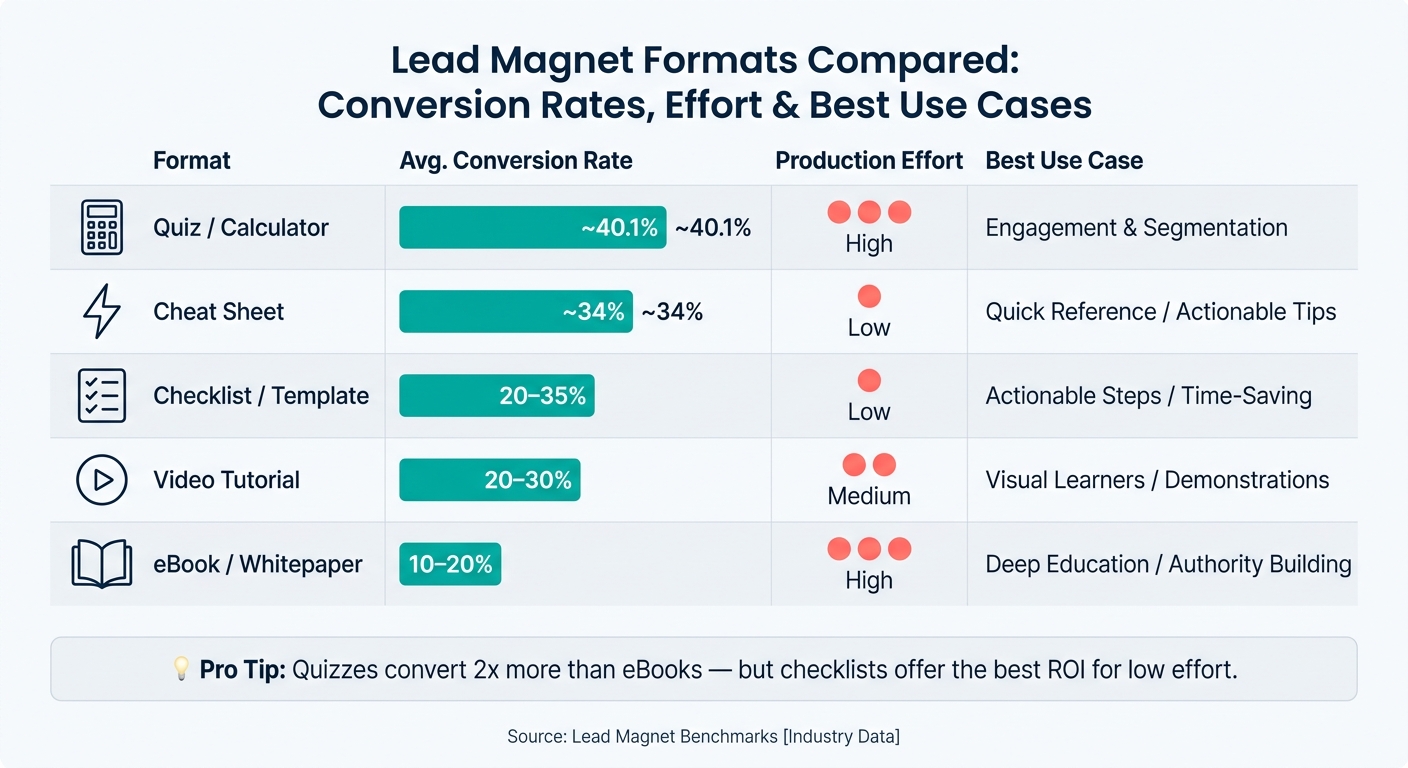
Lead Magnet Formats: Conversion Rates, Effort & Best Use Cases
Popular Lead Magnet Types
Lead magnets come in various formats, each with its own strengths in boosting opt-in rates and generating quality leads. Let’s dive into some of the most effective types and why they work.
Checklists and cheat sheets are like the Swiss Army knives of lead magnets - they’re simple, quick to produce, and offer instant value. For example, Love and London's "Travel Checklist" addresses a specific travel need, making it a conversion powerhouse. Checklists typically convert at 20–35%, while cheat sheets push slightly higher at around 34%.
Quizzes and interactive tools take the crown for conversion rates, averaging an impressive 40.1%. Take Solluna’s "Sleep Quiz" as an example - it not only engages users but also collects personalized data for tailored follow-ups. These formats excel at segmenting audiences, as quiz results reveal individual preferences and pain points.
Ebooks and whitepapers are heavy hitters when it comes to establishing authority. HubSpot’s "The 2025 State of Marketing" report, based on insights from 1,460 marketers, is a prime example. It generated thousands of leads and even earned media coverage. However, these formats require significant effort to produce and generally yield lower conversion rates (10–20%), making them ideal for building credibility rather than sheer volume.
Webinars and workshops offer something static content can’t: a personal touch. Tori Dunlap of Her First $100K uses live workshops with countdown timers to create urgency, effectively targeting Millennial and Gen Z women with financial education content. Templates and swipe files are another crowd-pleaser, especially for B2B audiences who value ready-to-use resources that save time and streamline workflows.
| Format | Avg. Conversion Rate | Production Effort | Best Use Case |
|---|---|---|---|
| Quiz / Calculator | ~40.1% | High | Engagement & segmentation |
| Cheat Sheet | ~34% | Low | Quick reference / actionable tips |
| Checklist / Template | 20–35% | Low | Actionable steps / time-saving |
| Video Tutorial | 20–30% | Medium | Visual learners / demonstrations |
| eBook / Whitepaper | 10–20% | High | Deep education / authority building |
Understanding these formats is just the first step - choosing the right one for your audience is where the magic happens.
How to Choose the Right Format for Your Audience
The effectiveness of a lead magnet depends heavily on how well it aligns with your audience’s needs and where they are in their buying journey. Sean Tinney, a content marketer at AWeber, puts it best:
"The best lead magnet is the one that answers the question your ideal subscriber asks most often before they are ready to buy."
For new visitors, low-commitment formats like quizzes or checklists work wonders. On the other hand, those actively comparing options may lean towards detailed templates or case studies. If someone is close to making a purchase, a free trial or demo can help ease any remaining doubts.
Audience preferences also play a big role. B2B buyers often gravitate toward whitepapers, reports, and templates - tools that make their jobs easier. Ecommerce shoppers, however, respond better to quizzes or discount-based offers. If your audience spends a lot of time on YouTube, a video tutorial will likely outperform a static PDF.
Not sure where to start? A quick social media poll can reveal what your audience wants, saving you time and effort before diving into production. Once you have your format, you can leverage AI for high-converting sales copywriting to speed up the creation process.
Choosing the right format is a critical first step. Every subsequent phase - research, content creation, and delivery - builds on this foundation.
How to Create a Lead Magnet: A Step-by-Step Process
Now that you’ve chosen the right format, it’s time to build your lead magnet from scratch. The process unfolds in three key phases: research, creation, and delivery.
Phase 1: Research and Planning
Start by identifying your target audience using tools like CRM systems and Google Analytics. These tools help you understand your audience’s demographics and behaviors, allowing you to create a buyer persona based on their goals and frustrations.
"Without a clear picture of who you're targeting, your efforts will cost you valuable resources. So, it's important to take the time to dig into what your audience values, their challenges and what motivates them." - Aaron Whittaker, Vice President of Demand Generation, Thrive Internet Marketing Agency
To uncover their pain points, explore platforms like Reddit, Quora, and niche Facebook groups. Pay attention to the language people use when describing their problems - it’s gold for crafting copy that resonates. Another great resource? Amazon’s 3-star reviews for top-selling books in your niche. These reviews often highlight what readers felt was missing, giving you insights into unmet needs.
Before diving into content creation, validate demand. A simple social media poll asking, “Would this be helpful?” can save you hours of wasted effort. Be as specific as possible: for example, a lead magnet titled "Meal Prep for Busy Parents Who Hate Cooking" will resonate far more than a generic "Healthy Eating Tips" guide.
Once you’ve nailed down your audience’s needs and confirmed their interest, you’re ready to focus on creating concise, actionable content.
Phase 2: Content Creation and Design
When creating your lead magnet, keep it concise and actionable. For PDF-based formats, aim for a length of 5–25 pages - short enough to avoid overwhelming readers but long enough to deliver real value. Address the reader’s problem upfront and provide your solution without delay.
Use the language you discovered during your research and aim for a 5th–7th grade reading level. This approach isn’t about dumbing things down; it’s about clarity. Content written at this level converts at 11.1%, compared to just 5.3% for more complex language. To make your content scannable, use short sentences, bullet points, and plenty of white space. For design, tools like Canva or Adobe Express can help you create professional-looking materials without needing a graphic designer.
Here’s a real-world success story: career coach Ashlee Anderson created a simple “top ten list” lead magnet that achieved a 32.4% conversion rate and generated $27,000 in passive income from her digital course. The secret? The clarity and relevance of her content did the heavy lifting.
Phase 3: Delivery and Distribution
Once your content is ready, focus on seamless delivery and effective follow-up to capture and nurture leads. Use a dedicated landing page - often called a squeeze page - with no navigation bar. This keeps visitors focused on one action: opting in. On average, squeeze pages see a 23% signup rate, compared to just 3–5% for pop-ups.
Streamline your opt-in process by minimizing form fields. The fewer fields you require, the higher your conversion rate. Avoid asking for a phone number - 37% of users abandon forms when they see that field. Automate the delivery of your lead magnet via email. Delivery emails have an average open rate of 80%, which is significantly higher than standard campaigns.
After delivery, set up a short email nurture sequence to build trust and guide your leads further down the funnel:
| Purpose | Timing | |
|---|---|---|
| Email 1: Delivery | Send the lead magnet link and set expectations | Immediately |
| Email 2: Quick Win | Share a tip or story to build trust | Day 2 |
| Email 3: Educational | Address a common mistake or myth | Day 4 |
| Email 4: Social Proof | Include a case study or testimonial | Day 7 |
| Email 5: Soft Pitch | Offer a clear next step | Day 10 |
Don’t overlook your thank-you page - it’s a great place to offer immediate value, such as a discount or an invitation to join a community. Every step of this process strengthens your marketing funnel and maximizes the impact of your lead magnet.
How to Test and Optimize Your Lead Magnets
Once you've created and shared your lead magnet, the work isn't over. To keep conversion rates high, you’ll need to test, measure, and fine-tune its performance. A lead magnet’s real potential emerges through ongoing optimization.
A/B Testing for Better Results
A/B testing is a straightforward way to compare two versions of an element - like a headline, button text, or form layout - to figure out which one performs better. The key? Test only one variable at a time. If you tweak multiple elements simultaneously, it becomes impossible to tell what’s driving the change.
Start with the factors that have the most significant impact on conversions, such as headlines or call-to-action (CTA) buttons. For example, swapping a generic button label like "Submit" for something more action-oriented and specific - like "Send Me the Checklist" or "Get My Free Template" - can recover up to 3% in lost conversions. In fact, testing headlines and CTAs alone has been shown to boost conversion rates by 10% to 30%.
"A/B testing is essential in determining whether a lead magnet is working for you or not." - Nitin Deshdeep, Digital Marketer, VWO
Beyond copy, experiment with the format and placement of your lead magnet. Backlinko’s Brian Dean, for instance, replaced standard opt-in forms with content upgrades - downloadable resources tied directly to specific blog posts. This adjustment increased his site’s conversion rate from 0.54% to 4.82%. Similarly, Copyblogger found that bundling multiple ebooks into a single package quadrupled their email signups. These examples highlight how presentation can be just as impactful as the content itself.
A/B testing isn't a one-and-done task. Regular testing can improve conversion rates by up to 37%. Once you’ve identified what works, the next step is tracking performance through key metrics.
Tracking and Analyzing Key Metrics
After launching your lead magnet, it’s crucial to monitor its effectiveness using clear benchmarks. For instance, a dedicated landing page should convert between 20% and 40% of visitors. If your numbers fall short, it could mean your offer, messaging, or form design needs adjustment.
Here are the key metrics to track:
| Metric | Benchmark | What It Tells You |
|---|---|---|
| Landing Page Opt-in Rate | 20–40% (dedicated pages) | Whether your offer and messaging resonate |
| Delivery Email Open Rate | 68–80% | If leads are engaging immediately after signing up |
| Unsubscribe Rate | < 0.5% | Whether your magnet aligns with audience expectations |
| Nurture Click Rate | 4–8% | Whether your follow-up emails are driving action |
But don’t stop at surface-level metrics. Focus on lead quality - how many of your lead magnet subscribers eventually convert into paying customers. This is the ultimate measure of your lead magnet’s success and its impact on revenue.
Tracking these numbers gives you the foundation for making strategic improvements.
Using Data and Feedback to Improve Over Time
Optimization isn’t a one-time project. Over time, lead magnets lose effectiveness as audience preferences evolve. If your opt-in rate declines for two or three consecutive months, it’s a sign that it’s time to refresh your offer or update the content.
Tools like Hotjar or Microsoft Clarity can help by showing where visitors drop off on your landing page. Combine this with qualitative feedback - such as post-download surveys or questions on social media - to understand whether your audience found the content useful. While data shows what is happening, feedback reveals why.
"Using an all-in-one platform like Systeme.io can simplify the technical side of this process. A lead magnet funnel is never truly finished. Regularly reviewing its performance and making small improvements ensures it stays effective." - Samira Farzana, Content Creator, FluentCRM
Lastly, segment your leads based on the specific asset they downloaded. This allows you to send more targeted follow-up emails and provides cleaner data for analyzing which lead magnets attract the most qualified prospects. Over time, these insights will help you refine your strategy and maximize results.
Conclusion: Building a Stronger Marketing Funnel with Lead Magnets
A thoughtfully designed lead magnet does more than just gather email addresses - it creates the first meaningful exchange of value between your brand and a potential customer. It's a moment of trust-building. As Amit Ashwini, Founder of DataDab, explains:
"Lead magnets pull qualified prospects into your orbit by demonstrating value instead of interrupting strangers with sales pitches."
The formula for success is simple: solve a specific problem, offer an immediate benefit, and make it easy to consume. Specificity is key - a title like "The 15-Minute Morning Routine Template" will always outperform something generic like "Productivity Tips." Simplicity also plays a major role: keeping your opt-in form to three fields or fewer can boost completion rates by up to 50%.
When done right, lead magnets can deliver impressive results. They often achieve conversion rates ranging from 30% to 50%+, and a follow-up sequence of three welcome emails after a download can drive 90% more orders compared to a single delivery email. If you're looking to make an immediate impact, start by creating a follow-up sequence - it’s one of the most effective steps you can take.
The easiest way to get started? Use what you already have. 94% of marketers repurpose existing content - like blog posts, webinars, or internal resources - into lead magnets. A top-performing blog post or presentation sitting in your archives could quickly transform into a checklist, template, or guide, feeding directly into the strategies outlined in this guide.
To put these ideas into action, check out the Marketing Funnels Directory. It’s a curated resource filled with tools for landing page creation, email automation, and more - a practical starting point to bring your marketing funnel to life.
FAQs
How do I pick the best lead magnet topic?
To pick the right lead magnet topic, zero in on a specific problem that your audience is eager to solve. Start by understanding their demographics, challenges, and habits. Then, make sure your topic matches where they are in the marketing funnel. Formats like checklists, templates, or guides tend to grab attention. Most importantly, your offer should feel relevant and worthwhile - something they’d gladly trade their contact details for.
What should I ask for on the opt-in form?
To get the most out of your lead magnet conversions, prioritize collecting only the essential contact information - primarily the visitor’s email address. This allows you to deliver the lead magnet and establish a channel for follow-up communication. While you might consider asking for extra details, like a name or phone number, keeping the form straightforward ensures a smoother user experience and increases the likelihood of sign-ups. Focus on gathering just what you need to provide value and maintain efficient follow-ups.
How do I know if my lead magnet is working?
To figure out if your lead magnet is doing its job, keep an eye on conversion rates - things like downloads or sign-ups - and engagement metrics such as email open rates or form submissions. These numbers reveal whether your lead magnet is pulling in the right audience and encouraging them to take action.
If the results aren’t great, it could mean your lead magnet isn’t hitting the mark in terms of relevance or value. Dive into your analytics regularly and make adjustments to ensure it connects with your audience and aligns with your marketing objectives.