If I want paid social tests to change pipeline, I don’t test random ad tweaks or marketing funnel software. I test one variable, one funnel stage, and one business KPI at a time.
That is the whole playbook. I match the test to the funnel stage, lock the hypothesis before launch, keep traffic split clean in Meta or LinkedIn, track each variant into the CRM, and wait for enough data before I pick a winner. If I change the ad, audience, landing page, and bid settings at once, I am not running a test - I am mixing signals.
Here’s the short version:
- Top of funnel: I look at CTR, CPC, and engagement
- Middle of funnel: I look at MQL cost, SQL rate, and lead quality
- Bottom of funnel: I look at CPA, ROAS, pipeline $, and cost per opportunity
- Meta test timing: about 7 to 14 days and 30 to 50 conversion events
- LinkedIn B2B timing: about 14 to 30 days and at least 300 clicks / 20 conversions per variant
- Pipeline readout: often needs 30 to 90 days in the CRM
What matters most is simple:
- Pick one stage
- Change one thing
- Name the test clearly
- Track it from ad click to CRM stage
- Judge the winner by funnel outcome, not just cheap clicks
I’d also keep budgets concentrated. A small budget spread across too many variants will not give me enough data to make a call. And if clicks look fine but conversion rate drops, I would move the test to the landing page or form - not keep changing the ad.
So the article’s core message is clear: paid social A/B testing works when I keep it controlled, tie it to funnel economics, and report results in terms sales and finance care about.
How To A/B Test Your Meta Ads Creatives (+ Free Cheat Sheet)
sbb-itb-a84ebc4
Plan the Test: Hypothesis, Naming, Metrics, and Funnel Setup
Once the funnel stage is set, lock the test design before launch.
Write a funnel-specific hypothesis and choose the primary KPI
A good hypothesis changes one variable and aims for one outcome. Use this format: "If we change [Variable X], then [Audience Y] will perform [Behavior Z] because [Reason]."
Match the hypothesis to the funnel stage. Keep the audience, budget, placement, and landing page the same so you can isolate what changed.
Pick one primary KPI for that stage - CPL, CPA, or ROAS. Metrics like CTR and CPC can help you understand why something happened, but they should not decide the winner.
Set the stop rule before launch. That should include:
- minimum sample size
- maximum quality drop
- kill criteria
Use a naming convention that holds up in reports
Use one naming format across the board: Platform_FunnelStage_Audience_Variable_Variant_Date
| Field | Meta Example | LinkedIn Example |
|---|---|---|
| Platform | FB |
LI |
| Funnel Stage | CONV |
MID |
| Audience | LAL-Purchasers |
JobTitle-IT |
| Variable | Creative |
Offer |
| Variant | Video-A |
Whitepaper-B |
| Date | 08/28/2026 |
08/28/2026 |
This may feel a little rigid, but it saves a lot of pain later. When naming breaks down, reporting usually follows.
Use the same fields in UTM tags and HubSpot CRM records so the test can be tracked end to end.
Align paid social tests with CRM and RevOps tracking
A clean test only helps if revenue teams can trace results back to the exact variant.
A platform-level win doesn't mean much if CRM definitions and pipeline stages don't line up. Define MQL, SQL, and Opportunity the same way across marketing and sales. Then make sure those definitions show up the same way in your CRM pipeline stages.
Record the following for each test:
- campaign
- ad variant
- landing page URL
- CTA
- lead timestamp
- CRM status
Set review windows that fit your sales cycle and buying lag.
Launch the Test in Meta, LinkedIn, and the Rest of the Funnel
Once your hypothesis is set, launch the test in a clean, controlled way. That’s how you keep the result tied to the change you made - and not to a dozen other moving parts.
Set up clean A/B tests in Meta and LinkedIn
In Meta Ads Manager, use the native A/B Test tool to split traffic 50/50 between one control and one variant. Keep the budget, schedule, and bidding the same on both sides.
In LinkedIn Campaign Manager, run the control and variant at the same time and use the same audience exclusions. That part matters more than people think. If the split isn’t clean from day one, stage-level data gets muddy fast.
As soon as the test goes live, check tracking.
Track conversions with pixels, tags, and CRM events
Before you look at performance, make sure measurement is working. Verify that the Meta Pixel and LinkedIn Insight Tag fire on both versions, and pass clean UTMs into the CRM.
A cheap lead is not a win if it dies later in the funnel. Check downstream CRM stages - MQL, SQL, and Opportunity - before you call a winner.
Match attribution windows to the funnel stage:
- 7 days for click-to-lead
- 14 to 30 days for SQL quality
- 45 to 90 days for pipeline creation
Keep budget and tracking steady for the first 3 to 5 days while the platform settles.
Extend testing beyond the ad to landing pages and forms
Sometimes the ad does its job, and the drop-off happens after the click. If CTR looks strong but conversion rate lags, shift the test downstream.
Start with the ad first. Fix CTR problems at the ad level. Then, if clicks are healthy and conversions still drag, test the landing page or form. Change one thing at a time so you know what moved the result.
Also, keep landing page tests and form tests in separate campaigns. That keeps performance data clean and makes attribution much easier.
Set Sample Size, Budget, and Timing Before Calling a Winner
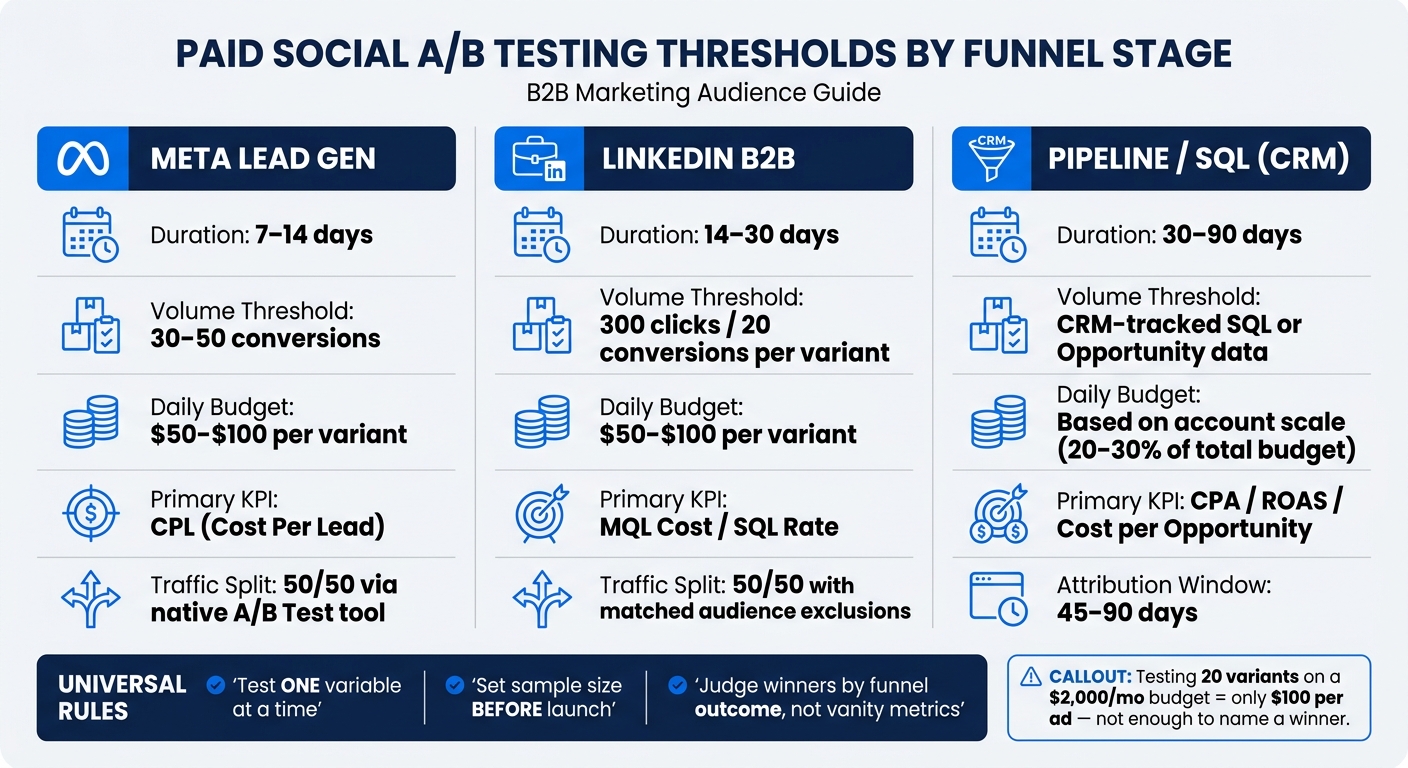
Paid Social A/B Testing Thresholds by Funnel Stage
After launch and tracking, give the test enough volume before you judge it. A clean setup doesn't help much if you call a winner too soon. In paid social, weak test calls usually come from three things: not enough volume, not enough budget, and not enough time.
Estimate sample size from baseline performance data
Set your sample size based on the KPI tied to that funnel stage. Start with the last 30 days of CVR and volume as your baseline. Then set your minimum detectable effect (MDE) - the smallest lift that would change a budget decision.
For B2B funnels on LinkedIn, use a higher bar for volume. A common working minimum is 300 clicks and 20 conversions per variant before you make a call. On Meta, don't optimize off fewer than 30-50 conversion events.
Tools like Evan Miller's A/B testing calculator or Optimizely's sample size estimator can help you turn baseline CVR and MDE into a clear sample target before you spend hard.
Budget each variant to reach usable volume
Set budget based on the volume you need, not just on how much you're willing to spend.
For LinkedIn or Meta lead gen tests, $50-$100 per day per variant is a common starting range. The right number still depends on CPM and target CPA. Another solid rule of thumb: put 20-30% of your total account budget into testing and keep the rest for scaling ads that have already proven themselves.
One common mistake is spreading a small budget across too many variants. If you test 20 variants on a $2,000 monthly budget, each ad gets only $100. That's enough to screen ideas. It's not enough to name a winner.
Run tests long enough to avoid false wins
Early delivery tends to bounce around, so don't read too much into the first few days. And if you're not trying to measure promo-period behavior, don't launch tests during promotions or seasonal spikes.
Use the thresholds below as stop rules.
| Funnel Stage | Recommended Duration | Volume Threshold |
|---|---|---|
| Meta lead gen | 7-14 days | 30-50 conversions |
| LinkedIn B2B | 14-30 days | 300 clicks / 20 conversions |
| Pipeline / SQL | 30-90 days | CRM-tracked SQL or Opportunity data |
Once a test clears these thresholds, compare results by funnel stage. Then move to stage-level analysis and reporting.
Analyze Results and Report What the Business Should Do Next
Once the test clears your sample and timing thresholds, make the call based on funnel outcome, not the platform number that looks best on the dashboard.
Pick winners by funnel stage, not by one vanity metric
Choose the winner based on the downstream metric that matters most at that stage.
Use:
- CTR for awareness
- CPL for lead gen
- CPA, ROAS, or cost per opportunity for pipeline tests
In B2B funnels, a weighted scorecard usually beats a single metric. A practical split is 40% cost per qualified lead, 30% SQL rate, 20% pipeline created, and 10% CTR. That helps stop a cheap-click variant from "winning" when it weakens pipeline later on.
If platform metrics and CRM results point in different directions, bring in offline conversions and compare MQL, SQL, and opportunity outcomes before scaling.
Log every test in a repeatable experiment record
Write down each test the same way every time. That way, future tests can build on what you already learned instead of starting from scratch.
Keep a shared test log with these fields for every test:
- Test name
- Platform
- Funnel stage
- Hypothesis
- Control vs. variant
- Budget ($)
- Sample size
- Result
- Final decision
This record makes it easier to compare tests across Meta, LinkedIn, and CRM outcomes. It also gives your team a reusable history for future launches.
Conclusion: Keep Tests Simple, Disciplined, and Tied to Pipeline
Good paid social testing should end with a pipeline decision - not just a platform report. The playbook is simple: test one variable at a time, write the hypothesis before launch, use a naming convention that still makes sense in reports, and report results in terms leadership cares about - pipeline, cost per opportunity, and sales acceptance rates.
Marketing Funnels Directory lists tools and vendors for funnel and RevOps setup.
FAQs
How do I choose the right funnel stage to test first?
Start with the funnel stage most likely to move your main KPI - not the stage that's simplest to test. Put your effort where it can do the most good for lead quality, conversion rate, or pipeline contribution.
In B2B, that usually means testing the parts that shape lead quality first, like forms, audience targeting, or creative hooks. Before you launch anything, make sure your measurement setup can track that stage in a dependable way.
What should I do if click-through rate improves but lead quality drops?
Do not scale the campaign.
A high CTR can look good on the surface. But a lot of clicks often just means the ad creative is making people curious. It does not mean the offer, targeting, or landing page is bringing in the right users.
Check for:
- intent mismatch between the ad and landing page
- weak lead capture that needs qualifying questions
- CRM data gaps
- reporting that puts too much weight on CTR or CPA instead of SQL rate and pipeline contribution
If traffic goes up while business outcomes get worse, it is not a winner.
How can I tell if my test has enough data to trust the result?
Trust the result only after the test reaches statistical significance - not after a few hours of data.
Most businesses use a 95% confidence level. That means there’s only a 5% chance the result came from random noise.
Let the test run for at least 1-2 weeks so you can pick up normal swings in behavior, like weekdays versus weekends. And don’t stop the test early just because one version jumps ahead at the start.
Before you lean on the result, check that your tracking setup is clean and working the way it should.