Sales teams waste time chasing leads that won't convert. AI lead scoring fixes this by analyzing over 200 data points, identifying patterns, and predicting which leads are most likely to close. Unlike manual scoring, which is static and tracks only 10–30 signals, AI models are dynamic, updating in real-time and achieving up to 92% accuracy. The result? Higher conversion rates, faster sales cycles, and reduced acquisition costs.
Key Takeaways:
- AI vs. Manual Scoring: AI evaluates 200+ signals vs. 10–30 in manual methods.
- Accuracy: AI models hit 40–92% accuracy; manual scoring lags at 15–55%.
- Efficiency Gains: AI increases conversions by 25–30% and cuts acquisition costs by 50%.
- Adoption Growth: By 2026, 75% of B2B companies will use AI for lead scoring.
AI not only boosts accuracy but also automates workflows, prioritizes high-value leads, and improves sales team focus. However, clean and enriched data is essential for success, and regular model updates ensure reliability. Ready to upgrade your lead scoring? Start with clean data, choose the right tool, and involve your team for seamless integration.
How To Get Accurate AI Lead Scoring With Imperfect Sales Data? - Sales Pro Blueprint
sbb-itb-a84ebc4
Traditional vs. AI-Powered Lead Scoring
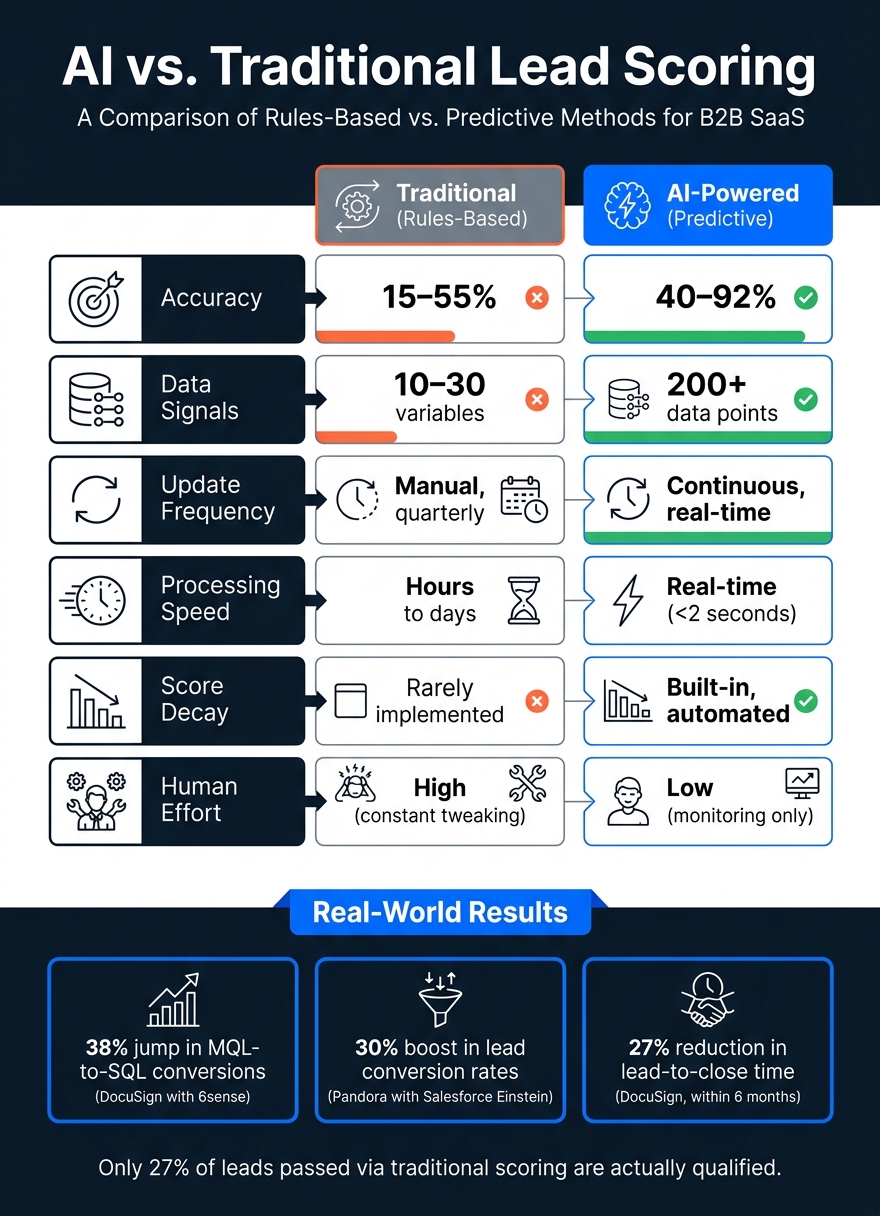
AI vs. Traditional Lead Scoring: Key Metrics Compared
How Traditional Lead Scoring Works
Traditional lead scoring relies on manually created rules. For instance, a marketing team might assign points like +10 for having a VP title, +5 for opening an email, and +15 for attending a webinar. Once a lead's total score surpasses a pre-set threshold, it gets passed along to the sales team.
The problem? These rules often stem from assumptions rather than hard data. Since this model is static, it doesn’t adapt when buyer behavior changes, requiring manual updates that can take weeks. Plus, traditional systems typically track only 10–15 variables, treating each action as a standalone event. This makes it hard to tell the difference between casual interest and genuine buying intent.
What does this mean for sales teams? Only 27% of leads passed to sales through traditional scoring methods are actually qualified. The rest? Mostly noise.
How AI Improves on Traditional Scoring
AI-powered lead scoring shifts away from guesswork by using historical data to identify patterns that predict conversions. It examines not just isolated actions but also sequences and relationships. For example, if a lead reads a blog post, then a case study, and later visits the pricing page, AI can recognize this as a strong indicator of buying intent rather than random activity.
The difference in accuracy is striking. Traditional models tend to hit 15–55% accuracy, while AI-powered models typically achieve 40–60% accuracy and can even reach 85–92% accuracy in mature setups. For example, DocuSign used predictive scoring with 6sense and historical Salesforce data in 2025, leading to a 38% jump in MQL-to-SQL conversions and a 27% reduction in lead-to-close time within six months. Similarly, Pandora saw a 30% boost in lead conversion rates with Salesforce Einstein.
AI also tackles a common issue with traditional systems: the "phantom high-scorer." In traditional models, scores can accumulate indefinitely, even if the lead hasn’t shown recent interest. AI, on the other hand, uses automated score decay, ensuring that only recent actions influence the score. This keeps scores relevant and actionable.
These improvements in accuracy not only make lead qualification more efficient but also boost overall sales performance by providing better-prepared data and seamless integration opportunities.
"A scoring system that gives your sales team the same conversion rate as random ordering is not a scoring system. It is a random number generator with a nice UI." - Kumo.ai
Here’s a quick comparison of the two approaches:
| Feature | Traditional (Rules-Based) | AI-Powered (Predictive) |
|---|---|---|
| Accuracy | 15–55% | 40–92% |
| Data signals | 10–30 variables | 200+ data points |
| Update frequency | Manual, quarterly | Continuous, automatic |
| Processing speed | Hours to days | Real-time (<2 seconds) |
| Score decay | Rarely implemented | Built-in, automated |
| Human effort | High (constant tweaking) | Low (monitoring only) |
This leap in accuracy and efficiency lays the groundwork for integrating AI scoring into your sales strategy, ensuring better results with less manual effort.
Preparing Your Data for AI Lead Scoring
Getting accurate AI lead scoring starts with clean, reliable data. Without it, even the best AI tools will fail to deliver meaningful results. As Darwin AI puts it:
"A model trained on dirty data produces dirty scores. Garbage in, garbage out, but at machine scale."
Unreliable data leads to flawed predictions. Most AI tools need at least 500 to 1,000 historical converted leads with consistent behavioral data to create a dependable model. If your CRM is cluttered with duplicates, missing information, or mislabeled outcomes, the AI will pick up on these errors and replicate them.
Auditing and Cleaning Your Existing Data
Start by pulling data from the last 12–24 months of closed deals in your CRM. Look for trends in areas like industry, company size, and job titles - this historical data forms the backbone of your AI model.
Address duplicate records by consolidating engagement histories through identity resolution. If 30–40% of your records lack key details like deal size, acquisition channel, or ICP (Ideal Customer Profile) fit, either update those fields or exclude them from the training process.
Be honest about your successes. If a deal closed but churned within 90 days, it should be tagged as a loss, not a win. Including these false positives in your training data can mislead the AI into repeating the same mistakes.
| Audit Step | Action Required | Purpose |
|---|---|---|
| Deduplication | Merge duplicate contact and account records | Ensures complete engagement history per lead |
| Outcome Tagging | Label deals as genuine win, loss, or churned deals | Avoids training on "false wins" |
| Field Validation | Verify email syntax and phone number connectivity | Filters out undeliverable leads |
| Temporal Audit | Separate pre- and post-submission behaviors | Prevents data leakage in training |
Once your data is clean, the next step is to standardize and enrich it.
Enriching and Standardizing Data Formats
After cleaning, focus on standardizing and enriching your data. AI models need consistency to identify patterns. For example, entries like "VP Sales", "VP of Sales", and "Vice President, Sales" should all be standardized to avoid confusion.
For fields with many unique values, such as ZIP codes, industries, or traffic sources, consistent encoding helps the model group similar data accurately. Beyond formatting, enrich your data in three key areas: firmographics (who they are), technographics (the tools they use), and behavioral intent (what they’re actively researching). A lead that aligns with your ICP, uses complementary technology, and shows active interest in your solution is far more promising than one that only matches a job title.
Keep in mind that B2B contact data degrades at a rate of about 2.1% per month, or roughly 22.5% annually. If your CRM hasn’t been updated in over a year, nearly a quarter of your data could be outdated. Companies that prioritize data enrichment report 25% higher conversion rates and a 15% reduction in customer acquisition costs.
The process is simple: clean your data first, enrich it second, and score it third. Following this order ensures your AI lead scoring system delivers reliable and actionable insights.
How to Implement AI Lead Scoring
With your data cleaned and enriched, you're ready to roll out an AI lead scoring system. This involves three key steps: picking the right tool, configuring the model, and feeding it actionable signals. These steps will help integrate AI into your sales process smoothly and effectively.
Choosing the Right AI Lead Scoring Tools
Start by selecting a tool that aligns with your sales process and go-to-market strategy. Your choice should reflect how your team operates and what you aim to achieve.
For product-led growth (PLG) and SaaS companies, MadKudu (around $999/month) is a solid option. It analyzes product usage signals and provides clear explanations, showing sales reps exactly which signals influenced a lead's score. If your team relies heavily on inbound leads and uses HubSpot, HubSpot Predictive Scoring is worth considering, though it requires the Enterprise plan (starting at $3,600/month for 10 seats). For enterprise teams focused on account-based marketing (ABM), tools like 6sense or Demandbase are popular. They excel at uncovering anonymous "dark funnel" intent, with pricing starting around $60,000 per year. Salesforce users might look at Salesforce Einstein, which offers deep CRM integration and account-level scoring (Enterprise plan at $165/user/month, plus about $50/user/month for the AI add-on).
When evaluating tools, focus on two key factors:
- Explainability: Avoid black-box models. Your team needs to understand why a lead received a certain score - whether it was due to a pricing page visit, job title, or another factor.
- Actionability: A score is meaningless unless it triggers automated workflows. Ensure the tool integrates with your CRM to enable lead routing, Slack notifications, or nurture campaigns.
"The score is not the system. The action triggered by the score is the system." - The SaaS Library
Configuring Your Predictive Scoring Model
Once you've chosen a tool, it's time to configure your model. Start by aligning your sales and marketing teams on your Ideal Customer Profile (ICP) and defining what qualifies as a Sales Qualified Lead (SQL). Conduct a workshop to get everyone on the same page, and document these definitions to avoid confusion later. Setting the SQL bar too low will overwhelm sales with weak leads, while setting it too high can starve the pipeline.
Next, train the model using data from your audited closed-won and closed-lost deals. Let the AI identify patterns and correlations instead of relying solely on gut instincts. Use this weighting framework to guide your setup:
| Signal Type | Recommended Weight | Example Signals |
|---|---|---|
| Behavioral | 35–50% | Pricing page visits, demo requests, email clicks |
| Firmographic | 20–30% | Job title, company size, industry |
| Intent | 10–30% | G2/Capterra views, third-party research |
| Negative (deductions) | Applied as subtractions | Competitor domains, unsubscribes, inactivity |
Incorporate negative scoring by subtracting points for disqualifiers like competitor email domains or irrelevant job titles (e.g., "student" or "intern"). Apply a decay of 50% to scores after 30 days of inactivity, ensuring your sales team focuses on active leads.
Adding Behavioral and Intent Data
Static fit scores alone won’t cut it. To make your system dynamic, layer in real-time signals:
- Firmographic data: Who is the lead?
- Behavioral data: What actions are they taking?
- Intent data: What are they researching?
Integrating these signals into your predictive model will enhance the accuracy of your lead scoring. Assign values based on the significance of each action: demo requests might score 40–50 points, pricing page visits 20–30, and top-of-funnel actions just 1–4 points. For B2B teams, aggregate signals at the account level - multiple engagements from the same company often indicate a strong buying committee.
Get your sales reps involved in refining the scoring process. Ask them to review the last 20 closed deals and identify common patterns that preceded a sale. Their insights can be more reliable than a pre-set vendor template. As Warmly.ai explains:
"The teams getting the most value from AI scoring are the ones who treated data quality as the product, not the tool configuration." - Warmly.ai
Before fully deploying the model, run it in shadow mode for one full sales cycle (typically 60 to 120 days). This lets you test and validate its accuracy without disrupting your current process. It also helps build trust with your sales team before the scores start driving real decisions.
Using AI Scores to Improve Sales Processes
Turn your AI scoring model into a powerful tool for driving sales by automating lead routing and tailoring follow-ups. By embedding these scores into your sales pipeline, you can boost engagement and streamline operations.
Connecting AI Scores to Your Sales Pipeline
Break AI scores into action tiers: high scores warrant immediate follow-ups, mid-range scores go into nurture campaigns, and low scores get periodic reviews. This ranking system helps sales teams prioritize leads while also tracking collective account activity. Why does this matter? In B2B sales, when one person at a company engages, others at the same company are far more likely to follow suit. In fact, companies with multiple engagements see conversion rates jump to 3–5 times the baseline. By routing leads based on these aggregated signals, sales teams can focus their efforts on the most promising accounts, maximizing their chances of success.
Automating Lead Routing and Follow-Ups
Timely follow-ups on high-intent leads can make or break a deal. Leads with strong intent convert at 53% when contacted within an hour, compared to just 17% after a 24-hour delay. To stay ahead, implement automated routing rules that activate once a lead hits a specific score. For example, if a lead’s score surpasses 80, the system can instantly assign it to an Account Executive, send out notifications, and launch a personalized email sequence - all without any manual input.
A real-world example? SurveyMonkey (now Momentive) used HubSpot's predictive lead scoring in 2023 to automatically route high-fit trial signups to Account Executives for direct outreach. Lower-scored leads stayed in automated nurture tracks. To ensure fast action, establish a Sales-Marketing SLA that requires leads above a certain score threshold to be assigned to reps within five minutes. This approach ensures no high-value opportunity slips through the cracks.
Using AI Scores for Forecasting and Reporting
AI scores don’t just improve lead management - they also bring precision to revenue forecasting. Instead of relying solely on deal stages, AI incorporates behavioral and firmographic data to assign specific probabilities to each deal. For instance, a lead might have a 68% likelihood to close based on factors like pricing page visits, company size, and past engagement.
DocuSign provides a compelling example of this in action. By using predictive scoring with 6sense and historical Salesforce data, they achieved a 38% boost in MQL-to-SQL conversions and shortened their lead-to-close time by 27% in just six months. To further refine pipeline management, segment your reporting by fit (how well the lead matches your ICP) and intent (behavioral signals). This way, you can differentiate between leads ready to buy now and those with long-term potential. Together, these insights empower sales teams to act decisively while improving strategic planning.
"The team that reviews scoring performance every week and adjusts in real time will outperform the team with the fancier AI model that checks in once a quarter." - Saleslabelconsulting
Monitoring and Maintaining Your AI Scoring Model
AI models can lose effectiveness over time as buyer behaviors change. Your Ideal Customer Profile (ICP) evolves, and outdated signals can mislead your sales team, damaging trust. To keep your lead scoring effective, it's crucial to monitor performance and maintain both model accuracy and user confidence.
Tracking Key Performance Metrics
A well-functioning model should show a clear pattern: conversion rates should increase progressively from the lowest scoring band (0–25) to the highest (76–100). If lower-scoring leads start converting more often than higher-scoring ones, something is off.
Another critical metric is the false positive rate - the percentage of high-scored leads that don’t convert. Aim to keep this under 35%. Additionally, if over 10% of your closed-won deals are coming from low-scored leads, your model might have blind spots.
Time-to-convert is another key factor. High-scoring leads should not only convert more often but also close faster. Data shows that leads scoring 85+ close at 42% higher average deal values compared to mid-tier leads (60–70).
Striving for 100% accuracy isn’t necessary and can even be counterproductive. Maintaining an error rate of 15–20% ensures a healthy balance between lead volume and precision. If you notice deviations in these metrics, it’s time to retrain your model.
Retraining Models When Performance Drops
AI models naturally degrade over time, so regular evaluations are essential to keep things running smoothly. A good practice is conducting a quarterly regression analysis. Every 90 days, analyze your closed-won and closed-lost deals. Compare their qualification scores with the actual outcomes.
If the correlation between scores and conversions weakens - top-performing models typically maintain an r-value above 0.65 - it’s time to retrain. Use the latest 3–6 months of sales data to update your model. Regrade leads based on real-world outcomes and test the updated model using a champion vs. challenger approach. Route 80% of leads through your current model and 20% through the updated one to validate improvements before rolling it out fully. This iterative process ensures your scoring system stays aligned with evolving sales patterns.
"The most optimal path to drive and maximize revenues would have been if you waited your lead flow in said fashion... it basically had just curated this incredible adjustment that would've meant several hundred thousand to us just in a single quarter." - Craig Daly
Getting Sales and Marketing Teams to Trust AI Scores
Even the most accurate model won’t deliver results if your team doesn’t trust it. Currently, sales reps ignore about 50% of marketing leads, often due to past experiences with unreliable scoring. Building trust requires clear communication and collaboration.
One way to rebuild confidence is by adding an explainability field in your CRM. Instead of just showing a score like 84, include a plain-English explanation, such as: "Score increased due to 3 pricing page visits and company size match." As The SaaS Library highlights:
"A score reps cannot explain is a score reps will not trust. Explainability beats accuracy for pipeline impact."
Additionally, involve your sales team through 30-minute signal workshops. Work with your top reps to review the last 20 closed-won deals and identify the behavioral signals they observed before each deal progressed. When sales reps help define what success looks like, they’re more likely to trust and act on the model’s scores.
Pair these efforts with monthly calibration sessions where sales and marketing teams review recent scores against actual outcomes. This collaborative approach bridges the gap between the model’s predictions and the team’s real-world experience, fostering both trust and alignment.
Conclusion
AI lead scoring is changing the game for sales and marketing teams. While traditional rules-based models hover at 15–25% accuracy, AI-powered systems deliver a much stronger performance, consistently achieving 40–60% accuracy. This improvement means less time wasted on cold leads, quicker pipeline progress through insight selling, and stronger revenue growth.
Businesses leveraging AI-supported scoring report a 38% increase in conversion rates and save about 4.8 hours per week per sales rep by cutting down on unproductive lead pursuits. These numbers highlight the importance of having a solid data infrastructure in place.
However, technology alone isn't a magic fix. AI works best when paired with strong foundations, including clear sales-marketing collaboration and regular model retraining. As Lead-Scorer explains:
"AI does not fix broken GTM foundations. It is an execution multiplier. That means it rewards strong foundations and exposes weak ones."
To maintain success, teams need reliable data, consistent feedback loops, and frequent updates to their AI models. If you're looking to refine your AI-driven marketing approach, the Marketing Funnels Directory is a great resource. It offers a curated list of tools, vendors, and courses designed to help you optimize B2B pipelines and manage leads with AI.
FAQs
What data do I need before using AI lead scoring?
To make AI lead scoring work well, you need a solid foundation of clean, historical data - ideally from at least 500 leads, divided between closed-won and closed-lost outcomes. Here’s the type of data you’ll need:
- Firmographic/Demographic data: Information such as company size, industry, revenue, and job roles.
- Behavioral data: Insights from activity logs, like website page visits, email interactions, or product usage patterns.
- Intent data: Signals from third-party sources that show market interest or buying intent.
For the best results, make sure this data is unified and organized in your CRM. This ensures the AI has a complete and accurate picture to work with.
How can I tell if my AI scores are actually working?
To see if your AI lead scoring is working well, start by analyzing the relationship between lead scores and outcomes. One way to do this is by grouping leads into score ranges (like 0–25, 26–50, and so on) and comparing their conversion rates. A good lead scoring model will show that higher scores consistently lead to higher conversion rates.
Another important step is calculating the correlation coefficient, also known as the r-value. If your model has an r-value above 0.65, it's generally a sign that it's performing well. In practice, high scores should closely match with "closed-won" leads, while low scores should align with disqualified leads. This alignment confirms that your scoring system is accurately prioritizing leads based on their likelihood to convert.
How do I get sales reps to trust and use AI scores?
To create confidence in AI-generated lead scores, it's important to include sales reps in the process of defining what makes a lead valuable. Work with them to pinpoint the key behaviors and firmographic details that signal a strong lead. Clarity matters - make sure to explain why a lead received a high score, whether it's due to specific actions, job roles, or other factors. Regularly evaluate results, adjust the scoring model based on successful deals, and collect feedback on any false positives to refine the system and increase its reliability.