If I wanted the short answer, I’d say this: the highest-paying affiliate platform in 2026 is not always the one with the biggest listed commission. What matters is what you keep after attribution loss, refunds, payout delays, and traffic limits.
Here’s the simple breakdown:
- I’d look at 5 payout types first: one-time %, flat bounties, recurring pay, tiered deals, and hybrid deals
- I’d check cookie length and attribution rules before commission rate
- I’d split platforms into networks like impact.com, Awin, CJ Affiliate, ShareASale, Rakuten, FlexOffers, Partnerize, and Webgains
- Then I’d compare them with direct or focused programs like PartnerStack, Avangate, ClickBank, Digistore24, Amazon Associates, Semrush, and HubSpot
- I’d match each one to my traffic model: content sites, media buyers, or funnel owners
The 15 platforms covered here are:
- impact.com
- PartnerStack
- Awin
- CJ Affiliate
- Rakuten Advertising
- ShareASale
- FlexOffers
- Partnerize
- Webgains
- Avangate Affiliate Network
- ClickBank
- Digistore24
- Amazon Associates
- Semrush Affiliate Program
- HubSpot Affiliate Program
My main takeaway: if you run B2B or SaaS traffic, I’d look first at PartnerStack, HubSpot, and impact.com. If I ran review content, I’d start with Awin, CJ, ShareASale, and Amazon Associates. If I bought traffic or ran funnels, I’d check ClickBank, Digistore24, FlexOffers, and impact.com. You can also explore free sales funnel tools to lower your overhead.
Highest Paying Affiliate Programs in 2026: The Ultimate List
sbb-itb-a84ebc4
Quick Comparison
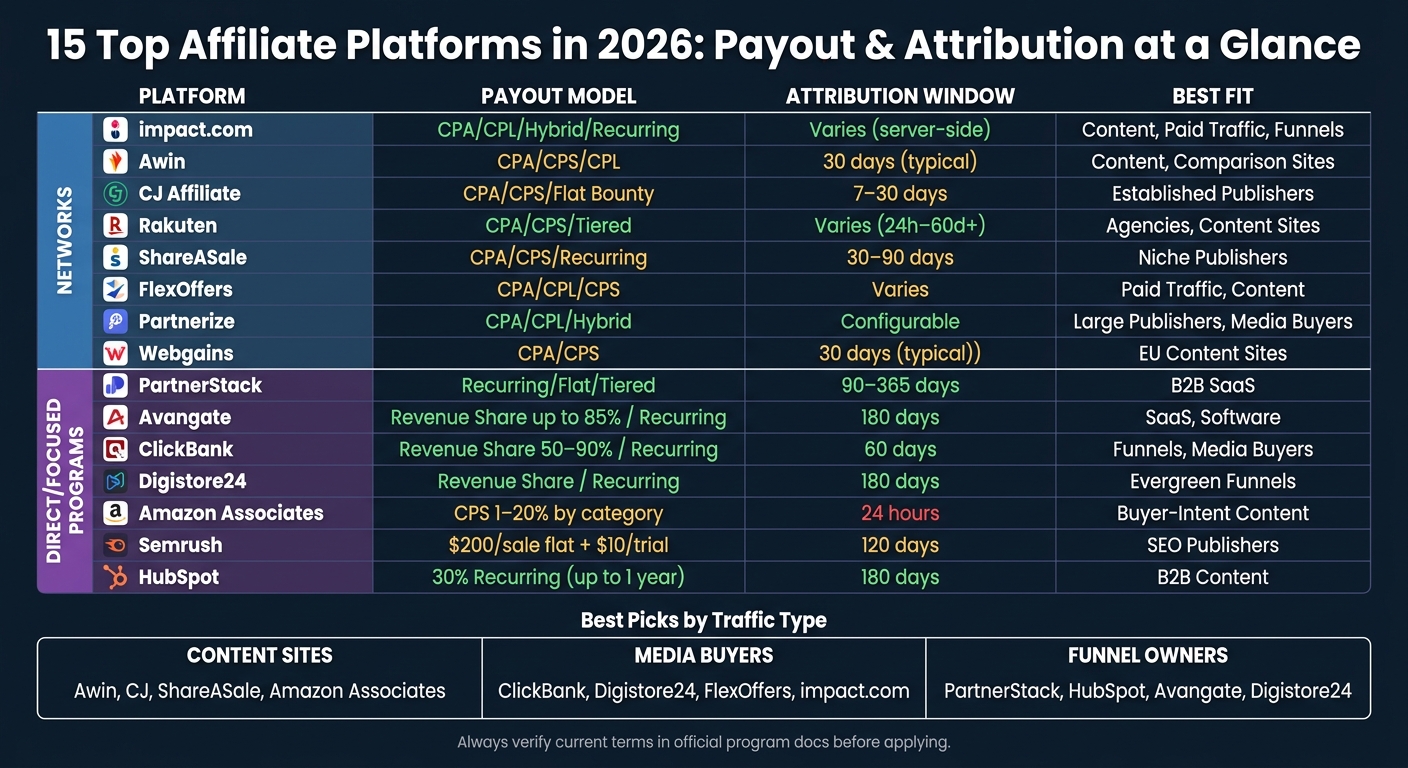
15 High-Paying Affiliate Platforms Compared: Payout, Attribution & Best Fit (2026)
| Platform | Main pay setup | Attribution window | Best match |
|---|---|---|---|
| impact.com | CPA, CPL, hybrid, recurring | Varies by advertiser | Content, paid traffic, funnels |
| PartnerStack | Recurring, flat, tiered | Usually 90 days | B2B SaaS affiliates |
| Awin | CPA, CPS, CPL | Usually 30 days | Content, comparison sites |
| CJ Affiliate | CPA, CPS, flat bounty | 7 to 30 days | Established publishers |
| Rakuten Advertising | CPA, CPS, tiered | Varies | Agencies, content sites |
| ShareASale | CPA, CPS, recurring | Usually 30 days | Niche publishers |
| FlexOffers | CPA, CPL, CPS | Varies | Paid traffic, content |
| Partnerize | CPA, CPL, hybrid | Varies | Larger publishers |
| Webgains | CPA, CPS | Usually 30 days | EU-focused publishers |
| Avangate Affiliate Network | Revenue share, recurring | 180 days | Software and SaaS |
| ClickBank | Revenue share, recurring | 60 days | Funnels, paid traffic |
| Digistore24 | Revenue share, recurring | 180 days | Evergreen funnels |
| Amazon Associates | CPS | 24 hours | Buyer-intent content |
| Semrush Affiliate Program | $200 per sale, $10 per trial | 120 days | SEO publishers |
| HubSpot Affiliate Program | 30% recurring for up to 1 year | 180 days | B2B content |
A simple rule I’d use: pick the platform that fits your traffic, build a profitable online business using the right model, and ensure it credits your sale well - not the one with the flashiest headline rate.
What High-Paying Actually Means in 2026
“High-paying” can mean a few different things in 2026 because affiliate platforms don’t all pay the same way.
The platforms on this list use five main payout models: one-time percentage commissions, flat bounties, recurring commissions, tiered payouts, and hybrid deals that combine more than one model. Each one changes the numbers in its own way. Those are the filters used in the list below.
Recurring commissions can beat bigger one-time payouts over time because they keep paying as long as the customer stays active.
Cookie length still matters. But attribution matters more. In a last-click setup, a closer partner can still take credit for the sale. Consent denial, cookie clearing, and weak tracking can also cut into your credit. That’s why stronger platforms use server-side tracking. In B2B and SaaS, many programs also rely on event-based tracking instead of basic cookie drops.
Before you label an offer high-paying, check a few things first:
- Commission model
- Attribution model
- Fraud rules
- Cross-device tracking
Fraud controls and consent rules help protect attribution accuracy. Use those checks when you read the comparison table below.
Quick Comparison Table
This table boils things down to the details that matter most in 2026: how you get paid, how long attribution lasts, what it takes to get approved, and what marketing funnel software each platform suits best.
| Platform | Payout Model | Cookie/Attribution Window | Approval/Traffic Limits | Best Fit |
|---|---|---|---|---|
| impact.com | CPA, CPL, hybrid, recurring | Varies by advertiser; server-side tracking available | Application required; advertiser-level approval | Media buyers, content sites, funnel owners |
| PartnerStack | Recurring, flat bounty, tiered | 90 days (default); event-based for SaaS | Invite or application; B2B/SaaS focus | Content sites, SaaS affiliates |
| Awin | CPA, CPS, CPL | 30 days (typical); varies by advertiser | $5 deposit; advertiser approval required | Content sites, coupon, loyalty |
| CJ Affiliate | CPA, CPS, flat bounty | 7-30 days (varies by advertiser) | Application + traffic review; quality standards enforced | Content sites, media buyers |
| Rakuten Advertising | CPA, CPS, tiered | Varies by advertiser | Selective; managed relationships preferred | Established content sites, agencies |
| ShareASale | CPA, CPS, recurring | 30 days (default); varies by merchant | Open network; merchant-level approval | Content sites, niche publishers |
| FlexOffers | CPA, CPL, CPS | Varies by advertiser | Application required; some offers restricted by traffic source | Media buyers, content sites |
| Partnerize | CPA, CPL, hybrid | Configurable; server-side tracking available | Enterprise-focused; managed onboarding | Media buyers, large publishers |
| Webgains | CPA, CPS | 30 days (typical) | Application required; advertiser approval | Content sites, European publishers |
| Avangate Affiliate Network | Revenue share (up to 85%), recurring | 180 days | Open application; software/digital focus | Content sites, SaaS affiliates |
| ClickBank | Revenue share (up to 75%), recurring | 60 days | Open marketplace; no traffic pre-approval | Media buyers, funnel owners |
| Digistore24 | Revenue share, recurring | 180 days | Open registration; digital/info products | Funnel owners, media buyers |
| Amazon Associates | CPS (1%-20% by category) | 24 hours (session-based) | Open; requires qualifying sales within 180 days | Content sites |
| Semrush Affiliate Program | $200 flat bounty per sale; $10 per trial | 120 days | Open via Impact; content and SEO focus | Content sites, SEO publishers |
| HubSpot Affiliate Program | 30% recurring (up to 1 year) | 180 days | Open application; content quality reviewed | Content sites, funnel owners |
How to Read Each Platform Entry
Each entry follows the same format: commission model, attribution window, niche fit, approval rules, and traffic limits. Keep that order for every platform entry below.
Read each one through the lens of your traffic model. If you run a content site, focus on attribution windows and niche fit. If you buy media, focus on approval rules and traffic limits. If you run funnels for digital products, focus on attribution logic and payout model. Your traffic type shapes actual earnings more than how easy a platform is to use.
Check the official program terms before you publish or buy traffic. Commission rates, cookie durations, and traffic restrictions can change. So use the official docs as your final check.
Pay close attention to geographic restrictions. Some programs limit payouts or traffic by country. That can change conversion economics and actual payout potential fast, especially if you're running paid campaigns or reaching people outside the U.S. It matters most when you're comparing offers across countries or sending paid traffic.
Use these entries to narrow your list, then confirm the final terms in the program docs. The platform entries below follow that same checklist.
1. impact.com
impact.com is a partnership platform where each advertiser sets its own payout, attribution, and approval rules. That means earnings can swing a lot from one program to the next. But it also means the upside can be higher than what you usually get on fixed-rate networks.
Commission Model
Start with the payout setup, because that's where impact.com differs from simpler affiliate platforms. Advertisers can use CPA, CPL, or hybrid payouts. The platform's contracting system also lets brands go beyond standard last-click setups and use more performance-based deal terms.
Cookie or Attribution Window
Attribution windows are set by each advertiser, so they can vary a lot across programs. impact.com also supports multi-touch attribution, which means more than one partner can get credit instead of giving all the credit to the last click.
Approval and Traffic Restrictions
Approval is handled at the advertiser level. Traffic is also screened for fraud with AI fraud screening that flags suspicious activity in real time. On top of that, tracking needs to follow privacy and consent rules.
Best Fit by Business Model
This setup works best when your traffic source lines up with the advertiser's payout model. impact.com is a good fit for content publishers, influencers, and performance marketers going after midmarket and enterprise brands. Media buyers and funnel owners can also do well here, especially when an advertiser offers CPL or hybrid payouts.
2. PartnerStack
PartnerStack is built for B2B SaaS. That matters because B2B deals often take longer to close, and recurring commissions can add up over time. In that setup, PartnerStack can beat one-time bounty programs, especially when the sales cycle stretches out and lifetime value is higher.
Commission Model
Most PartnerStack programs pay a recurring revenue share, though the exact terms depend on the merchant.
Cookie or Attribution Window
Most programs use a 90-day window, and some stretch that to 180 days or even 1 year. It also supports lead-to-deal attribution, which connects trial signups and lead forms back to the affiliate. That's a better match for longer buying cycles, where one cookie drop often misses the full path to conversion.
Approval and Traffic Restrictions
Approval depends on the merchant. In most cases, you'll need a B2B site, relevant social proof, or an established agency or consultancy.
Best Fit by Business Model
PartnerStack works best for B2B content sites, agencies, consultancies, and funnel owners sending trial or lead-gen traffic. That traffic tends to do best when your funnel can capture leads and keep them warm before the sale closes.
3. Awin
Unlike PartnerStack, which leans toward SaaS, Awin is a broader affiliate network. The key thing to know is simple: terms are set at the merchant level. So your earnings, payout setup, and attribution rules can change from one program to the next.
Commission Model
Commission rates vary by merchant. In plain English, there isn't one standard rate across Awin. One brand may pay well, while another may be much tighter. That same variation can shape how attribution works too.
Cookie or Attribution Window
Cookie windows also vary by merchant. Awin uses last-click attribution by default, though some programs allow commission sharing. That means the rules can shift depending on the offer you're promoting.
Approval and Traffic Restrictions
Awin usually asks for a small refundable deposit and a manual review of your site or social profile. The review looks at quality and relevance, so publisher quality matters more here than simple platform access.
Best Fit by Business Model
Awin is a strong fit for content sites and comparison publishers. Media buyers and marketing funnel owners can still use it, but they need to check each merchant's rules before putting more spend behind a campaign.
4. CJ Affiliate
CJ is a more selective, brand-focused network that tends to work best for established publishers. It sits in the middle ground between broad affiliate networks and direct merchant relationships - stricter than Awin, but often a better option if you want to work with well-known brands.
Commission Model
CJ doesn't use one network-wide commission rate. Each merchant sets its own terms, which can include CPS, CPA, lead-based payouts, or recurring commissions. In practice, payouts often fall in the 3% to 15% range, depending on the category. The minimum payout threshold is $50, and payments are usually sent by ACH direct deposit.
Cookie or Attribution Window
CJ uses merchant-set attribution windows. It also supports cookieless tracking and device fingerprinting, which helps preserve attribution as browser privacy rules limit older tracking methods.
Approval and Traffic Restrictions
CJ requires approval at two levels: first from the network, then from each merchant you want to join. Publishers need an active site and an audience that lines up with the merchant's offer. Inactive accounts can be deactivated.
That added screening makes CJ a better fit for publishers that can show solid traffic quality.
Best Fit by Business Model
CJ is best for established content sites that can meet tighter approval standards and want access to major brand programs. Funnel owners may also find it useful because CJ provides real-time metrics, including historical EPC data, so it's easier to compare offers before building campaigns.
5. Rakuten Advertising
Compared with CJ, Rakuten is less network-wide and more advertiser-led. In plain English, the merchant sets the rules more directly, so terms can change a lot from one program to the next.
Commission Model
Commission rates vary by advertiser. Rakuten's Dynamic Commissioning lets advertisers change payouts based on the action, product, or partner involved. So instead of one flat rule, a merchant might pay different rates for a sale, a lead, or a certain product category. That means the payout logic matters just as much as the headline commission rate.
Cookie or Attribution Window
Most advertisers use a 30-day window. Some go as short as 24 hours, while others run 60+ days.
Approval and Traffic Restrictions
Approval rules and traffic restrictions depend on the advertiser, so check each program before you promote it. Rakuten also uses AI-driven fraud prevention to spot suspicious activity in real time. Before launch, review each merchant's paid-traffic and geo rules. Paid traffic only works when the merchant clearly allows it.
Best Fit by Business Model
Rakuten is a good fit for content publishers and established partners that use flexible traffic and placement models, especially if they can verify paid-traffic rules before sending paid traffic.
6. ShareASale
ShareASale is less selective than some of the networks above. That said, the strongest payouts still tend to come from niche SaaS and B2B merchants. It runs on a merchant-led model, so what you earn depends on the merchant you choose.
Commission Model
The top payouts are mostly found in SaaS and B2B offers.
Cookie or Attribution Window
Most merchants use 30- to 90-day cookie windows. In most cases, merchants also use last-click attribution, which means the final click gets the credit.
Approval and Traffic Restrictions
Each merchant sets its own approval rules. Check the allowed traffic sources for every merchant - especially paid search, coupon, and email - so you know whether the higher-paying offers will actually work with your traffic mix.
Best Fit by Business Model
ShareASale fits publishers that can line up niche content with the right merchant offers. FlexOffers is next, and it uses a similar merchant-by-merchant setup with broader traffic coverage.
7. FlexOffers
FlexOffers is the broader, mixed-vertical follow-up to ShareASale. It hosts more than 12,000 affiliate programs across many industries, and payout terms depend on the advertiser.
Commission Model
Advertisers on FlexOffers use CPS, CPA, and CPL. Retail and consumer goods programs often pay percentage-based commissions in the 1% to 10% range, while finance, insurance, and SaaS offers often move to flat-fee CPL or CPA payouts with higher earnings per conversion. That means offer-level vetting matters before you buy traffic.
Cookie or Attribution Window
Cookie windows and attribution rules change by advertiser. GDPR consent rules can limit cookie tracking.
Approval and Traffic Restrictions
FlexOffers is easier to access than impact.com or Partnerize, but each advertiser sets its own rules. The network uses AI-driven automation to monitor traffic in real time and flag suspicious traffic.
Best Fit by Business Model
FlexOffers works best for content publishers and media buyers who can match traffic to the right vertical. Since terms differ by program, each offer needs its own review.
8. Partnerize
Partnerize is built for the enterprise end of affiliate marketing, where deal terms are often set at the merchant level.
Commission Model
Payouts and attribution are set by each advertiser and are often negotiated.
Cookie or Attribution Window
Attribution windows depend on the advertiser.
Approval and Traffic Restrictions
Approval rules and traffic limits also depend on the advertiser, so check each merchant’s terms before you apply. Partnerize also offers real-time tracking for clicks, conversions, and revenue, which makes reporting easier to follow. Its automation tools can also flag suspicious activity.
Best Fit by Business Model
Best for content sites, media buyers, and funnel owners sending high-quality traffic under advertiser-specific terms.
9. Webgains
Webgains works like other merchant-led networks: what matters most is which program you join, not the network itself. Rates, tracking, and payout terms change from one advertiser to another. So the upside here comes from picking the right merchant, not from any fixed network-level payout.
Commission Model
Commission rates depend on the advertiser. Some programs pay CPS, while others use flat lead fees or bounties for qualified leads.
Cookie or Attribution Window
Cookie windows also depend on the advertiser. Check each program’s terms before you build content or put money behind a campaign.
Approval and Traffic Restrictions
You first apply to Webgains, then request access to each advertiser. Each merchant sets its own approval rules and traffic limits. Consent rules can also affect tracking and attribution.
Best Fit by Business Model
On Webgains, merchant fit is the main earnings driver. It tends to work well for content sites and European publishers that can line up their traffic with each merchant’s rules. If you buy media, verify source acceptance before you scale spend.
10. Avangate Affiliate Network
Avangate (2Checkout/Verifone) is built around software, SaaS, and other digital products. That matters because software often has higher margins, which can lead to stronger commission payouts.
Commission Model
Commission rates depend on the merchant. But software offers often pay more than physical-product offers because the margins are higher. The main thing to watch is net earnings after refunds and chargebacks - not just the headline commission rate.
Cookie or Attribution Window
Avangate typically offers a 120-day cookie window.
Approval and Traffic Restrictions
Rules can change from one merchant to another. Before you send traffic, check the fine print on:
- Paid search
- Brand bidding
- Coupon use
That step can save you a headache later.
Best Fit by Business Model
Avangate is a strong match for tech review sites, software comparison blogs, funnel owners, and media buyers sending high-intent traffic to SaaS and digital software offers.
For a broader digital-product marketplace, compare it with ClickBank next.
11. ClickBank
Like Avangate, ClickBank is strong for digital offers. The difference is speed. It’s built for faster offer testing and broader marketplace access.
ClickBank leans heavily toward digital products, especially software and courses. You’ll also find some high-margin health offers.
Commission Model
ClickBank pays on a RevShare basis, usually 50% to 75%. Some offers go as high as 90%.
That said, the headline commission rate doesn’t tell the full story. Refunds, chargebacks, and reversals can cut into what you keep, so it makes more sense to judge offers by net earnings, not just the top-line payout.
Cookie or Attribution Window
ClickBank uses a 60-day cookie and last-click attribution.
Approval and Traffic Restrictions
Before you send traffic, check each offer’s rules around traffic sources, claims, and geo limits. ClickBank also uses fraud controls to flag suspicious activity, especially in niches where refunds are common.
Best Fit by Business Model
ClickBank tends to work best for funnel owners and media buyers who want to test offers fast and optimize around net earnings.
It can also work well for content sites, especially when high-intent traffic lines up with the right offer. Its main edge is simple: fast testing, clear payouts, and easy offer selection.
12. Digistore24
Digistore24 is a marketplace for digital offers that runs on a reseller model. The big draw is straightforward: a long attribution window, reseller handling, and payouts for digital offers without the hassle of billing customers through the merchant yourself.
Commission Model
Digistore24 pays a vendor-set revenue share, and many offers include recurring commissions. That said, reversals can cut into net earnings, so it pays to watch refund rates and offer quality. Before you scale anything, check the traffic rules for each offer.
Cookie or Attribution Window
Digistore24 uses a 180-day cookie window with last-cookie attribution. That setup works well for evergreen content and long-tail marketing, where someone may click now and buy much later.
Approval and Traffic Restrictions
Traffic rules depend on the vendor, not the platform as a whole. Some offers are open to many traffic sources, while others are much tighter. Check the rules for each offer before you promote it.
Best Fit by Business Model
Digistore24 tends to work best for evergreen traffic when the offer margin is high enough to handle reversals. It's a solid fit for evergreen content, review sites, funnel owners, and media buyers promoting digital offers.
13. Amazon Associates
Commission Model
Amazon Associates uses a category-based CPS model. Payouts usually range from 1% to 20%, depending on the product category.
Cookie or Attribution Window
The standard cookie window is 24 hours. If a shopper adds the item to their cart during that period, attribution can extend for that same item.
Approval and Traffic Restrictions
The program has an open application process. But there’s a catch: you need to generate qualifying sales within 180 days to keep the account in good standing.
Best Fit by Business Model
Amazon is the broadest and fastest-moving option in this set. It works well when traffic is close to the buying point and ready to convert.
The tradeoff is the short attribution window, which limits upside. That setup fits quick-conversion traffic much better than long email sequences or slow decision cycles.
It’s a strong match for content sites targeting near-term purchase intent. It’s a poor fit for long consideration journeys, paid media, and nurture-heavy funnels.
14. Semrush Affiliate Program
Semrush moves this list away from broad affiliate networks and into a direct software offer. That matters because the traffic here is usually higher intent. People clicking through are often already looking at SEO or marketing tools, which changes how this offer performs. The program runs through impact.com and uses a flat-bounty setup.
Commission Model
There are no recurring commissions here. Instead, affiliates earn flat bounties for actions like paid subscriptions, free trials, or account registrations. So the upside doesn't come from a large percentage rate. It comes from sending the right kind of traffic - people who are already in research mode and close to making a decision.
Cookie or Attribution Window
Attribution is last-click through impact.com. For the cookie window, check the offer terms listed in the program, since that's where Semrush states the current timeframe.
Approval and Traffic Restrictions
The program is open to content creators who promote Semrush with tracked links. Agencies and resellers aren't part of this setup and instead use separate Semrush programs.
Best Fit by Business Model
This program fits best for SEO-focused publishers and compliant media buyers reaching users who are comparing marketing tools. It's a weaker fit for agencies and resellers. Put simply, this is a tool-intent offer, not a broad consumer play.
15. HubSpot Affiliate Program
HubSpot is a strong fit for B2B publishers speaking to people who are actively looking at CRM and marketing software.
Commission Model
HubSpot pays a 30% recurring commission for up to 1 year through Impact.
Cookie or Attribution Window
HubSpot uses a 90-day last-click cookie through Impact.
Approval and Traffic Restrictions
Approval tends to favor B2B publishers and educational content around CRM, pipeline management, and revenue attribution. HubSpot does not spell out detailed traffic restrictions here. So in practice, it works best as a direct benchmark for B2B publisher traffic, not broad consumer traffic.
Best Fit by Business Model
This program is best for B2B content publishers covering CRM and marketing software. It’s a weak match for broad consumer audiences or top-of-funnel traffic. Use HubSpot as the B2B benchmark before you compare network listings with direct merchant deals below.
Best Picks by Business Model
After comparing payout models and approval rules, this is where you match each platform to the way you get traffic. Start with your traffic source and payout model. Then use the fit below to trim the list before you check each program’s terms.
Content sites tend to do best on networks with longer attribution windows, a broad mix of merchants, and better approval odds.
Media buyers need platforms with clear paid-traffic rules, fast tracking, and low-friction approval.
Funnel owners usually do best with platforms that support recurring commissions, longer windows, and lead-to-deal attribution.
| Business Model | Key Priority |
|---|---|
| Content Sites | Longer windows, broad merchant fit |
| Media Buyers | Paid-traffic approval, fast tracking |
| Funnel Owners | Recurring payout, lead attribution |
Match the platform to your traffic model, then verify the program terms before you apply.
Network Listings vs. Direct Merchant Deals
After you compare individual platforms, the next step is simple: figure out where the better terms come from.
The network handles tracking, reporting, and payments. But the merchant - not the network - sets the payout terms.
Most merchants publish a public rate that any approved member can see. But a direct relationship can lead to private rate tiers, higher payouts, longer attribution windows, or custom terms. In 2026, the highest payouts usually come from negotiated deals, not default listings. That gap is exactly why direct relationships matter.
One thing trips people up: network approval does not mean merchant approval. Merchants still check niche fit, audience match, and traffic quality on their own.
A simple way to handle this is to use the network listing as a test run. See how the offer performs first. Then, once you have numbers, reach out to the merchant and negotiate from there.
Use data like:
- conversions
- clicks
- revenue
That gives you a stronger case when you ask for a rate bump or a longer attribution window.
Before you spend money or submit an application, check the traffic rules, attribution terms, and payout thresholds.
What to Check Before You Apply or Buy Traffic
Before you join any network or direct program, review the terms first. Use this checklist to screen the platforms above before you apply or put money into traffic.
Start with the payout trigger. You need to know exactly what causes a commission - a click, a lead form, or a completed sale. Then confirm that setup in the dashboard, not just on the promo page.
Check new-customer restrictions. A lot of high-paying programs only pay for new customers. If someone buys again, you may get nothing.
Beyond payout terms, most costly mistakes come from attribution and traffic rules. Check whether the program uses first-click or last-click credit, what can overwrite your referral, and whether cross-device tracking works. If the merchant runs retargeting or brand-search ads, your referral credit can disappear before the sale closes.
| What to Verify | Why It Matters |
|---|---|
| Payout trigger (click, lead, sale) | Defines what triggers your commission |
| New-customer restriction | May exclude repeat buyers |
| First-click vs. last-click credit | Determines who gets credit for the sale |
| Cookie overwrite policy | Retargeting or brand search can replace your referral |
| Cross-device tracking | Mobile-to-desktop journeys may not be tracked |
| Payment timing (Net-30, Net-60) | Affects cash flow on paid campaigns |
| Minimum payout threshold (USD) | Delays payment until you hit the floor |
| Paid search, social, email, coupon, and brand-bidding rules | Violations can get your account terminated |
| Geographic eligibility | Some programs only pay on U.S.-based conversions |
| Fraud controls | Suspicious transactions and invalid leads may be excluded |
Check channel rules before launch. Brand bidding and geo limits can shut you out fast.
Final Takeaway
After looking at payout models and attribution windows, the last filter is net earnings - what actually hits your account after clawbacks and missed attribution.
Content sites, media buyers, and funnel owners don’t play the same game. Each one needs different attribution and traffic rules. That makes fit matter more than the headline rate.
Before you commit, audit attribution, payout triggers, and traffic rules. A lower rate with reliable credit usually beats a higher rate that leaks conversions.
The best platform is the one that credits the right sale and fits how you send traffic.
FAQs
How do I choose the right affiliate platform for my traffic?
Choose an affiliate platform that fits your business stage, budget, and marketing goals.
You’ll also want to check the basics before you commit. Make sure it works with your CRM and content management system, and look for analytics plus multi-touch attribution so you can track lead quality - not just raw volume.
It also helps to put content collaboration and partner management near the top of your list. Those features can save time, cut back on back-and-forth, and keep your workflow on track.
For more guidance, you can consult the Marketing Funnels Directory.
What matters more: commission rate or attribution window?
The attribution window matters a lot more in longer B2B sales cycles, where someone may click now and convert much later. As the article notes, cookie tracking is usually 15-30 days, while many B2B programs use longer windows to line up with extended buying journeys.
If your funnel drives fast, almost immediate actions, the attribution window matters less. In that case, tracking accuracy and overall attribution matter more. Put simply, your attribution window should match your time-to-convert.
What should I check before applying or buying traffic?
Set clear goals and pin down the funnel stage you want to hit. That makes picking a pricing model much simpler: CPM for awareness, CPC for engagement, and CPA for conversions.
Before you switch bidding models, check the basics:
- Audit your click and conversion counts
- Standardize your UTM tags
- Verify currency conversions
- Wait until you have at least 30 conversions in 30 days before using automated CPA bidding
If those inputs are messy, your bidding will be messy too.