Most pages fade fast. Evergreen pages can keep pulling search traffic for 12 to 36+ months. That happens when I target stable search intent, match the right page format, keep the page updated, and send readers to the next step in the funnel using the right marketing funnel software.
Here’s the short version:
- Evergreen content compounds while news, trend, and launch posts usually spike, then drop
- Older pages often win in Google - 72.9% of first-page results are more than a year old
- New pages rarely break through fast - only 1.74% reach the top 10 in their first year
- AI Overviews now shape clicks - they show on about 58% of U.S. informational SERPs
- Pages hold rankings longer when they match intent, answer clearly, load well, and earn links over time
- Update cycles matter - high-value pages should be checked every 30 to 90 days
If I had to reduce the whole topic to one rule, it would be this: long-term traffic comes from topics people keep searching, plus pages I keep useful. That means picking repeat-problem keywords, building the page in the format Google already favors, and fixing decay before traffic slips.
A simple way to think about it:
| Content type | How traffic behaves | How long it tends to last |
|---|---|---|
| Evergreen | Slow build, then steady growth | 12 to 36+ months |
| News | Sharp spike, then drop | Days to weeks |
| Trend | Short lift, then decline | Weeks to months |
| Launch | Burst around release, then archive tail | Weeks to months |
So when I want SEO traffic that keeps coming without starting from zero each month, I put more effort into evergreen pages than time-sensitive posts.
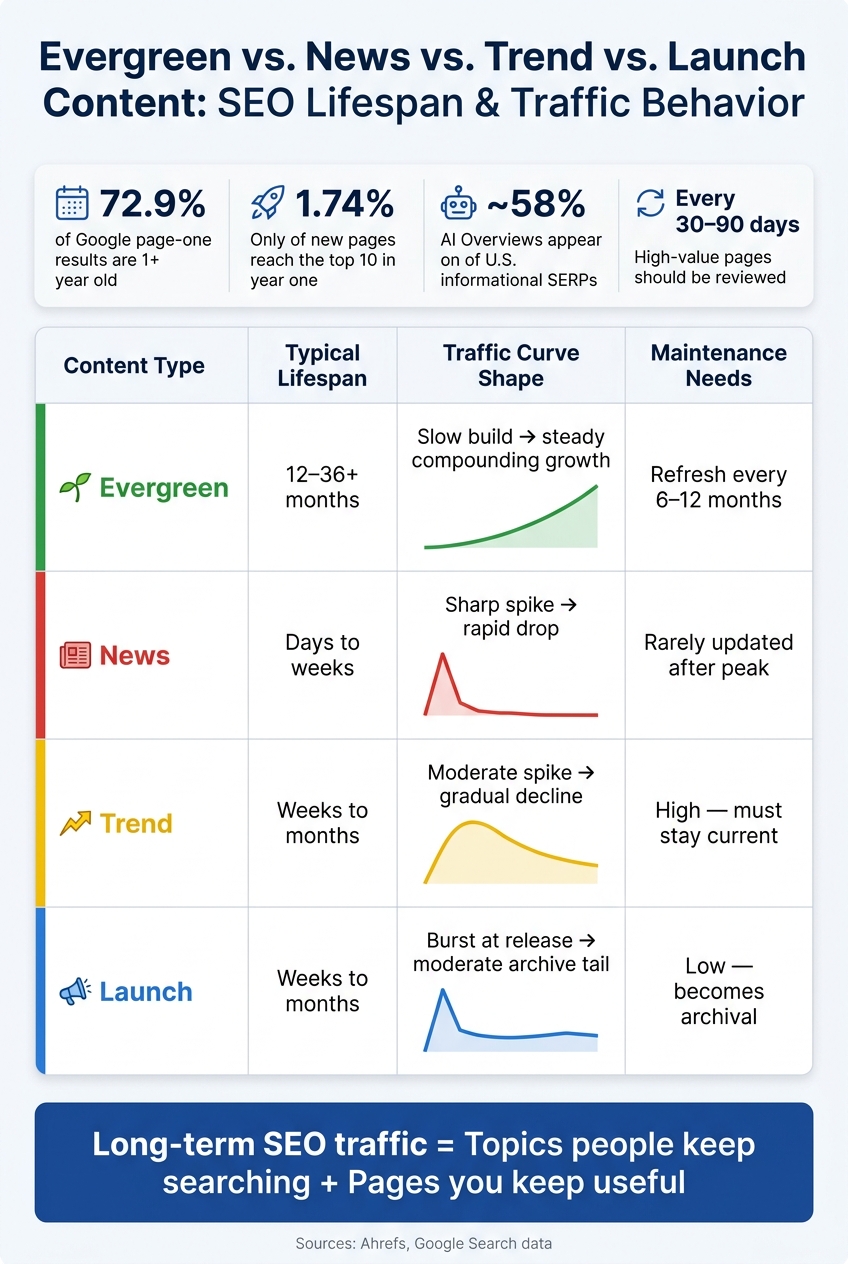
Evergreen vs. News vs. Trend vs. Launch Content: SEO Lifespan & Traffic Behavior
How to Find & Create Evergreen Content That Brings Traffic for Years
sbb-itb-a84ebc4
What Is Evergreen Content and How Does It Keep Driving Traffic Over Time?
Evergreen content covers topics that stay useful long after you hit publish. Common formats include definitions, how-to guides, process explainers, best practices, decision frameworks, and comparison or alternative pages. These pages answer questions people search for again and again, so they can keep bringing in visits over time. The next step is figuring out how long those topics stay useful.
What Makes a Topic Evergreen
A topic is evergreen when search intent stays stable over time. Definitions, how-to guides, process explainers, best practices, and decision frameworks fit that model. Comparison and alternative pages fit too, and they often pull in buyers who are already close to making a choice.
What these formats have in common is simple: they answer recurring questions buyers come back to over time. They are not tied to an announcement or the news cycle. They solve a problem that does not expire. That steady demand is why evergreen topics usually last longer than news, trend, and launch content.
Why Evergreen Traffic Compounds Instead of Spiking
Evergreen content usually does not spike overnight. Its traffic tends to build slowly and then compound. That matters because every new link and ranking gain can extend the page's traffic runway. Not every evergreen topic lasts the same amount of time, though, which makes topic life span the next call.
How Long Do Evergreen Topics Last Compared to News, Trend, and Launch Content?
Topic lifespan is the amount of time a subject stays relevant enough to rank and bring in traffic. Some topics stick around for a long time. Others fade almost as soon as they spike. The gap usually comes down to two things: how stable the search query is and whether the page can hold its rankings.
Evergreen content can bring in traffic for 12 to 36+ months when you update it from time to time to slow content decay. News pages usually peak within days or weeks. Launch pages often get a burst of attention around the announcement, then taper off and sit in the archive. Trend content tends to last for weeks or a few months before interest drops.
How to Judge Topic Lifespan Before You Publish
Start with the search results. Open an incognito window, search the target keyword, and look at the top pages. If you mostly see guides, tutorials, or best-of lists, the topic is probably evergreen. If the page is filled with news stories or social posts, the shelf life is likely short.
You can also sanity-check the topic in two fast ways. First, look at the "People Also Ask" box. If it shows recurring questions, that usually points to a topic people keep coming back to. If it leans toward timely angles, the window may be short. Second, check whether the topic is tied to a one-time event, a product announcement, or a specific date. Content built around one-time triggers tends to age out fast. Content that solves repeat problems can build traffic over time.
Evergreen vs. News vs. Trend vs. Launch Content
These formats differ in three plain ways: how long they stay useful, how traffic rises and falls, how much upkeep they need, and how they fit into marketing funnels.
| Content Type | Typical Lifespan | Traffic Curve | Maintenance Needs |
|---|---|---|---|
| Evergreen | 12–36+ months | Steady, compounding growth | Periodic refreshes every 6–12 months |
| News | Days to weeks | Sharp spike, rapid drop | Rarely updated after peak |
| Trend | Weeks to months | Moderate spike, gradual decline | High (to stay relevant to the trend) |
| Launch | Weeks to months | Initial spike with moderate tail | Low (becomes archival) |
That table tells the story pretty clearly. Evergreen pages are built for staying power. News and launch content are built for timing. Trend content sits somewhere in the middle - it can pull traffic fast, but it usually fades once the moment passes.
After lifespan comes the real question: which ranking signals keep these pages visible.
What Ranking Factors Help Evergreen Pages Hold Visibility Long Term?
Once publish date stops doing the heavy lifting, long-term rankings come down to four things: intent match, depth, authority, and technical health. So the next step is pretty direct - what signals help a page keep its spot after it starts ranking?
On-Page and Technical Signals That Support Durable Rankings
Search intent alignment sits at the center of this. If the top results for your target keyword are how-to guides, but your page is built like a product comparison, the format is out of sync with what searchers want. And when intent changes - for example, from guides to listicles - your page needs to change too. If it doesn't, rankings tend to slide.
Structure also plays a big role. A clear H1, H2, and H3 setup helps search engines and AI systems understand what the page is about. Under each H2, give a direct answer first. That simple move can help with snippet visibility and AI Overview eligibility.
On the technical side, Core Web Vitals still matter, especially LCP. Fast, usable mobile pages tend to hold up better over time. Crawl efficiency matters too. If crawl budget gets burned on thin or duplicate pages, your high-value evergreen pages may get less attention.
Once a page matches intent and loads cleanly, authority starts to matter even more.
Authority Signals: Backlinks, Internal Links, and Topical Coverage
Evergreen pages usually pick up backlinks little by little, not in one big spike. Pages with original research, proprietary data, and clear expert perspective tend to attract links over time because other writers can cite them easily.
Internal links matter just as much, and they're one of the few levers you fully control. A pillar page backed by 8-15 related cluster pages shows subject depth to search engines and passes authority across the topic. Anchor text should describe the destination page - not vague text like "click here" - so crawlers can read the relationship between pages more clearly.
The table below maps the main ranking factors to their long-term impact:
| Ranking Factor | Long-Term SEO Impact | Key Signal |
|---|---|---|
| Topical Clusters | High | Interlinked subtopics supporting a pillar page |
| Information Gain | High | Proprietary data or contrarian expert views |
| Core Web Vitals | Medium | LCP and mobile speed |
| Answer Structure | Medium | Direct answers under H2 headings |
| Schema Markup | Medium | Machine-readable FAQ, HowTo, and Product data |
E-E-A-T signals connect the rest. Named authors with verifiable credentials, firsthand experience inside the content, and citations to strong external sources all help build trust. Citing strong external sources increases AI citation rates by 30% to 40%, and about 96% of AI Overview citations come from sources with strong E-E-A-T signals. In plain English: a page that looks trustworthy from the outside - and reads like it came from someone who knows the topic firsthand - tends to last a lot longer than one that doesn't.
Even strong pages lose steam if they're left alone for too long, which is why freshness comes next.
How Often Should Evergreen Content Be Updated to Prevent Content Decay?
Content decay is the slow drop in rankings, clicks, or traffic on pages that used to perform well. It often happens when search intent changes, competitors improve their pages, or your facts get old. The page is still live, but it brings in less traffic. That’s why update cycles matter more than just hitting publish once.
Refreshing a page that’s already decaying often brings traffic back faster than creating something new. The reason is simple: the page already has links, history, and a place in search.
Refresh Cycles by Page Importance and Traffic Value
Set your review schedule based on page value.
| Page Tier | Review Interval | Typical Update Scope |
|---|---|---|
| Tier 1: High-Value (top 20 pages by traffic or revenue) | Every 30–90 days | Full intent audit, stat refresh, internal link optimization, Core Web Vitals check |
| Tier 2: Supporting Content (mid-traffic cluster pages) | Every 6 months | Update examples, check for broken links, add new "People Also Ask" questions |
| Tier 3: Stable Assets (long-tail, low-change topics) | Annually | Verify accuracy, update the year in titles/meta, refresh screenshots |
Shorter review cycles help you catch decay before rankings and clicks slide.
What to Update When a Page Decays
When a page starts to slip, start with Search Console. Look for ranking drops, lower CTR, or weaker conversion rates. Then compare the page against the current SERP. If intent has shifted, the page may no longer match what searchers want.
From there, update the parts that age fastest:
- Replace old stats
- Add current PAA answers
- Strengthen internal links
- Refresh
dateModified - Resubmit the URL in Search Console
Also check for technical drift. A new script can slow Core Web Vitals, and changes to robots.txt can slow reindexing.
Fresh updates help pages stay visible in search and AI surfaces.
How Evergreen Pages Differ from News, Trend, and Launch Content in a Marketing Funnel
Once a page starts pulling in traffic, the next question is simple: does that traffic turn into leads?
Evergreen content brings in steady search traffic across the funnel. News, trend, and launch content usually bring short spikes. For marketing teams, that gap is about more than raw traffic. It comes down to what each content type does for leads and pipeline.
Where Evergreen Content Fits Across Funnel Stages
Evergreen pages can help at every stage of the funnel, but their business impact changes based on where they sit.
| Funnel Stage | Search Intent | Evergreen Content Role | Conversion Impact |
|---|---|---|---|
| Awareness (TOFU) | Informational | "What is" guides, explainers, checklists | Builds trust |
| Consideration (MOFU) | Commercial investigation | "Best of" lists, how-to guides, use-case evaluations | Supports comparison |
| Decision (BOFU) | Transactional | "Vs" pages, alternatives, pricing guides | Drives conversion |
The big risk is drop-off after the first answer. A TOFU page might do its job, but if it doesn't send readers to MOFU and BOFU pages, people leave and compare options somewhere else.
That's why internal paths matter. A reader who lands on an explainer should have an easy next step - maybe a high-converting sales funnel, a use-case guide, or a pricing page.
BOFU evergreen pages should get priority. They tend to convert the best because they meet people closer to a buying decision.
Conclusion: What Actually Drives Long-Term Traffic
Long-term organic traffic comes from lasting search intent, strong pages, regular refreshes, and clear funnel paths.
FAQs
How do I spot an evergreen keyword?
Look for keywords with informational intent - how-to guides, definitions, and tutorials - where the main problem doesn’t go out of date. Evergreen keywords focus on questions and pain points people keep having, not news, trends, or product launch topics.
To check whether a keyword fits, look at the search results and see if Google favors guides instead of time-sensitive pages. You can also review common customer questions, then use long-tail phrases and People Also Ask results to confirm that the topic keeps showing up over time.
What are the first signs of content decay?
The first signs of content decay usually show up as drops in search rankings or organic traffic. Sometimes the page doesn’t crash - it just stalls while competitors pull ahead.
You can also spot decay when stats, examples, or product mentions start to feel dated. And when user behavior shifts, the page may no longer match what people want from that search.
Which evergreen pages should I update first?
Start with your 20 highest-traffic pages. Then look at pages that slipped in rankings over the last quarter or show performance decay. In many cases, updating existing content brings better ROI than publishing something new.
Put extra attention on pages that haven’t been refreshed in 3 or more months. Update the stats, add new examples, include recent sections, and adjust the published date to send a clear freshness signal.