If I had to cut this list down fast, I’d sort the tools by data setup first - CRM-native, warehouse-first, or ABM-led. That tells me more than a long feature checklist.
Here’s the short version:
- Adobe Marketo Measure - best for large Salesforce + Marketo teams that want deep multi-touch reporting
- Dreamdata - best for RevOps teams that want account journeys tied to warehouse data
- CaliberMind - best for Salesforce-first enterprise teams with strict reporting controls
- Demandbase One - best for ABM teams focused on account activity and intent signals
- SegmentStream - best for warehouse-led teams that want custom attribution views
- HockeyStack - best for teams that want marketing, sales, and product data in one place
- Factors.ai - best for growth-stage SaaS teams that want lower-cost account attribution
- HubSpot Marketing Hub - best for teams already running on HubSpot
- Salesforce Campaign Influence & Einstein Attribution - best for Salesforce-native reporting tied to opportunities
- 6sense Revenue AI - best for account prioritization and intent, less for touch-by-touch credit
- VisibleFlow - no verified details available
A few patterns stand out from the comparison:
- In B2B, account-level measurement usually matters more than model count
- Long sales cycles and buying committees make simple contact-level attribution weak
- Tools tied back to CRM or warehouse records help reduce gaps between influenced pipeline and closed-won revenue
- Setup time ranges from light for CRM-native tools to 1 to 3 months for enterprise setups like Marketo Measure
- Entry pricing spans from free/$399 per month on Factors.ai to $1,399 per month and up for HockeyStack, with enterprise tools often priced through sales
If you want the fastest shortlist, I’d use this rule:
- Pick HubSpot if your team lives in HubSpot
- Pick Salesforce-native tools if revenue reporting must stay inside Salesforce
- Pick Demandbase or 6sense if your motion is ABM-first
- Pick Dreamdata, SegmentStream, or HockeyStack if your team leans on warehouse or unified GTM data
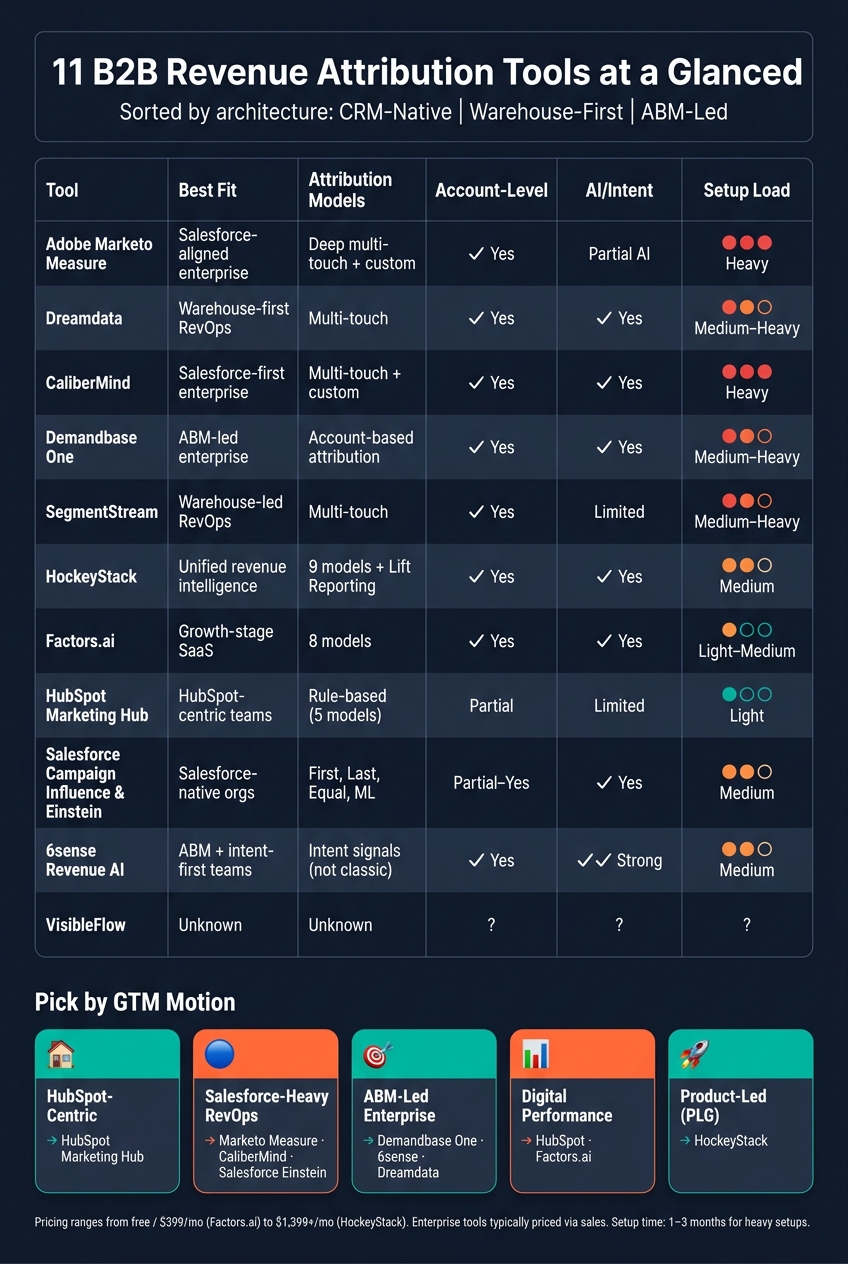
11 B2B Revenue Attribution Tools Compared by GTM Motion & Setup
How to select a B2B revenue attribution tool
sbb-itb-a84ebc4
Quick Comparison
| Tool | Best Fit | Models | Account-Level View | AI/Intent | Setup |
|---|---|---|---|---|---|
| Adobe Marketo Measure | Salesforce-aligned enterprise | Deep multi-touch + custom | Yes | Some AI support | Heavy |
| Dreamdata | Warehouse-first RevOps | Multi-touch | Yes | Yes | Medium to heavy |
| CaliberMind | Salesforce-first enterprise | Multi-touch + custom | Yes | Yes | Heavy |
| Demandbase One | ABM-led enterprise | Account-based attribution | Yes | Yes | Medium to heavy |
| SegmentStream | Warehouse-led teams | Multi-touch | Yes | Limited detail in article | Medium to heavy |
| HockeyStack | Unified revenue reporting | 9 models | Yes | Yes | Medium |
| Factors.ai | Growth-stage SaaS | 8 models | Yes | Yes | Light to medium |
| HubSpot Marketing Hub | HubSpot-centric teams | Rule-based models | Partial account rollup | Limited | Light |
| Salesforce Campaign Influence & Einstein Attribution | Salesforce-native orgs | First, last, equal, ML-based | Partial to yes | Yes | Medium |
| 6sense Revenue AI | ABM teams | Limited classic attribution | Yes | Strong intent focus | Medium |
| VisibleFlow | Unknown | Unknown | Unknown | Unknown | Unknown |
My takeaway: don’t start with features. Start with where your deal data lives, how clean your CRM is, and whether your team needs board reporting, ad optimization, or account-level buying-group visibility.
That’s the lens I’d use for the full comparison below.
1. Adobe Marketo Measure
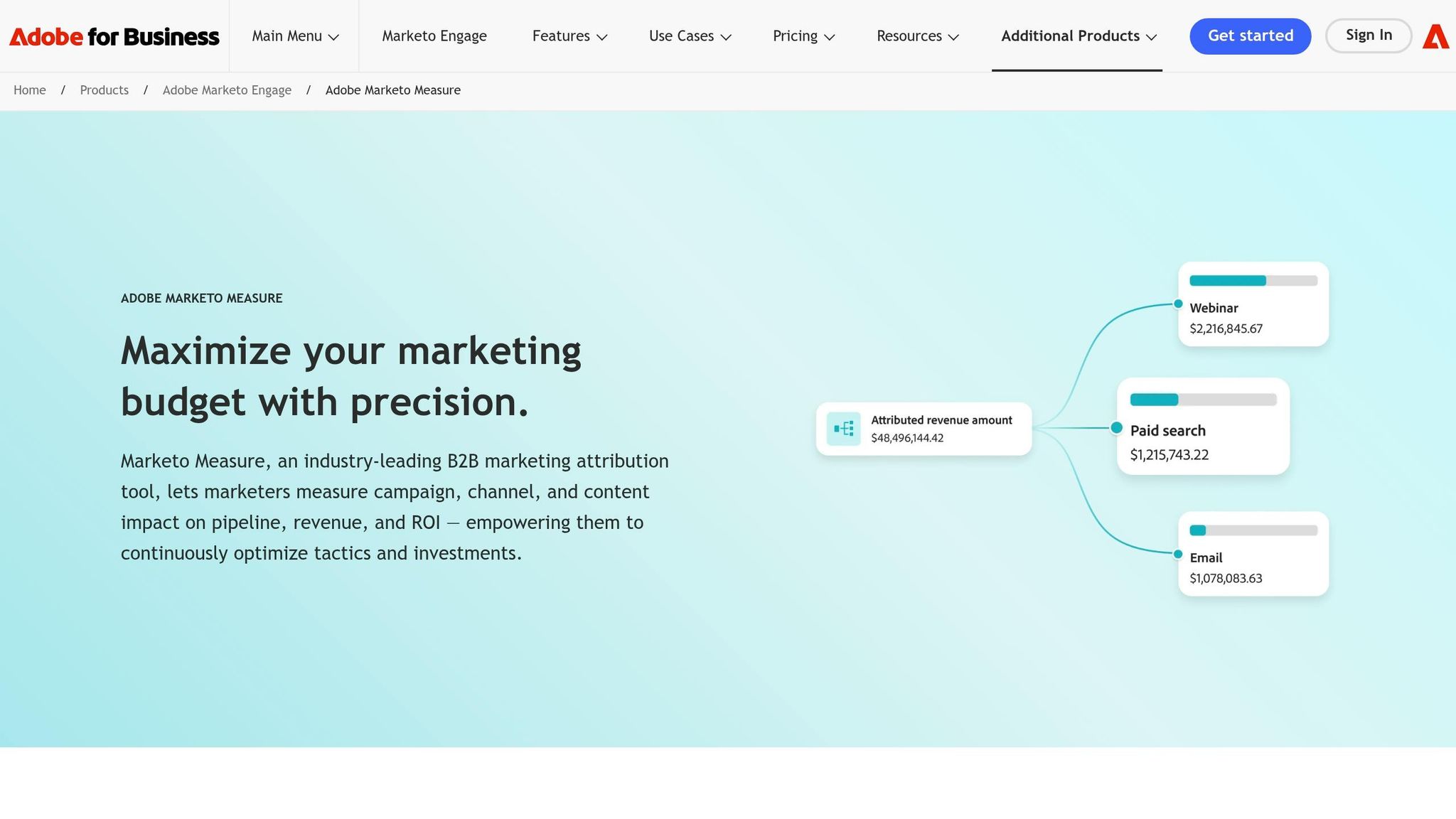
Formerly Bizible, Adobe Marketo Measure is built for complex B2B sales cycles and multi-stakeholder buying journeys. It tracks how marketing and sales touchpoints contribute across the full path to revenue. If you're sizing up attribution tools and software vendors, Marketo Measure is often the enterprise standard for deep reporting and a broad set of models.
Attribution Models
Marketo Measure supports first-touch, lead-creation, U-shaped, W-shaped, full-path, single-touch, and custom models. It also gives teams a rules engine, so you can set logic like most visits or most recent interaction instead of sticking to one fixed model.
Adobe AI can suggest model stages and weights. That can help, but the main point is simple: set the attribution window to match your actual sales cycle. If you don't, early awareness touches can get shortchanged.
Account-Level Fit
Marketo Measure works at the account level, which matters in B2B because deals usually involve buying committees, not just one person. That's a big shift from contact-only tracking.
Teams that move from single-touch to multi-touch models like these often find that up to 60% of B2B spend had been misallocated before. That's not a small reporting tweak - it can change how budget gets assigned across channels and programs.
Integrations
The platform connects natively with Salesforce and Marketo Engage, tying touchpoints directly to opportunity records and offline conversions. For teams already using those systems, that setup is a strong fit.
Implementation usually takes 1 to 3 months. So this isn't plug-and-play. It tends to work best for teams that already have clean CRM processes and are standardized on Salesforce and Marketo Engage.
Executive Reporting
Marketo Measure turns opportunity-level data into revenue reporting for pipeline and bookings reviews. In plain English, it helps teams connect marketing activity to closed deals and influenced revenue.
With clean setup and solid governance, it can become the single source of truth for revenue attribution.
Next: Dreamdata for broader journey mapping and account-level reporting.
2. Dreamdata
Where Marketo Measure tends to suit large enterprise setups, Dreamdata is often a better match for warehouse-first RevOps teams. It’s built for account-level attribution across long B2B sales cycles and maps the full customer journey - from anonymous touchpoints all the way to closed-won revenue.
Attribution Models
Dreamdata uses multi-touch attribution to follow journeys across search, social, review sites, and other early touchpoints. It can also connect anonymous activity to known members of a buying committee. On top of that, Conversion Syncing sends pipeline outcomes back to ad platforms, so campaigns can optimize for revenue instead of clicks.
B2B Account Fit and Integrations
Dreamdata is built for complex buying committees and brings marketing, sales, and pipeline data into one view. Its warehouse-first setup exports auditable pipeline data straight to BigQuery or Snowflake. That matters here because it affects both reporting depth and the amount of work needed to get the system in place.
The platform pulls data from CRM systems, ad platforms, sales touchpoints, and website activity. Its AI Signals engine reviews those sources to spot high-intent behavior and rank the accounts most likely to convert. The catch? It needs clean CRM data and a mature data stack to work well.
Executive Reporting
Dreamdata gives marketing, sales, and RevOps a shared view of what’s driving pipeline. That makes board reporting easier because the focus stays on revenue influence, not just channel metrics. Paid plans start at $750/month.
That pricing and data model make Dreamdata a strong fit when board reporting depends on auditable revenue data.
Next: CaliberMind for predictive scoring and pipeline reporting.
3. CaliberMind
If Dreamdata is a better match for warehouse-first RevOps teams, CaliberMind is a better match for Salesforce-first enterprise teams. It’s an enterprise revenue analytics platform built for teams that need custom attribution, account-level rollups, and tight governance.
Attribution Models
CaliberMind supports multi-touch, campaign, channel, and custom attribution models. That matters when leadership wants to know what influenced pipeline and revenue - not just what drove clicks.
B2B Account Fit
CaliberMind is built for mature RevOps teams with strict governance and audit needs. It rolls contact activity up into account-level reporting across the buying committee. It also includes native ABM program integration and account-based engagement tracking, which makes it a strong fit for account-based GTM motions.
This is built for enterprise use. For smaller teams or lower-ACV deals, it can be too heavy.
Integrations
CaliberMind connects with Salesforce, Marketo, HubSpot, email platforms, and data enrichment tools. It also supports full ETL pipelines and API access. Setup uses a tracking snippet along with your current Salesforce and marketing connections.
Executive Reporting
Role-based dashboards, buyer-journey views, and an AI assistant help with pipeline, bookings, and board reporting.
Next: Demandbase One for account-based targeting and intent data.
4. Demandbase One
Where CaliberMind leans into governed reporting, Demandbase adds ABM activation and intent data. Demandbase One is an ABM platform that brings together account intelligence, advertising, and sales activation to spot in-market accounts. It also uses intent data to identify those accounts early in the buying cycle.
Attribution Models
Demandbase One is built around account-level attribution. It pulls touchpoints together at the account level across buying cycles that can stretch for months. It also connects anonymous activity to parent accounts, which helps teams see dark-funnel influence that standard web analytics often miss.
B2B Account Fit
This platform is designed for account-based GTM teams. It tracks buying signals like intent data, ad engagement, and site visits, then ties those signals to account-level pipeline evidence. That matters because a lot of B2B research happens off-site and never shows up in standard tracking.
Integrations
Demandbase One connects with CRM systems like Salesforce and HubSpot, marketing automation tools like Marketo and HubSpot, and ad platforms such as LinkedIn and Google. That CRM sync keeps account-level attribution tied to contacts and opportunities, instead of leaving it floating on its own.
Executive Reporting
You can report on pipeline value, win rate, cost per qualified opportunity, and sourced vs. influenced pipeline. There's a catch, though: self-reported influenced pipeline often comes in at 2-4x above CRM-verified numbers. Tying account-level evidence back to CRM records helps close that credibility gap.
Next: SegmentStream for teams that want attribution built from raw pipeline and revenue data.
5. SegmentStream
SegmentStream tracks multi-channel touchpoints across the buying committee in a warehouse-first setup. So it tends to fit teams that already centralize GTM data in a warehouse, not teams that want plug-and-play ABM workflows.
B2B Account Fit and Integrations
It’s best for teams with a warehouse-led RevOps stack that want account-level attribution without a heavy native ABM suite. Because it connects through the warehouse, data quality and governance come down to how well your current stack is set up.
Executive Reporting
Reporting is custom rather than prebuilt. That works well for teams that already build their own pipeline and bookings dashboards. If you want more packaged revenue intelligence, move to HockeyStack.
Next: HockeyStack for more complete revenue intelligence across marketing, sales, and product data.
6. HockeyStack
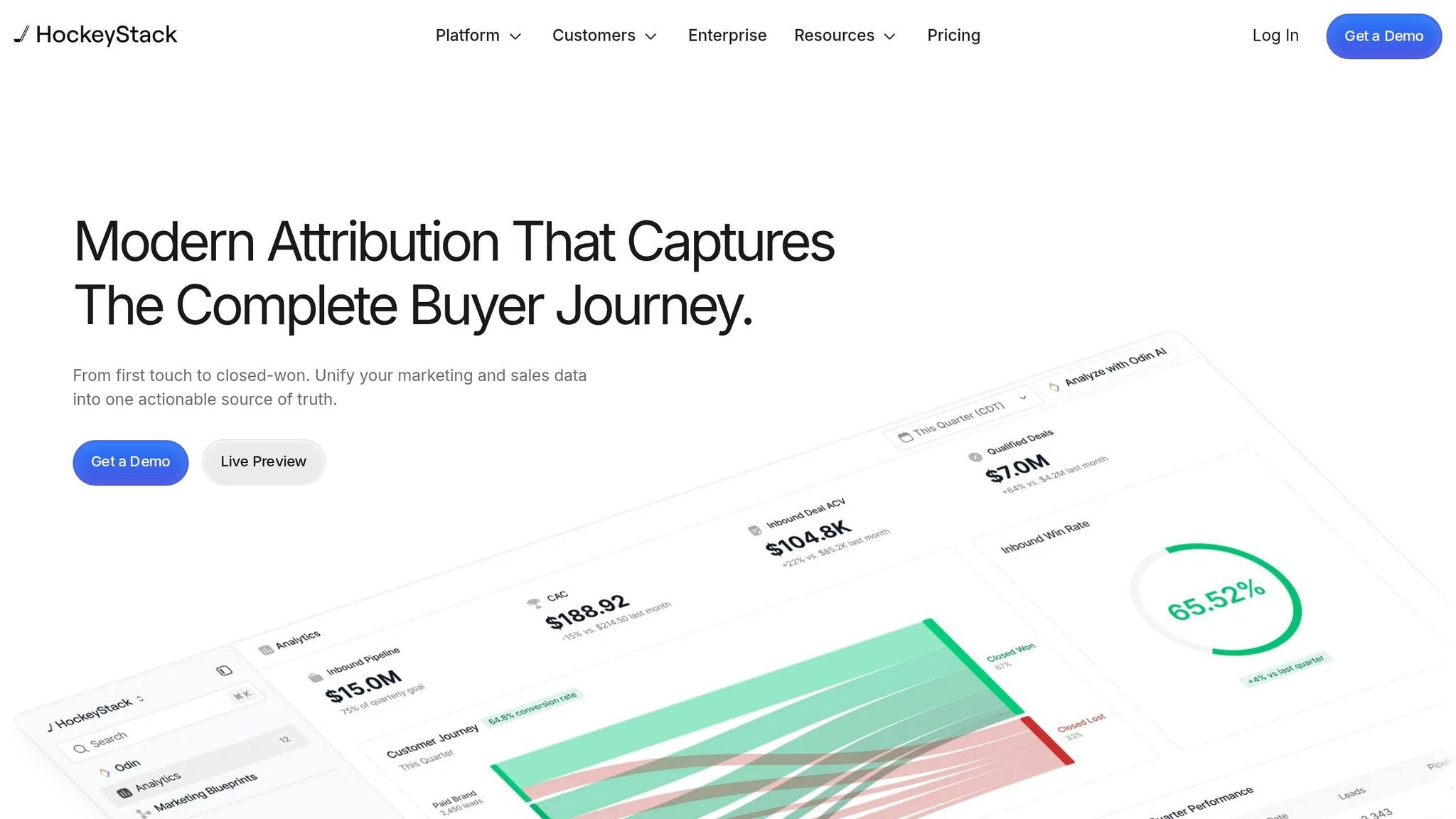
Coming after SegmentStream, HockeyStack gives you a more packaged revenue-intelligence setup instead of a warehouse-first build. It’s a fit for teams that want account-level attribution without piecing the whole thing together from scratch. Its Atlas layer ties anonymous and known touchpoints across CRM, marketing automation, ad, and web data.
Attribution Models
HockeyStack supports 9 attribution models at the same time. That includes standard first-touch, last-touch, and multi-touch options. It also adds Lift Reporting, which estimates incremental marketing impact on pipeline and revenue.
It goes a step further by mixing tracked touchpoints with survey data, which helps surface dark social and word-of-mouth that usually slip through the cracks.
B2B Account Fit
This platform is built for enterprise GTM teams dealing with long, messy, multi-touch buying cycles. Reverse-Funnel Analysis works backward from closed-won revenue to show the sequences and content that helped move accounts.
HockeyStack also includes account and contact enrichment, with 10,000 annual credits included.
Integrations
HockeyStack connects with major CRMs, ad platforms, and warehouses, including:
- Salesforce
- HubSpot
- Pipedrive
- TikTok
- BigQuery
- Snowflake
- S3
- Redshift
Executive Reporting
Odin and Nex-LM let GTM teams ask questions in plain English, while 12+ AI agents help with pipeline, campaign, and account analysis.
The dashboards give teams a lot of flexibility, which is useful - but it can also lead to sprawl if no one keeps things in check. Pricing starts at $1,399/month, and there’s no free tier or trial.
HockeyStack has a 4.6/5 rating on G2. Users often call out the unified data view as a plus, while also pointing to limited pricing transparency. So if your team wants attribution and reporting in one interface, HockeyStack makes a lot of sense.
Next: Factors.ai.
7. Factors.ai
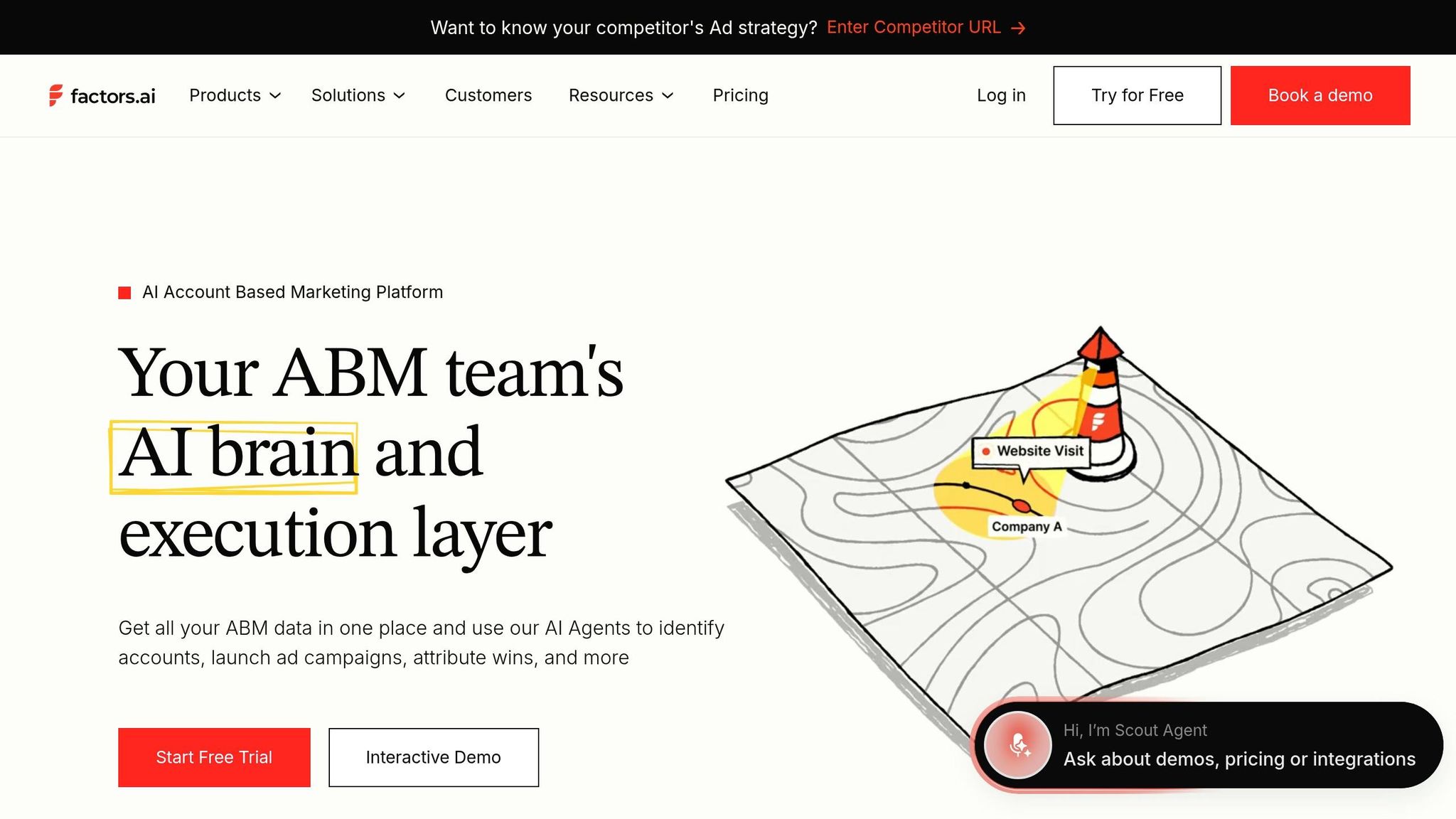
Factors.ai is a lower-cost pick for growth-stage B2B SaaS teams running account-based motions. Pricing starts at $399/month, and there’s also a permanent free plan for basic company identification and website traffic analysis.
Attribution Models
The platform supports eight attribution models, including first touch, last touch, linear, U-shaped, time decay, and Influence Touch. You can compare models side by side, which helps when different teams look at performance in different ways. It also separates short conversion cycles from longer interaction cycles.
B2B Account Fit
Setup is lighter than what you usually get with enterprise tools, but clean CRM and ad data still matter. Factors.ai uses multiple data providers to identify anonymous traffic and says it can unmask over 75% of website visitors.
Its Engagement Scoring looks at interactions across web, ads, and CRM. Predictive Scoring uses machine learning trained on up to 105 days of historical data to rank accounts by likelihood to convert.
One nice touch: LinkedIn AdPilot caps impressions per account, which helps prevent overserving a small target list.
Integrations
It syncs both ways with Salesforce and HubSpot. It also connects to LinkedIn Ads, Google Ads, Meta Ads, Bing Ads, and data tools like Bombora, 6sense, Clearbit, Segment, and RudderStack.
That said, some users have said the integration ecosystem is still maturing.
Executive Reporting
Scout Watch supports natural-language queries. Scout Map shares revenue attribution and pipeline health reports. Scout Patrol handles automated monitoring. Dashboards cover account engagement, funnel performance, and stage velocity.
Factors.ai holds a 4.5/5 rating on G2 and has earned badges for "Easiest Setup" and "Best Support".
Next: HubSpot Marketing Hub for teams already centered on HubSpot.
8. HubSpot Marketing Hub
HubSpot Marketing Hub fits best for teams that already use HubSpot as their CRM. Professional starts at about $890/month, plus a $3,000 onboarding fee, and Enterprise runs about $3,600/month. If your team is already in HubSpot every day, that matters. Attribution lives inside the same system, which makes reporting simpler and cuts down on tool sprawl.
Attribution Models
Professional and Enterprise support first-touch, last-touch, linear, U-shaped, and W-shaped attribution models. HubSpot also offers closed-won reporting, which lets you track a contact from the first interaction all the way to a closed-won deal inside one CRM-based setup.
That’s the good part. The limit is that these are still rule-based models for native reporting. If you want algorithmic attribution, you’ll need a specialist tool.
HubSpot attribution is only as reliable as CRM hygiene.
B2B Account Fit
HubSpot maps contacts to accounts through email domains or manual sales rep associations, then rolls touchpoints up to the account level. Customer Journey Analytics, available in Professional and Enterprise, helps you see how multiple stakeholders move through the funnel before a deal closes.
This works well for owned-channel activity. You can usually get a clean view of what happened in email, forms, campaigns, and site activity. But offline interactions and dark-social touchpoints mostly stay out of view. So HubSpot is good for native reporting, but not the best pick for deeper account intelligence.
Setup is light for existing HubSpot users, but data hygiene does the heavy lifting.
Integrations
HubSpot has native integrations with Google Ads, Meta, and LinkedIn, which pull spend data into deal attribution. That said, a clean UTM setup still matters. Without it, ad platform data may flow into reporting without enough detail for downstream attribution.
Executive Reporting
For board-level reviews, HubSpot can surface pipeline value, pipeline velocity, win rates, and cost per qualified opportunity. Its closed-won setup also makes it easy to show which campaigns touched deals that later closed.
For teams already on HubSpot, implementation is fast. The catch is simple: output quality depends on disciplined CRM processes.
Next: Salesforce Campaign Influence & Einstein Attribution for Salesforce-first teams.
9. Salesforce Campaign Influence & Einstein Attribution
Salesforce Campaign Influence and Einstein Attribution make sense for teams that already manage accounts, opportunities, and revenue inside Salesforce. Pricing starts at $75/user/month for CRM Analytics, while Einstein Attribution comes with higher-tier Einstein 1 Editions.
Attribution Models
Campaign Influence supports first-touch, last-touch, and equal-distribution models inside Salesforce. Einstein Attribution takes a different route. It uses machine learning to assign weight to touchpoints based on historical closed deals.
That can be useful, but there’s a catch: the weighting is opaque. You get the output, not a clear view into how each touchpoint earned its share.
B2B Account Fit
For B2B teams, account-level rollups tend to be more useful than contact-only views, especially when campaign membership stays clean. That’s where Salesforce can work well.
The flip side is simple: this setup fits teams with disciplined campaign tracking, not messy CRM hygiene. If campaign data is loose, the reporting can fall apart fast.
Integrations
Native CRM attribution cuts out sync lag and extra security overhead. It also connects deeply with Salesforce CRM Analytics for reporting.
But this strength comes with a limit. It does not handle attribution as cleanly across other CRMs or external data stacks. So if your go-to-market data lives in several systems, things can get clunky.
Executive Reporting
For board reviews, Salesforce surfaces pipeline and revenue dashboards, along with win-rate and deal-size comparisons. That matters because CRM-verified influence often trails self-reported influenced pipeline by 2x to 4x.
In plain terms, native CRM reporting can help cut through inflated numbers. But it only works well when the CRM data is already in good shape.
For teams that need broader account intelligence and ABM activation, the next option is 6sense Revenue AI.
10. 6sense Revenue AI
6sense Revenue AI is an AI-driven ABM and revenue intelligence platform built to spot in-market accounts and turn calls, emails, and meetings into structured data for RevOps reporting. Compared with the attribution-first tools above, 6sense does a better job with AI-led account prioritization than with detailed touchpoint credit. In this list, it stands out most for AI and account visibility - not for classic attribution depth.
Attribution Models
6sense is not a classic multi-touch attribution tool. It puts more weight on account intent and buying-stage signals than on assigning credit across touchpoints.
B2B Account Fit
6sense is best for ABM teams that need a clearer view of anonymous buying behavior and dark-funnel activity across the account.
Integrations
6sense works as an intelligence layer on top of your current CRM and marketing automation stack, not as a replacement for those core systems. It adds to the data already in your CRM and marketing automation tools instead of trying to replace them.
Executive Reporting
For leadership teams, 6sense turns sales activity into structured account data that RevOps can use for pipeline and territory reporting.
Next: VisibleFlow, the last tool in this comparison.
11. VisibleFlow
There are no verified source details available for VisibleFlow. That means there’s nothing confirmed on its models, integrations, or reporting.
So at this point, the comparison comes down to trade-offs. The pros and cons section breaks those down next.
Pros and Cons
The main dividing line is architecture: CRM-native, warehouse-first, or ABM-led.
That matters more than a long feature list. In practice, the right tool usually comes down to one thing: where your reporting needs to live and how your team works day to day. If your reporting must be CRM-native, warehouse-first, or ABM-led, that choice will shape the shortlist fast.
The table below strips the comparison down to the trade-offs that tend to matter most: setup load, attribution depth, and board-ready reporting.
| Tool | Best For | Pros | Cons | Typical Reporting Strengths |
|---|---|---|---|---|
| Adobe Marketo Measure | Salesforce-aligned enterprises | Deep Salesforce integration; robust multi-touch models | High complexity; requires significant governance overhead | Enterprise-grade pipeline; multi-touch ROI |
| Dreamdata | Revenue Ops and enterprise teams | API-first; deterministic account-level mapping | High setup effort if UTM and naming conventions are inconsistent | Pipeline alignment; CRM-verified bookings |
| CaliberMind | CMO and RevOps teams | Role-based dashboards; fast basic setup | Enterprise-only; no self-serve | AI-driven insights; CMO-ready dashboards |
| Demandbase One | ABM-first enterprise teams | Account-level aggregation; buying committee mapping | Requires a mature ABM motion to deliver full value | Account-level pipeline; committee visibility |
| SegmentStream | Warehouse-led RevOps teams | Warehouse-native; flexible account-level attribution | Custom reporting only; no prebuilt revenue dashboards | Custom pipeline and bookings views |
| HockeyStack | Unified revenue intelligence | Ties marketing, sales, and product data into one timeline | Starts at $1,399/month; requires disciplined field mapping | Full-funnel velocity; PLG metrics |
| Factors.ai | Teams tracking dark-funnel demand | Identity resolution across web, ads, and CRM | Integration ecosystem still maturing | Dark-funnel visibility; account-based engagement |
| HubSpot Marketing Hub | SMB and growth teams | CRM-native convenience; fast setup | Shallower attribution depth than specialist tools; Professional starts at approximately $890/month plus a $3,000 onboarding fee | Lead-to-revenue flow; board-level summaries |
| Salesforce Campaign Influence & Einstein Attribution | Salesforce-native orgs | CRM-native reporting tied directly to closed deals | Still contact-first; can miss early-stage interactions | Closed-loop revenue; CRM-verified pipeline |
| 6sense Revenue AI | ABM teams prioritizing intent signals | Strong AI-led account prioritization; dark-funnel visibility | Not a classic multi-touch attribution tool; limited touchpoint credit depth | Account intent reporting; pipeline and territory views |
| VisibleFlow | - | No verified details available | No verified details available | - |
A simple way to read this: some tools are built to fit the CRM, some are built to sit on top of the warehouse, and some are built to serve an ABM motion first. That changes what you get out of them. A CRM-native setup can make board reporting cleaner. A warehouse-led setup can give RevOps more control. An ABM-led setup can show account and committee activity that contact-based tools often miss.
Tools like Dreamdata and HockeyStack close the self-reported pipeline influence gap by writing attribution outcomes directly into CRM records or data warehouses, making the numbers auditable.
The next section maps these trade-offs to GTM motion, so teams can choose by operating model instead of feature count.
Which Revenue Attribution Tool Fits Your GTM Motion?
Once you compare features and reporting depth, the next step is simple: pick based on your GTM motion.
The best tool is usually the one that fits how your team already works - not the one with the longest feature list.
HubSpot-centric teams should start with HubSpot Marketing Hub. It gives you native CRM reporting, which means less setup and fewer handoffs.
Salesforce-heavy RevOps teams should stick with Salesforce-native tools. Adobe Marketo Measure, CaliberMind, and Salesforce Campaign Influence & Einstein Attribution keep attribution close to Salesforce, so your team doesn't need to bolt on a separate workflow.
ABM-led enterprises should focus on account-level attribution. Demandbase One and 6sense Revenue AI stand out for buying-committee visibility and intent signals. Dreamdata works well for ABM teams that want account-level journey mapping.
Digital-performance teams should lean toward ad optimization. HubSpot Marketing Hub and Factors.ai both support paid media attribution for teams that care most about channel ROI.
Product-led teams need attribution tied to product usage data. HockeyStack is the clearest fit here, bringing marketing, sales, and product data into one revenue timeline.
Use this matrix to line up your operating model with the right tool:
| GTM Motion | Best Fit | Why It Fits |
|---|---|---|
| HubSpot-Centric | HubSpot Marketing Hub | Fastest CRM synchronization |
| Salesforce-Heavy RevOps | Adobe Marketo Measure, CaliberMind, Salesforce Campaign Influence & Einstein Attribution | Native CRM governance |
| ABM-Led Enterprise | Demandbase One, 6sense Revenue AI, Dreamdata | Account-level visibility |
| Digital Performance | HubSpot Marketing Hub, Factors.ai | Paid media optimization |
| Product-Led (PLG) | HockeyStack | Product data in attribution |
In most cases, account-level measurement matters more than model complexity.
For broader vendor research, see Marketing Funnels Directory.
FAQs
How do I choose between CRM-native, warehouse-first, and ABM-led attribution tools?
Choose based on your data maturity, sales cycle, and what your team needs day to day.
- CRM-native tools work best for teams that already run on a CRM and care most about lifecycle stages, leads, and deals.
- Warehouse-first platforms make sense for teams that need account-level stitching and clean data for BI.
- ABM-led tools are the right fit when account intelligence and predictive scoring matter most.
Across all three, prioritize account-level measurement and keep your CRM as the source of truth for pipeline data.
Why does account-level attribution matter more than contact-level attribution in B2B?
In B2B, account-level attribution lines up better with how companies buy: through committees of six to eight stakeholders, not just one person.
Contact-level attribution usually follows only the person who filled out the form. That leaves out marketing’s effect on the rest of the buying group. When you roll touchpoints up to the parent account, you get a fuller and easier-to-defend view of the customer journey and the actual sales cycle.
What data should I clean up before implementing a revenue attribution tool?
Clean up your CRM first. Deduplicate records, merge duplicate accounts, standardize company names, and make sure your lead lifecycle stages and fields line up with how your sales team works.
Then fix campaign tracking. Use consistent UTMs, audit your data sources, and sort out lead-source mismatches. Also pull buyer context out of notes and spreadsheets so it lives in the system instead of getting lost.