Welcome email workflows are one of the most effective ways to keep new customers engaged and loyal. Here's why they work:
- Higher Open Rates: Welcome emails have an average open rate of 69%, far outperforming regular emails.
- Retention Impact: Improving retention by just 5% can increase profitability by 25–95%.
- Customer Expectations: 74% of customers expect a welcome email immediately, but only 57.7% of brands deliver.
- Revenue Potential: Multi-step welcome workflows generate 90% more orders than a single email and 320% more revenue per email than standard campaigns.
The first 48 hours after signup are critical. A well-timed, personalized welcome sequence not only introduces your brand but also guides users toward early actions like making a purchase or exploring your product. By focusing on clear goals, personalization, and timing, welcome workflows can significantly reduce churn and build lasting customer relationships.
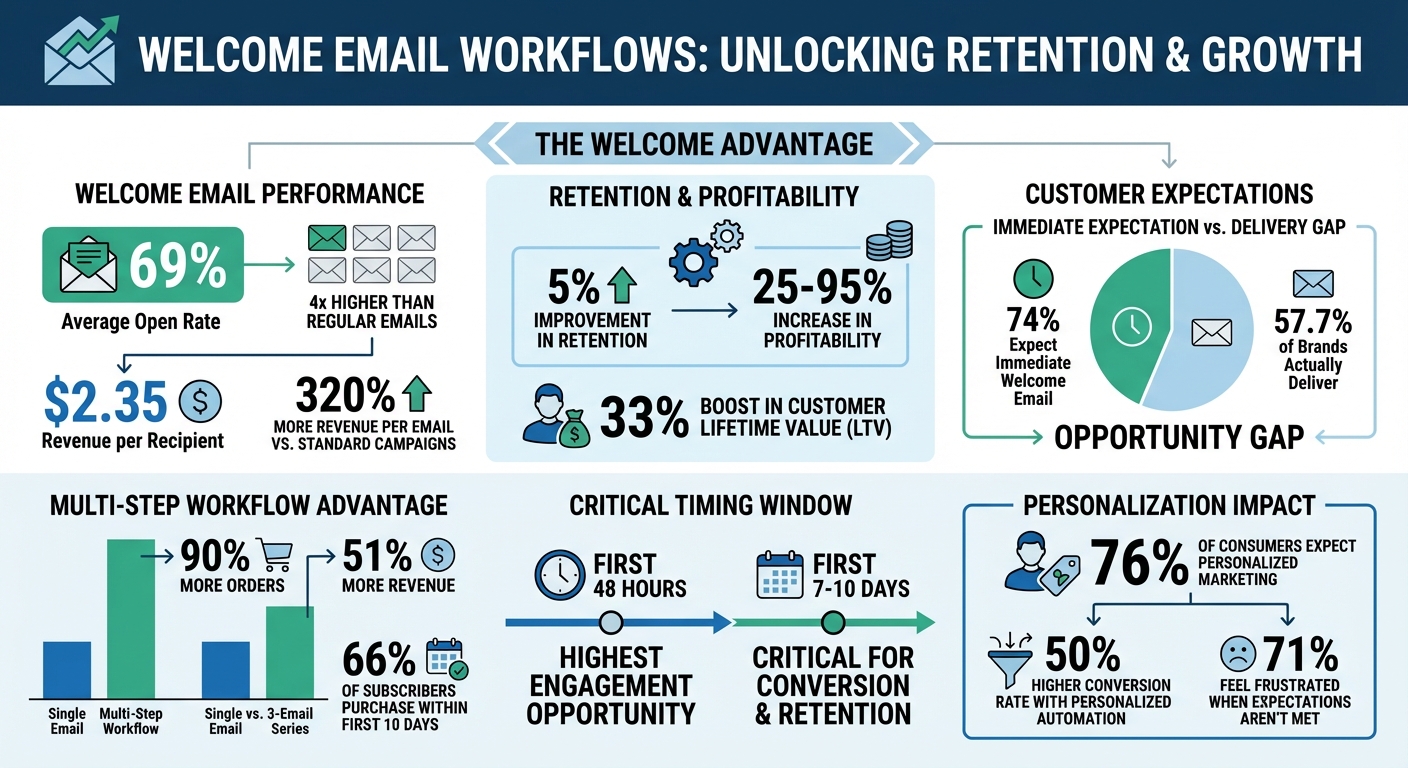
Welcome Email Workflow Statistics: Open Rates, Revenue Impact, and Customer Expectations
What Welcome Email Workflows Are
Defining Automated Welcome Workflows
An automated welcome workflow is an email sequence that runs on autopilot, triggered as soon as someone signs up for your list. This could happen through a newsletter subscription, a lead magnet download, or even a free trial registration. Think of it as a quick-start guide for new subscribers, designed to turn them into loyal fans.
The process kicks off immediately, with follow-up emails distributed over several days or weeks to keep the momentum going. Each email has a specific goal: offering something valuable like a discount or a guide, showcasing product benefits, collecting feedback, or encouraging an early conversion.
"Your audience is never more attentive than right after they sign up for your messages!" - Backstroke
This initial burst of attention is why welcome emails are so powerful. They boast open rates of around 69%, which is about four times higher than most regular email campaigns. Timing and relevance are everything here.
By understanding the difference between a one-off welcome email and a multi-step workflow, it’s clear that a series of well-timed messages can build a much stronger connection than a single email ever could.
Single Emails vs. Multi-Step Workflows
A single welcome email might say "thanks" or share a discount code, but it often leaves the rest to chance. A multi-step workflow, however, takes a more thoughtful approach, nurturing the relationship over time. The payoff? Multi-email welcome sequences generate 90% more orders on average compared to standalone welcome emails.
Here’s a closer look at how they stack up:
| Feature | Single Welcome Email | Multi-Step Workflow |
|---|---|---|
| Primary Goal | Simple acknowledgment or incentive delivery | Building a relationship and guiding onboarding |
| Engagement | High initial open rate, but interest fades quickly | Sustains engagement across multiple messages |
| Conversion | Focuses on one "buy now" opportunity | Guides subscribers through their decision-making process |
| Personalization | Limited to basic signup data | Adapts based on user interactions with earlier emails |
| Order Volume | Average performance | Drives 90% more orders than single emails |
The table highlights how multi-step workflows are better equipped to keep subscribers engaged and guide them toward meaningful actions. They don’t just deliver information - they create a journey.
"A single email can't build a relationship. It can't build anticipation, trust, or the kind of familiarity that makes someone want to hear from you again." - Yemi Pelumi, Copywriter, EmailTooltester
This multi-step approach mirrors how people naturally make decisions. It tackles concerns, builds trust, and keeps things simple by giving each email one specific goal - whether that’s activating a feature, sharing a tip, or encouraging a purchase. This way, subscribers stay engaged without feeling overwhelmed.
sbb-itb-a84ebc4
How Welcome Email Workflows Increase Retention
Reaching Customers at the Right Time
The moment someone signs up, their interest is at its highest. In fact, 74% of consumers expect a welcome email immediately after subscribing. Miss this opportunity, and you're already falling behind.
Timing is everything. The first 7 to 10 days after subscription are critical for both conversion and retention. During this period, 66% of subscribers make a purchase before the welcome email series has even finished. That’s how fast customers move today.
"We've found that most people make a purchase within 10 days of subscribing to a mailing list. Make sure you have emails sending throughout that 10-day window when people are most likely to purchase." - Alexa Maltzer, Vice President of Client Strategy, Power Digital Marketing
To keep the momentum going, send emails daily for the first five days. Research shows that email open rates are highest at 8:00 p.m. (59%) and 2:00 p.m. (45%), so timing matters. Automated workflows can also adjust to customer behavior - like downloading a guide or visiting a pricing page - ensuring emails arrive when they’re most relevant.
Here’s a key tip: exclude welcome series recipients from your regular promotional emails until the onboarding process is complete. As Eric Miller, Director of CRM and Email at Tinuiti, explains:
"For email subscribers who are currently in the welcome series, suppress them from calendar sends. They aren't ready for your full cadence. They're still evaluating you and you haven't earned their trust yet."
Once you’ve mastered timing, the next step is to make those emails feel personal.
Using Personalization to Connect With Customers
Personalization transforms welcome emails into engaging, tailored experiences. Today, 76% of consumers expect brands to deliver personalized marketing, and 71% feel frustrated when those expectations aren’t met. The payoff is clear: personalized automation can deliver a 50% higher conversion rate compared to generic messages.
By leveraging "zero-party data" (like preferences shared by the customer) and "first-party data" (such as browsing behavior), brands can craft emails that resonate. For example, messages can be tailored based on where the customer signed up, their interests, or the problems they want to solve.
In 2025, UK furniture retailer DFS used Bloomreach Engagement to create a welcome series that catered to customer interests. By sending targeted content - like a bedroom furniture guide to those browsing that category - DFS boosted welcome email revenue by 3.9%.
Similarly, BrewDog, a Scottish brewer, ran an A/B test with 80,000 customers to personalize subject lines based on lifecycle stages. This approach led to a 13.8% increase in email sequence revenue.
"Personalization along with lifecycle marketing, message logic, and timing are what make onboarding emails feel relevant across the whole welcome email series." - Team Braze
Once emails are personalized, the focus shifts to guiding customers toward meaningful actions.
Encouraging Early Actions That Build Loyalty
Encouraging early engagement is key to turning new subscribers into loyal customers. Welcome workflows should highlight "activation milestones" - like completing an account setup, downloading an app, or redeeming a discount - which are essential for long-term retention.
Each email should focus on one clear call-to-action to avoid overwhelming the customer. For e-commerce brands, this might mean browsing a curated bestseller list or using a welcome discount. For SaaS companies, it could involve setting up a first project or inviting team members. The goal is to guide users toward an early "win" with your product.
A well-designed welcome sequence can boost a customer's lifetime value (LTV) by 33%. Early engagement sets the tone for ongoing interaction.
"Create a desired action. Nobody wants to get the introduction experience again. It's critical to think about the customer journey as an event in a series." - Kevin Orbach, CEO, Kevin Orbach Marketing Agency
If you’ve promised a discount or freebie during signup, deliver it in the very first email - don’t make your customer search for it. Reiterate the offer in subsequent emails to keep it top-of-mind for those who haven’t converted yet. By the third or fourth email, include customer reviews or testimonials to build trust and address any hesitation.
The Perfect Automated Email Welcome Sequence In 2025
How to Build Welcome Email Workflows That Work
Creating an effective welcome email workflow means aligning trigger events, crafting engaging content, and timing your sequence to match subscriber behavior.
Setting Up Workflow Triggers
The trigger is the starting point of your welcome workflow. Surprisingly, only 57.7% of brands send a welcome email, even though 74% of new subscribers expect one right after signing up. This gap presents a huge opportunity.
Decide what action will launch your workflow - whether it’s signing up for a newsletter, downloading a lead magnet, redeeming a discount, or starting a free trial. Connect your signup form to your audience list and program the workflow to trigger immediately after signup.
"The trigger event tells you why they joined, which tells you what they want next. This helps you map the welcome journey to meet their needs and avoid a one-size-fits-all welcome flow that feels robotic." - Yemi Pelumi, Copywriter, EmailTooltester
Timing is everything. Set your first email to go out immediately or within minutes of signup. This ensures you’re reaching subscribers while your brand is still fresh in their minds. Use exclusion rules to filter out existing customers, ensuring only new subscribers receive the series. Also, pause your regular promotional emails while someone is in the welcome workflow to avoid overwhelming their inbox.
Once you’ve nailed the trigger, the next focus is writing emails that hold your audience’s attention.
Writing Email Content That Gets Results
Each email in your workflow should focus on a single, clear goal - whether it’s activating a feature, explaining a benefit, or encouraging a purchase. Trying to achieve too much in one email can confuse your audience and reduce effectiveness.
If you promised an incentive, like a discount or freebie, make it the highlight of your first email. Don’t hide the discount code or force subscribers to search for it. Use data like signup source or browsing behavior to create personalized emails that encourage action.
Write in a conversational tone to make your emails feel approachable and personal. Keep paragraphs short and easy to skim. Use action-driven calls-to-action (CTAs) like “Get My Discount” or “Discover Our Story” instead of generic phrases like “Click Here”.
Some brands take creativity to the next level. For example, Apple’s Apple Cash welcome email uses an iMessage-style animation to explain the product visually, eliminating the need for long explanations. Miro simplifies its onboarding process by breaking it into three easy steps: “create a board,” “shape your ideas,” and “invite your team”.
Social proof is especially impactful in welcome emails. With open rates exceeding 50% - about four times higher than standard marketing emails - you’ve got a prime opportunity to showcase customer reviews or user-generated content.
Once you’ve crafted compelling emails, it’s time to think about how many to send and when.
Choosing the Right Workflow Length and Timing
The length of your workflow should match the complexity of your product. Simple products may only need 3–4 emails, while more complex offerings, like B2B tools or high-ticket items, might require 5–6 emails to fully educate and convert prospects.
The first 48 hours after signup are critical. Most welcome flow conversions happen within the first 10 days, so prioritize sending your most impactful emails early in the sequence.
"The first 48 hours after someone subscribes represents your highest-engagement opportunity. During this window, subscribers actively remember signing up and expect to hear from you." - Emercury
A three-email welcome series can generate 51% more revenue than a single email, and multi-email workflows drive 90% more orders than standalone blasts. However, sending more than six emails risks turning subscribers off and increasing unsubscribe rates.
Start by sending emails 1–2 days apart, then space them out to 3–4 days as the sequence progresses. If you’ve offered a discount, send a final reminder 10–14 days after signup or just before the offer expires. Keep an eye on engagement metrics - if open rates drop sharply after the fifth or sixth email, it might be time to trim your sequence.
Tracking Performance and Improving Your Workflows
Once you’ve set up a solid welcome workflow, keeping an eye on how it’s performing is key to maintaining customer retention. Performance tracking helps you spot what’s working and where things might be falling short. For instance:
- Open rates show how enticing your subject lines are.
- Click-through rates (CTR) measure how well your content and calls-to-action are engaging readers.
- Conversion rates track how many recipients take the desired action, like making a purchase or signing up for a trial.
Among these, Revenue per recipient (RPR) stands out as a critical metric. Welcome emails, on average, generate $2.35 per recipient, which is 320% more revenue per email compared to standard promotional campaigns. Don’t overlook the unsubscribe rate either - if it climbs above 0.5%, it could mean your content or frequency isn’t aligning with subscriber expectations. Together, these metrics provide a clear picture of how your workflow is performing and where you can make improvements.
| Metric | Average Performance | Good Performance | Excellent Performance |
|---|---|---|---|
| Email 1 Open Rate | 50% | 65% | 80%+ |
| Email 1 Click Rate | 10% | 15% | 20%+ |
| Journey Conversion Rate | 1% | 2% | 3%+ |
| Unsubscribe Rate | 0.5% | 0.3% | 0.1% |
Metrics to Track
Another helpful metric is Click-to-open rate (CTOR), which measures how compelling your email content is for those who actually open it. This metric separates the performance of your subject line from the quality of the email’s content. Additionally, tracking inbox placement is crucial - emails landing in the Promotions tab instead of the Primary inbox can see engagement drop by over 50%.
Real-world examples highlight the impact of optimizing deliverability. In February 2026, Dr. Squatch used Mailmend’s inbox placement tools to shift their welcome emails from the Promotions tab to the Primary inbox. This tweak alone led to a 112% surge in revenue, along with better open rates and CTRs. Similarly, StickerYou optimized their automated sequences during the same month, achieving a 64% boost in open rates and a 43% increase in CTR by the end of the month.
To keep things fresh and effective, review your workflows quarterly. Update links, refresh offers, and tweak messaging based on how your audience is interacting with your emails.
Running A/B Tests to Improve Results
Performance metrics provide a baseline, but A/B testing lets you fine-tune your workflows. For example, you can test subject lines to see if clarity outperforms curiosity or if including a subscriber’s name boosts open rates. Just remember: test one element at a time so you can clearly identify what’s driving the results.
- Call-to-action (CTA) format: Compare button CTAs with plain text links. Buttons often drive more clicks.
- Email design: Some audiences prefer visually appealing HTML emails, while others respond better to plain-text messages. In tests, emails with images achieved a 60% higher CTR than text-only versions.
- Timing and frequency: Experiment with sending more emails in the first 72 hours versus spreading them out over two weeks. You can also test reminder intervals - like 48, 24, and 12 hours before a discount expires - to find the sweet spot between urgency and overwhelm.
For reliable results, aim for 100 conversions per variation. If your signup volume is lower, stick to testing just two variations at a time.
Finding Tools in the Marketing Funnels Directory
To build and refine your workflows effectively, you’ll need the right tools. The Marketing Funnels Directory at topmarketingfunnels.com offers a curated list of email marketing platforms, courses, and resources tailored to help you create better customer journeys.
Whether you’re looking for software with advanced "if/then" branching logic, behavior-based triggers, or deep e-commerce integration, the directory organizes tools by use case - covering everything from social media and ad funnels to B2B workflows. This makes it easier to find solutions that fit your specific needs and budget.
Conclusion
Automated welcome email workflows are a game-changer for engaging new customers when their interest is at its peak. By reaching out immediately after signup, these workflows deliver on promises, build trust through personalized messaging, and set the stage for long-term connections. They go beyond a simple introduction, educating subscribers, addressing concerns, and fostering emotional ties that turn initial curiosity into lasting loyalty.
The numbers speak for themselves: welcome sequences generate 320% more revenue per email than standard promotional campaigns and lead to 90% more orders compared to single welcome emails. Open rates for these workflows range from an impressive 51% to 90%, with click rates averaging 14–15%. These statistics highlight how critical it is to get your welcome sequence right.
What separates successful workflows from the rest? It starts with nailing the basics: delivering immediate value, creating multi-step sequences (usually 3–5 emails), collecting zero-party data early on, and pausing other campaigns to avoid overwhelming new subscribers. The key is to treat automation as more than just a sales tool - it’s a way to build meaningful relationships.
"If you get it right? You've got a customer for life. Get it wrong? You might as well light your acquisition cost on fire."
Want to create workflows that deliver results? The Marketing Funnels Directory at topmarketingfunnels.com is a great place to start. It offers a curated list of email marketing platforms, courses, and tools tailored to specific goals, whether you’re focused on e-commerce, B2B, or funnel optimization. From advanced automation features to behavior-based triggers, you’ll find resources that align with your retention strategy and budget.
FAQs
What should my welcome email sequence include?
A great welcome email sequence starts with a warm, personalized introduction. This helps set the tone, build trust, and showcase what makes your brand stand out. Use this opportunity to educate your subscribers about your products or services, address common questions, and guide them with clear calls-to-action - whether it’s making their first purchase or exploring your website.
To keep your emails engaging, leverage automation and personalization to make each message feel relevant. Including social proof, like testimonials or reviews, can also strengthen credibility. Sweeten the deal by offering exclusive discounts or incentives, which not only encourage action but also improve retention. The goal is to guide new subscribers seamlessly through their journey with your brand.
How many welcome emails should I send?
A welcome email series usually consists of 2 to 3 emails. These emails serve as a way to introduce your brand, connect with new subscribers, and inspire them to make their first purchase. Sticking to proven strategies ensures your messages resonate and achieve their intended goals.
Which metrics show if my welcome workflow is working?
When analyzing your welcome email workflow, focus on three main metrics: open rates, click-through rates, and placed order rates. Ideally, open rates should fall between 68.6% and 80%, with top-performing workflows often hitting the higher end of that range. For placed order rates, a strong benchmark is around 10%.
Tracking these numbers closely gives you valuable insight into how well your emails are performing. By understanding these metrics, you can fine-tune your strategy to boost customer engagement and improve retention over time.