Single-touch attribution is a simple way to measure marketing success by giving all credit for a conversion to a single interaction. It’s easy to use and ideal for businesses with short sales cycles or limited resources, but it ignores the full customer journey. Using marketing funnel resources can help you better understand these touchpoints. Here’s a quick breakdown:
- First-Touch Attribution: Focuses on the first interaction that sparks interest. Good for tracking awareness campaigns but misses mid-to-late funnel activities.
- Last-Touch Attribution: Credits the final interaction before conversion. Useful for bottom-funnel strategies but overlooks earlier contributions.
Quick Comparison
| Model | Pros | Cons | Best For |
|---|---|---|---|
| First-Touch | Tracks initial discovery; simple to set up | Misses mid/bottom funnel; misleading insights | Awareness campaigns, new channels |
| Last-Touch | Highlights final conversion drivers | Ignores early/mid funnel; favors short cycles | Bottom-funnel, quick purchases |
For businesses with longer, complex sales cycles, multi-touch attribution offers a more balanced view. But if you’re working with fewer than 100 conversions per month or have limited analytics resources, single-touch models can still provide quick insights.
Single Touch Attribution
While this model is straightforward, maximizing its effectiveness often requires conversion optimization to ensure the single touchpoint is as impactful as possible.
sbb-itb-a84ebc4
First-Touch Attribution Pros Checklist
First-touch attribution is a straightforward way to figure out how customers first discover your brand. It’s particularly useful when you want a clear picture of your acquisition channels without diving into overly complex analytics.
Shows Where the Customer Journey Begins
This model answers a key question: "How did this customer first find us?" By giving 100% credit to the initial interaction, first-touch attribution highlights the success of awareness strategies like SEO, blog posts, or paid social campaigns. It’s a quick way to see which channels are pulling in new audiences.
It’s also a great tool for testing new syndication channels or brand campaigns. First-touch data quickly reveals which sources are sparking interest and driving discovery.
Easy to Set Up and Use
Another big plus? Simplicity. Unlike multi-touch models that require pulling data from multiple platforms, first-touch attribution relies on basic tracking. Many tools - like Google Analytics, HubSpot, Facebook Ads, and standard CRM dashboards - already have this functionality built in as a default setting .
"It's easy to set up and understand, especially for smaller teams or brands just getting started with attribution." – Klaviyo
Because it assigns all credit to a single interaction, the model keeps reporting clean and avoids the double-counting issues that can crop up with multi-channel approaches. There’s no need for advanced expertise, making it perfect for smaller teams or quick campaign adjustments. This simplicity allows marketers to quickly identify which entry points are driving the most engagement.
Works Well for Top-of-Funnel Strategies
First-touch attribution shines when your focus is on top-of-funnel activities. If your goal is to generate awareness and capture new leads, this model provides the insights you need to measure those efforts effectively .
"First-touch attribution captures the moment your audience first notices you, giving you a clear view of top-of-funnel impact." – AttributionApp
It’s especially effective in situations with short buying cycles, like transactional or product-led environments, where the first interaction often leads directly to conversion. This makes it a valuable tool for evaluating top-of-funnel campaigns.
For optimal results, use first-touch attribution when experimenting with new channels or programs to see what’s resonating with new audiences. Pair it with additional metrics to get a more rounded view of your overall performance.
First-Touch Attribution Cons Checklist
First-touch attribution may seem appealing due to its simplicity, but it falls short when it comes to capturing the complexity of customer journeys and sales funnels. By focusing solely on the initial interaction, this model overlooks critical touchpoints that influence revenue generation.
Misses Mid and Bottom Funnel Impact
One major issue is that first-touch attribution ignores everything that happens after a customer’s initial discovery. It assigns all the credit to that first interaction, leaving out key elements like webinars, retargeting ads, email campaigns, case studies, and sales outreach from your reports. This creates what some call "assist blindness", where the vital efforts that nurture leads and close deals are invisible.
In B2B sales, which often require 12–20 touchpoints, this oversight can lead to poor budget allocation. Funds may be diverted away from mid-funnel activities - the very ones that play a pivotal role in converting leads into customers.
Can Lead to Misleading Insights
The simplicity of first-touch attribution can create a false sense of clarity. Reports may look "clean", but they don’t reflect the true drivers of revenue.
"The risk is that marketers start optimizing for what's easy to prove, not what drives revenue. Budget gets pulled toward channels that generate 'clean' first-touch data, even if they don't move deals forward." – Channel99
This approach often encourages prioritizing high lead volumes through low-intent content, like generic whitepapers, which may grab attention but rarely result in conversions. Meanwhile, high-impact channels that contribute to actual deal progression are neglected. Additionally, since the model doesn’t account for the costs of subsequent touchpoints, ROI analyses remain incomplete.
Data supports this: companies that transitioned from single-touch to multi-touch attribution saw their cost per acquisition improve by 14% to 36%. Relying on first-touch data alone can be especially problematic in industries with long sales cycles, where these misleading insights can snowball.
Doesn't Work Well for Long Sales Cycles
For B2B companies with sales cycles stretching beyond 90 days, first-touch attribution struggles to provide accurate insights. Unlike multi-touch models, which track every step of the buyer’s journey, first-touch models fail to account for the nurturing and engagement that occurs between the initial interaction and the final purchase.
In some cases, the first touch may have happened months - or even years - before a deal closes. This gap is further complicated by modern privacy regulations like GDPR and updates like iOS 14, which reduce lookback windows and make it harder to track long-term customer journeys.
There’s also the risk of outdated data. For example, if a sales rep reuses an old lead record in the CRM, the deal could be mistakenly attributed to an irrelevant first touch. The reality is that most B2B journeys involve multiple stakeholders engaging with your brand at various stages, and first-touch attribution simply cannot capture this complexity. By ignoring the complete sales cycle, the model leaves businesses with an incomplete picture of what drives success.
Last-Touch Attribution Pros Checklist
Last-touch attribution flips the script on first-touch attribution by focusing solely on the final interaction that leads to a conversion. While it shares the simplicity of single-touch models, it answers a different question: What was the final push that got someone to act? This perspective is particularly useful for marketers zeroing in on bottom-of-the-funnel performance.
Tracks What Drives Conversions
This model is all about identifying the exact moment a prospect becomes a customer. It highlights the specific ad, email, or search term that directly triggered the conversion. Since it operates within a short time window - often just hours or days before the conversion - it minimizes tracking errors caused by cookie expiration or privacy limitations. Tools like Google Analytics and Salesforce make this data readily available by default.
"Last-touch attribution answers a useful question: What got someone to act?" – Channel99
Interestingly, nearly 78.4% of marketers rely on last-click models to evaluate media effectiveness.
Measures ROI Clearly
One of the biggest perks of last-touch attribution is how straightforward it makes ROI calculation. By assigning full credit to a single touchpoint, you can easily connect a specific marketing action to its resulting conversions - no complex data models required. For instance, if a single abandoned cart email generates 50 sales in a day, you can directly attribute those results to that campaign.
This simplicity resonates with executives and finance teams who value clear-cut answers without needing to dive into advanced analytics. It also aligns with the "immediacy" mindset of sales teams, as it identifies the exact trigger that pushed a lead into the opportunity stage. Despite its limitations, 41% of marketers still rely on last-touch attribution as their primary model because it delivers actionable insights quickly.
"Last-touch attribution is a favorite among smaller organizations, early-stage startups, or teams without dedicated analytics support. It also appeals to executives who want answers without a PhD in data science." – Channel99
Additionally, this model serves as a benchmark when transitioning to more complex multi-touch models. Comparing the results helps companies understand how credit shifts across the customer journey and assess whether the added complexity is worth the effort.
Best for Bottom-of-Funnel Strategies
Last-touch attribution shines when it comes to optimizing bottom-of-funnel tactics. It’s particularly effective for testing elements like landing page designs, call-to-action copy, and offer performance. Whether it’s a flash sale, limited-time promotion, or abandoned cart recovery campaign, this model pinpoints which final nudge converts prospects into buyers.
It’s especially useful in scenarios with short sales cycles - think e-commerce, impulse buys, or Product-Led Growth (PLG) strategies - where the journey from discovery to purchase happens quickly. In these cases, the last interaction often plays the most decisive role, giving teams actionable insights to refine their conversion-stage strategies in real time.
Chief Revenue Officers and Demand Generation Managers often favor this approach because it maps directly to the moment a deal closes. It also helps justify budgets by clearly showing which bottom-funnel tactics are driving conversions, making it easier to secure funding for proven strategies.
Last-Touch Attribution Cons Checklist
Last-touch attribution, much like its first-touch counterpart, has its drawbacks. By focusing solely on the final interaction before a conversion, it overlooks critical parts of the customer journey, potentially leading to flawed marketing strategies.
Ignores Early and Mid-Funnel Contributions
This model operates on a "winner-takes-all" principle, giving full credit to the last touchpoint and ignoring everything that came before it. Early-stage efforts like awareness ads, SEO-driven content, webinars, and social media campaigns often go unacknowledged. These activities play a crucial role in building trust and guiding prospects through the funnel, yet they receive no credit. This oversight can lead to underfunding top-of-funnel efforts, ultimately stalling lead generation.
Interestingly, while 75% of companies now use multi-touch attribution, many marketers still stick to last-touch models despite their flaws. In B2B settings, this approach often credits only the final decision-maker, overlooking the contributions of early influencers and advocates within the buying process.
"Last-touch attribution may represent the 'final straw,' but there were a lot of straws on that camel's back." – Channel99
This narrow focus not only distorts budget allocation but also creates challenges in navigating complex sales cycles.
Favors Short Sales Cycles
Last-touch attribution is better suited for quick, impulse-driven purchases - think flash sales or app downloads - where the customer journey is brief. But for more considered, high-value purchases, it falls short. When buyers spend weeks or months researching, this model fails to account for the many trust-building interactions along the way. The result? A skewed understanding of performance metrics.
Switching to multi-touch attribution often yields better insights. Companies making this shift report cost per acquisition improvements of 14% to 36%, with some seeing a 6% boost in total conversions through data-driven strategies.
Beyond these limitations, last-touch attribution can also lead to errors in measuring performance.
Can Create Attribution Errors
Platforms like Facebook and Google Ads often claim full credit for the same conversion, resulting in double-counting that inflates performance metrics and muddies the waters when determining which channel truly drove results.
"Marketers know that the chance of an individual seeing an ad for new headphones once and then instantly buying them is unlikely. Yet they're happy to assign all credit for a transaction to the last click... It's a means of marketing measurement." – AdExchanger
Another common issue is unattributed direct traffic. Untracked links - such as those in emails, PDFs, or dark social - often default to "Direct" traffic, making it harder to evaluate the effectiveness of various channels. Additionally, by focusing solely on the immediate transaction, last-touch attribution ignores touchpoints that contribute to long-term customer value. To get a more accurate view of channel performance, marketers need to cross-reference data in a centralized dashboard rather than relying on a single platform’s self-reported metrics.
First-Touch vs. Last-Touch Attribution Comparison
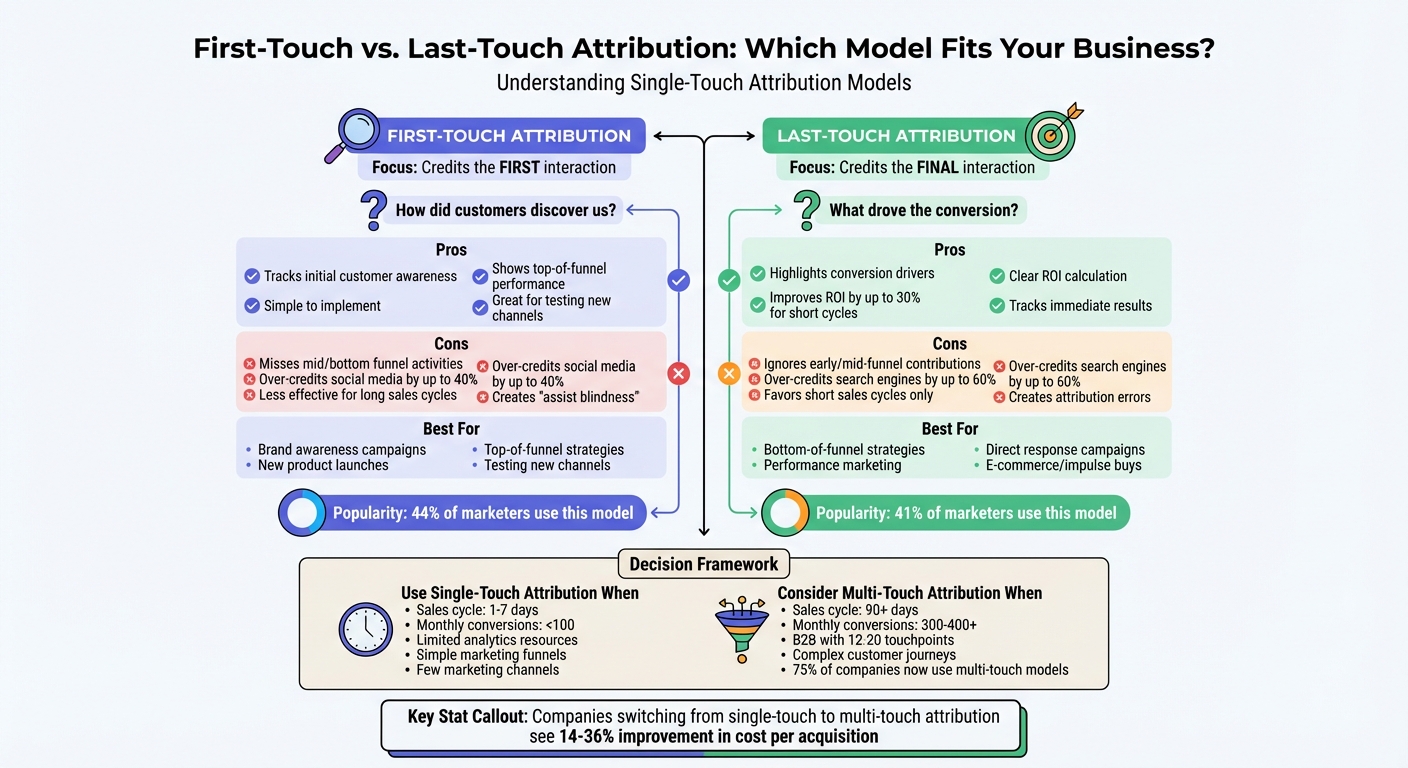
First-Touch vs Last-Touch Attribution: Complete Comparison Guide
Deciding between first-touch and last-touch attribution depends on your marketing goals. First-touch shines a light on how customers discover your brand, while last-touch zeroes in on what ultimately drives conversions. According to recent data, 44% of marketers favor first-touch attribution, while 41% opt for last-touch models when analyzing online campaigns.
These models focus on different stages of the marketing funnel. First-touch is ideal for justifying investments in awareness efforts like SEO, social media ads, and high-converting sales funnels - channels that introduce your brand to new audiences. On the other hand, last-touch highlights the effectiveness of bottom-of-funnel tactics such as branded search, retargeting ads, and cart abandonment emails - those final pushes that seal the deal.
"The rivalry between first and last touch attribution isn't about supremacy but synergy".
Sales cycle length also plays a huge role in deciding which model works best. For shorter cycles, like in e-commerce using all-in-one marketing platforms, last-touch attribution can improve ROI calculations by up to 30%, as it focuses on actions directly tied to revenue. However, in longer B2B sales cycles, first-touch attribution is more effective because it tracks that initial moment of interest. For example, industries like financial services often see last-touch models over-credit search engines by up to 60%, overlooking the organic content that first sparked customer interest.
Here’s a quick breakdown of the two models:
| Model | Pros | Cons | Ideal Use Cases |
|---|---|---|---|
| First-Touch Attribution | Highlights initial customer awareness; simple to implement | Misses later touchpoints; less effective for long sales cycles | Best for top-of-funnel strategies, new product launches, and brand awareness campaigns |
| Last-Touch Attribution | Focuses on final conversions; accurately tracks ROI | Ignores earlier contributions; works best for short sales cycles | Ideal for bottom-of-funnel strategies, performance marketing, and direct response campaigns |
Both approaches have their blind spots. First-touch models often over-credit social media impressions by up to 40%, while last-touch models tend to favor high-intent channels that might have converted regardless of earlier interactions. This is why many businesses are shifting to multi-touch attribution for a more balanced view. In fact, 75% of companies now use multi-touch attribution, recognizing that relying on a single-touch model can lead to budget misalignment. For businesses handling 100–300 conversions per month, a position-based model - assigning 40% credit to both the first and last touch - often delivers a more accurate picture than sticking with just one.
When to Use Single-Touch Attribution Checklist
When selecting an attribution model, keeping things simple can sometimes be the smartest choice. Here’s when single-touch attribution can deliver the best results.
Ideal for Simple Funnels
Single-touch attribution works best for straightforward customer journeys. If your buyers typically make decisions within 1 to 7 days, this model provides clarity without adding unnecessary complexity. Picture scenarios like flash sales, local service bookings, or impulse-buy e-commerce items or digital products - where customers see your ad, click through, and purchase, all in one sitting.
It’s also a great fit for businesses focusing their marketing efforts on just a few channels. For example, if your campaigns primarily run on Google Ads or email, single-touch attribution simplifies tracking and keeps things manageable.
Good for Teams with Limited Analytics Resources
For businesses generating fewer than 100 conversions per month, single-touch attribution often makes the most sense. Complex multi-touch models require a significant amount of data to produce actionable insights. For instance, Google Analytics 4 needs 300 to 400 conversions monthly for its data-driven model, while Google Ads requires over 600 conversions in a 30-day period. Without hitting these thresholds, platforms usually default to simpler last-click models.
Smaller teams also benefit from the ease of single-touch models, which are pre-integrated into popular platforms like HubSpot, Google Ads, and LinkedIn. They’re ready to use with minimal setup or specialized expertise.
"There's no need to over-complicate a process before it's ready to become complex" (Sharla Moody, Contently).
When time and resources are limited, starting simple is often the best approach.
Use Alongside Other Metrics
While single-touch attribution offers clarity, it’s essential to pair it with broader performance metrics for a more comprehensive view. For instance, combining this model with metrics like branded search volume or direct traffic can help you gauge brand awareness - something last-click models might overlook. Linking attribution data to your CRM can also provide insights into how marketing-sourced leads convert into revenue. Regular conversations with your sales team may uncover blind spots, such as prospects finding your brand through webinars while your attribution model credits paid search.
Running parallel comparisons of first-touch and last-touch data can help you identify which channels spark initial interest versus those that close deals. For tactical decisions - like testing new ad creative or refining email subject lines - single-touch models provide quick, actionable insights. Use these insights as a decision-making tool to guide your strategy effectively.
Key Takeaways
When evaluating single-touch attribution, here are the main points to keep in mind.
Single-touch attribution models - whether first-touch or last-touch - are quick to implement and cost-efficient but fail to capture the full journey. First-touch attribution emphasizes where a customer’s journey begins, while last-touch attribution zeroes in on the final interaction that leads to a conversion. While these models are simple to use, they overlook the crucial middle stages of the customer journey.
The choice of an attribution model directly impacts how marketing budgets are allocated and which channels receive funding. Julia Moreno from Dataslayer explains it best: "The attribution model you choose determines which marketing channels live or die." First-touch models often overemphasize the value of awareness channels like paid social and SEO, while last-touch models tend to favor closing tactics such as branded search. This imbalance can lead to underfunding the channels that initially drive demand, highlighting the need for a balanced approach.
Your decision on which attribution model to use should align with your business goals, sales cycle, and available data. Single-touch attribution works well for short sales cycles (1–7 days), low conversion volumes (fewer than 100 per month), or limited analytics resources. However, for businesses with longer, more complex B2B sales cycles involving 12–20 touchpoints, single-touch models often fall short. In these cases, multi-touch attribution is a better fit, offering potential for improved CPA results.
No single model can provide a complete picture. To make smarter decisions, pair attribution data with other metrics like branded search volume, direct traffic, and qualitative input from your sales team. Running side-by-side comparisons of first-touch and last-touch data can also help identify which channels spark initial interest and which ones close the deal.
Ultimately, your attribution model should evolve alongside your business. Start with simple models when testing new channels or managing limited data. As your conversion volume grows, transition to more advanced models that capture the entire customer journey. The key is to align your measurement strategy with your current business needs - don’t force your business to fit the model.
FAQs
How do I choose between first-touch and last-touch attribution?
When deciding, think about what aligns best with your goals. First-touch attribution gives credit to the very first interaction, making it useful for identifying which channels are most effective at driving initial awareness and generating new leads. On the other hand, last-touch attribution focuses on the final interaction, highlighting the touchpoint that directly resulted in a conversion.
If your priority is building awareness, first-touch attribution might be the way to go. But if you're more focused on tracking what seals the deal, last-touch attribution is a better fit. For a more comprehensive understanding of the customer journey, multi-touch attribution could be a great option. However, keep in mind that single-touch models are easier and faster to analyze.
When should I switch from single-touch to multi-touch attribution?
When your marketing spans multiple channels and touchpoints, relying on single-touch attribution can lead to misleading insights. Single-touch models often oversimplify the customer journey, which can result in misallocated resources and undervalued mid-funnel efforts. If you notice inconsistent results, certain channels being over- or under-valued, or budgets that aren't delivering the desired impact, it’s a clear sign to switch to multi-touch attribution. This approach gives you a more accurate view of your campaigns, helping you optimize spending and improve ROI.
How can I reduce double-counting and 'Direct' traffic attribution errors?
To avoid double-counting and mistakes in attributing 'Direct' traffic, consider using multi-touch attribution models. These models assign credit to multiple customer interactions rather than overemphasizing a single channel like 'Direct' traffic. By spreading credit more evenly, multi-touch attribution provides a clearer picture of channel performance and minimizes misattribution, making your data far more dependable.