B2B buyers demand tailored marketing experiences, much like what they encounter on platforms like Netflix or Amazon. Personalization isn’t optional anymore - it directly impacts engagement, lead quality, and conversions. Here’s why it matters and how you can implement it:
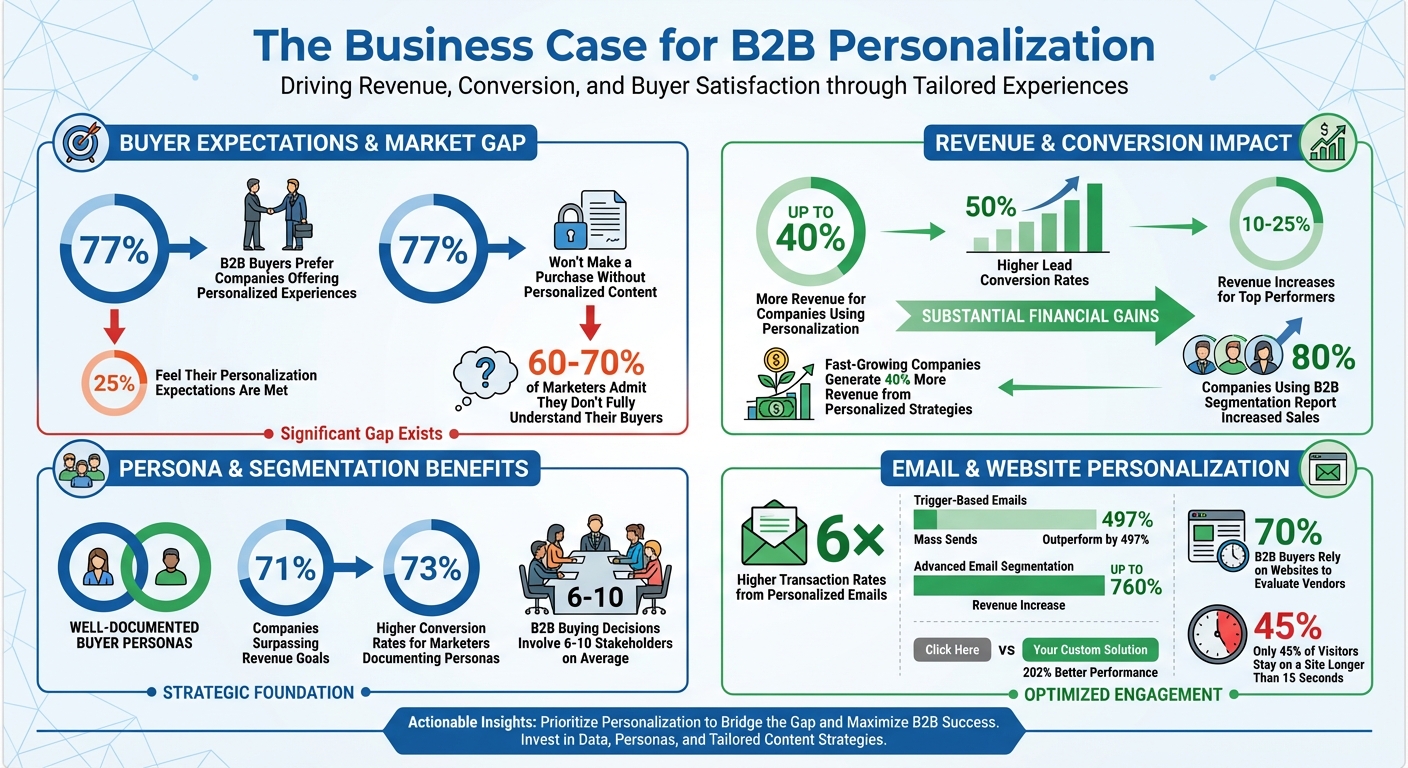
- 77% of B2B buyers prefer companies that offer personalized experiences.
- Companies using personalization see up to 40% more revenue and 50% higher lead conversion rates.
- Tools like AI, CRMs, and marketing automation enable scalable personalization.
To succeed, focus on these steps:
- Create Buyer Personas: Identify key stakeholders and tailor messaging to their roles and priorities.
- Segment Audiences: Use firmographic and demographic data to target the right companies and individuals.
- Leverage Technology: Automate personalized outreach with behavioral triggers, dynamic content, and AI tools.
- Refine Email and Website Personalization: Use tailored CTAs, dynamic email content, and intent-based website journeys.
Personalization builds trust and shortens sales cycles. Start small, test results, and scale what works.
B2B Personalization Statistics and ROI Impact
B2B Lead Generation Video Personalisation using make.com
sbb-itb-a84ebc4
Creating Targeted Buyer Personas
Knowing your audience is the backbone of effective personalization. The stats speak volumes: 71% of companies that surpass their revenue and lead goals have well-documented buyer personas. Yet, 60–70% of marketers admit they don’t fully understand their buyers. That gap can make or break your campaigns.
When it comes to B2B, crafting personas takes a different approach than B2C. Instead of diving into personal interests like hobbies or family size, focus on job roles, key performance indicators (KPIs), and professional priorities.
Start by gathering insights from teams like sales, customer service, and marketing. Then dig into your CRM to identify patterns in "closed-won" deals over the past 12–18 months. One key takeaway? B2B buying decisions often involve 6–10 stakeholders. This means you’ll need personas tailored to each role. For example, a CFO might prioritize ROI, while an IT Director is more concerned with technical specs.
Here’s a real-world example: Thomson Reuters developed personas for each decision-maker, leading to a 175% increase in marketing revenue, a 10% bump in leads passed to sales, and a 72% faster lead conversion time. Similarly, Skytap saw a 124% jump in qualified sales leads by aligning campaigns with clearly defined personas.
"Your ICP tells you which buildings to enter. Your buyer personas tell you who to talk to once you're inside and what to say." – MarTech Do
How to Define Buyer Personas for B2B Campaigns
Building accurate personas involves combining internal data with external research. Analyze your marketing tools and CRM to review engagement trends, buying history, and customer demographics. Then, supplement this with surveys or interviews with recent customers to uncover their motivations, pain points, and internal objections.
Next, map out the key roles in your target accounts:
- Decision-maker: The one who signs off on contracts.
- Influencer: Researches options and makes recommendations.
- End-user: The person who will actually use your product.
- Champion: Your internal advocate who pushes for your solution.
To make these personas actionable, assign them memorable names and images. Document their go-to sources for information - whether it’s industry podcasts, trade publications, or conferences. Limit your personas to 3–5 to keep your strategies focused. Additionally, create "negative personas" to help your sales team avoid wasting time on leads that aren’t a good fit. Update these personas every six months to reflect market changes.
With these personas in place, you’re ready to refine your audience segmentation.
Segmenting Audiences with Demographic and Firmographic Data
Once your personas are defined, use firmographic and demographic data to segment your audience. Firmographics focus on the organization - things like industry, revenue, company size, location, and business model. Demographics, on the other hand, zoom in on the individual, covering details like job title, seniority, education, and years of experience.
A layered approach works best. Start broad with your total addressable market, then narrow it down using firmographic criteria to identify your Ideal Customer Profile (ICP). For instance, you might target SaaS companies with 100–500 employees and revenues between $10 million and $50 million. Within these accounts, demographic data can help pinpoint specific roles, such as the VP of Marketing or Director of Sales Operations.
This layered strategy naturally creates distinct audience segments that require tailored approaches. For example, an enterprise with 5,000 employees may need a nine-month sales cycle involving multiple stakeholders, while a 50-person startup might close in six weeks with just a couple of decision-makers.
The payoff? 80% of companies using B2B segmentation models report increased sales, and fast-growing companies generate 40% more revenue from personalized strategies compared to slower-growing competitors.
To streamline this process, add a custom "Persona" field in your CRM (like Salesforce or HubSpot) to tag leads with their archetypes. This enables automated nurture tracks tailored to each persona. For instance, IT Directors might receive technical white papers, while CMOs get ROI-focused briefs.
Regularly audit your CRM to refine your segments. Look for patterns - such as which firmographic and demographic combinations lead to the highest win rates or are linked to longer sales cycles and higher churn. Marketers who document their personas see 73% higher conversion rates compared to those who don’t.
| Feature | Firmographic Segmentation | Demographic Segmentation |
|---|---|---|
| Focus | The Organization/Company | The Individual Decision-Maker |
| Key Data Points | Industry, Revenue, Company Size, Location, Business Model | Job Title, Age, Seniority, Education, Job History |
| Strategic Use | Identifying target accounts (ICP) | Tailoring messaging and tone (Personas) |
Dynamic segmentation is the ultimate goal. As prospects engage with your content - whether it’s attending webinars, downloading case studies, or visiting pricing pages - they should automatically shift between segments based on their behavior. This ensures your messaging stays relevant throughout the buying journey.
Personalization Techniques for B2B Lead Generation
When you combine well-defined buyer personas with segmented audiences, you unlock the potential to deliver deeply personalized experiences. Here’s the reality: 77% of B2B buyers won’t make a purchase without personalized content. Yet, only 25% feel their expectations are met. That gap is where opportunity lives.
At its core, personalization means addressing specific challenges and priorities for each prospect. By leveraging behavioral signals, account-based strategies, and dynamic content, you can create tailored experiences that resonate.
Behavioral Personalization and Account-Based Marketing
Behavioral personalization begins with identifying key "why now" moments - those pivotal times when prospects are most likely to engage. These moments might include funding announcements, leadership changes, product launches, or major hiring initiatives. For instance, if a company recently onboarded several new sales reps, it’s the perfect time to pitch a sales enablement tool.
A practical approach to scaling this effort is what SalesHive calls "programmatic personalization." This method combines reusable templates with one or two personalized lines informed by AI research. The result? Response rates three times higher than generic outreach. It’s an 80/20 strategy: 80% of the message is templated, while 20% is customized based on recent activity.
Here’s how to prioritize your accounts for maximum impact:
| Account Tier | Depth | Implementation Method |
|---|---|---|
| A (Strategic) | Trigger + Persona Hypothesis + Tailored Proof Point | Coordinated email, call script, and LinkedIn message |
| B (Mid-Market) | Trigger or Industry Signal + Persona Angle | 1–2 custom lines generated programmatically via AI |
| C (Long-tail) | Segment-based template with light context | Focus on learning and testing over deep research |
Beyond outreach, incorporate multidimensional lead scoring that evaluates behavioral signals like webinar attendance or content downloads alongside broader organizational indicators, such as earnings reports or funding rounds. Use this data to identify accounts actively researching solutions and coordinate your outreach across emails, calls, LinkedIn, and retargeting ads for a unified experience.
This groundwork sets the stage for personalized email campaigns to nurture high-value leads. Utilizing the right marketing funnel tools can help streamline this transition from account prioritization to active nurturing.
Personalized Email Campaigns and Nurture Sequences
Email remains a cornerstone of personalized outreach. Personalized emails deliver 6× higher transaction rates, and trigger-based emails outperform mass sends by an incredible 497%. Advanced segmentation can even drive revenue increases of up to 760%.
Dynamic segmentation is the backbone of effective email personalization. Leads should move seamlessly between segments based on real-time behaviors. For example, if a prospect visits your pricing page multiple times in one week, they should immediately enter a high-intent nurture track featuring case studies and demo offers.
Dynamic content blocks take personalization to the next level. These allow email elements - like images, text, and CTAs - to adapt based on the recipient’s role or industry. A CFO might see ROI-focused messaging, while an IT Director gets technical specs and integration details - all from the same campaign.
Real-world examples show the power of this approach. AAA boosted sales by 41% by delivering personalized webinar content to targeted segments, while Protolabs saw a 62% increase in qualified prospects through tailored digital engagement.
Behavioral triggers can automate timely follow-ups. For instance:
- If a prospect abandons a sign-up form, send a personalized email within 24 hours addressing potential objections.
- If they download a white paper, follow up with a related case study three days later.
You can also collect zero-party data by embedding one-click survey questions in emails. Use this information to learn about a prospect’s challenges and immediately place them into the right nurture track. Keep data clean - 79% of marketers cite poor data quality as their biggest obstacle to effective personalization.
Next, extend these efforts to your website to ensure a seamless experience.
Website and Landing Page Personalization
Your website is often the first touchpoint for potential buyers, making it a critical opportunity for personalization. While 70% of B2B buyers rely on websites to evaluate vendors, only 45% of visitors stay on a site longer than 15 seconds. Personalization can change that. Personalized calls-to-action (CTAs) perform 202% better than static ones, and companies that excel in personalization generate 40% more revenue compared to others.
Start by personalizing high-impact elements like hero banners, headlines, product recommendations, and navigation menus. For example, Outsystems used Demandbase to deliver personalized website experiences, leading to a 3.6× increase in content consumption and a 59% jump in page views.
Social proof is another powerful tool. Use industry-specific logos, testimonials, and case studies to build trust. For instance, show healthcare companies relevant client success stories, and manufacturing firms examples tailored to their needs.
Intent-based journeys can further refine the experience. HubSpot replaced a generic "Free CRM" CTA with a "Get a Demo" prompt for visitors who had interacted with free tools, driving a 560% boost in conversions.
To collect actionable data, incorporate interactive elements like "choose your path" buttons that let visitors self-identify their needs. Match CTAs to the visitor’s funnel stage: show "Watch a Demo" to first-time visitors and "Start Free Trial" to prospects who’ve engaged with mid-funnel content. Begin small by personalizing high-traffic pages for two or three key segments, such as new versus returning visitors.
"Make sure the default experience was solid first, because you can't personalize your way out of a broken baseline." - Jeff Loquist, Senior Director of Optimization, SiteTuners
Test changes for at least four weeks to ensure reliable results before rolling out site-wide adjustments. These efforts can turn your website into a powerful tool for capturing and converting high-intent leads.
Tools and Resources for Personalization
How Technology Enables Personalization
Personalization at scale wouldn’t be possible without the right mix of technology and data working together. At the core of this effort is your CRM system, which acts as the central hub by organizing firmographic data - like industry type and company revenue - alongside behavioral signals such as website visits and email activity. This combination helps shape your Ideal Customer Profiles (ICPs).
From there, marketing automation platforms bring your multi-channel strategies to life. For example, if a prospect checks out your pricing page, the system can automatically send a follow-up email featuring a case study tailored to their interests. AI personalization engines elevate this further by analyzing public data - like LinkedIn activity, news updates, or changes in a company’s tech stack - to create highly specific outreach messages.
Website personalization tools take it a step further, customizing experiences by adjusting images, calls-to-action, and content based on factors such as the visitor’s industry, location, or position in the buying process. Additionally, data enrichment and intent tools help pinpoint high-priority accounts by analyzing search behavior and technographics, feeding this information into your CRM for better targeting.
These technologies have proven to boost engagement, drive pipeline growth, and shorten sales cycles for B2B companies.
"Intelligent personalization is no longer just a marketing idea, it is a proven growth strategy that helps businesses improve engagement, generate better leads, and close deals faster." - Michael Frost, UnboundB2B
Clean CRM data is a must, as inaccurate information can hinder AI-driven personalization efforts. A tiered approach works well: hyper-personalize for top-tier enterprise accounts while using AI-assisted personalization for mid-market leads. Start small, test the results, and expand from there. By integrating CRM tools, automation platforms, and AI-powered personalization, you’ll be well-positioned to explore specialized solutions in the Marketing Funnels Directory.
Finding Personalization Solutions in the Marketing Funnels Directory
Once your tech stack is set, the next step is finding the best personalization tools through curated resources like the Marketing Funnels Directory (https://topmarketingfunnels.com). This directory organizes tools into categories like "Personalization & Targeting", making it easier to move beyond generic messaging. Each tool listing includes descriptions, use cases, and pricing tiers, helping you find options that align with your budget and technical needs.
The directory also provides frameworks for advanced segmentation, such as psychographic profiling (understanding buyer motivations) and technographic segmentation (targeting based on a company’s tech stack). Technical guides walk you through setting up behavioral triggers for email campaigns and engagement-focused touchpoints, enabling you to replace time-based drips with action-driven sequences.
For example:
- Deadline Funnel (starting at $49/month) adds personalized countdown timers to emails and landing pages to encourage urgency.
- Personyze uses machine learning to create real-time visitor profiles, offering a free tier for up to 5,000 page views per month and paid plans starting at $149/month.
- Proof (starting at $79/month) provides real-time social proof and visitor notifications, helping increase on-site conversions.
The directory also includes resources for tracking success, offering specific metrics to measure the impact of personalization and ensure CRM integration is effective. A weekly newsletter keeps you updated on new tools, funnel strategies, and performance benchmarks. Whether you’re launching your first personalization effort or scaling an existing program, this directory can guide you in selecting and implementing the right tools to make personalization a lasting part of your strategy.
Conclusion
With 77% of B2B buyers refusing to make purchases without personalized content - and only 25% feeling their expectations are met - the potential for revenue increases of 10–15%, or even up to 25% for top performers, is undeniable. Achieving this success hinges on treating personalization as a system grounded in clean data, precise segmentation, and the right technology.
Start by creating detailed buyer personas based on firmographic and behavioral data. From there, tier your accounts: hyper-personalize for high-value enterprise deals, use AI-assisted templates for mid-market prospects, and automate outreach for smaller, long-tail leads. This tiered approach ensures that your effort aligns with the potential returns. Personalization doesn't just enhance engagement - it accelerates lead velocity and boosts deal values, directly impacting both the speed and size of your revenue pipeline.
Once you've built strong personas and segmented your outreach, technology becomes the key to scaling these strategies. A well-chosen tech stack - including your CRM, marketing automation tools, and AI-driven personalization platforms - can help you extend personalized outreach across email, web, and social channels. Resources like the Marketing Funnels Directory (https://topmarketingfunnels.com) can guide you in finding tools tailored to your needs, such as behavioral triggers and dynamic content engines. Their frameworks and implementation guides make it easier to turn concepts into repeatable, scalable processes.
"The future of B2B growth belongs to those who can deliver the right content to the right person at the right time, every time." - Michael Frost, UnboundB2B
The core principles remain unchanged: understand your audience, segment with precision, and provide consistent, relevant experiences. What’s evolved is the ability to achieve this at scale, thanks to AI and automation. Start small, track your results, and expand what works. The evidence is clear - personalization enhances engagement, improves lead quality, and shortens sales cycles.
FAQs
How can B2B companies use buyer personas to improve personalization?
B2B companies can step up their personalization game by crafting detailed buyer personas that mirror their ideal customers. Start by digging into data from sources like website behavior, email interactions, and social media activity. This helps you get a clear picture of your audience’s goals, challenges, and how they make decisions. With this insight, you can fine-tune your messaging, content, and solutions to address their specific needs and pain points.
For even greater impact, match your content to where your buyer is in their journey - whether they’re just becoming aware of a problem, weighing their options, or ready to make a decision. Tailoring interactions to these stages not only builds trust but also shows you truly understand their business needs. This kind of personalization can increase the chances of converting leads. On top of that, using behavioral insights and adjusting your communication style makes your outreach feel more relevant, which boosts engagement and drives better outcomes.
What technologies are essential for scaling B2B content personalization?
To make B2B content personalization work on a larger scale, businesses need the help of AI-powered tools to craft tailored experiences. Here’s a quick breakdown of the essential technologies driving this effort:
- AI and machine learning: These tools dive into customer behavior, building detailed, multi-layered profiles that go beyond surface-level insights.
- Automation platforms: They simplify and scale personalized communication, ensuring consistency across interactions.
- Content AI: This technology adjusts messaging in real time to match user preferences, keeping content relevant and engaging.
- Analytics tools: These are key for tracking performance and fine-tuning personalization efforts for better results.
When combined, these tools make it possible for businesses to deliver content that’s not only timely but also highly relevant, creating a more meaningful customer experience.
How does audience segmentation improve B2B lead generation?
Audience segmentation enhances B2B lead generation by breaking your target market into smaller, well-defined groups based on common characteristics like industry, company size, location, or behavior. This strategy allows you to share targeted and meaningful content that resonates with each group, driving higher engagement and better conversion rates.
When you adjust your messaging to fit each segment’s specific needs - like solving challenges unique to an industry or aligning content with different stages of the decision-making process - you build stronger relationships with potential clients. This approach improves the quality of your leads and speeds up the sales cycle, making your marketing efforts more focused and effective.