Omnichannel UI ensures customers experience a smooth transition across devices and channels, meeting the expectations of modern shoppers who demand consistency. Here's why it matters:
- 73% of customers shop across multiple channels, spending 4% more in-store and 10% more online.
- Businesses with unified experiences retain 89% of their customers, while fragmented experiences lead 71% to abandon brands.
- Tools like Customer Data Platforms (CDPs) enable seamless transitions, keeping shopping carts, preferences, and progress intact between devices.
The complexity of customer journeys has increased, with interactions now ranging from 20 to 500 touchpoints. Yet, 49% of users still email themselves links to continue tasks on another device, highlighting gaps many brands fail to address. Omnichannel UI solves this by focusing on user behavior, not platform constraints, and integrating data for consistent branding and reduced effort.
Key elements of effective omnichannel UI design include:
- Consistency: Uniform branding and functionality across platforms.
- Optimization: Tailoring interfaces to device-specific strengths.
- Seamlessness: Eliminating friction in transitions.
- Orchestration: Anticipating user needs through data.
- Collaboration: Enabling devices to work together.
Companies adopting omnichannel strategies report 9.5% annual revenue growth, compared to 3.4% for others. Real-world examples, like Lola's Cupcakes integrating loyalty data across channels, show how this approach reduces costs and boosts engagement.
The future of omnichannel UI includes AI-driven tools, augmented reality, and smart devices that enhance customer experiences and drive business outcomes.
8. Thinking Beyond Interactions: Omnichannel Experiences and CX (ft. Kim Salazar)
Omnichannel UI vs. Single-Channel Journeys
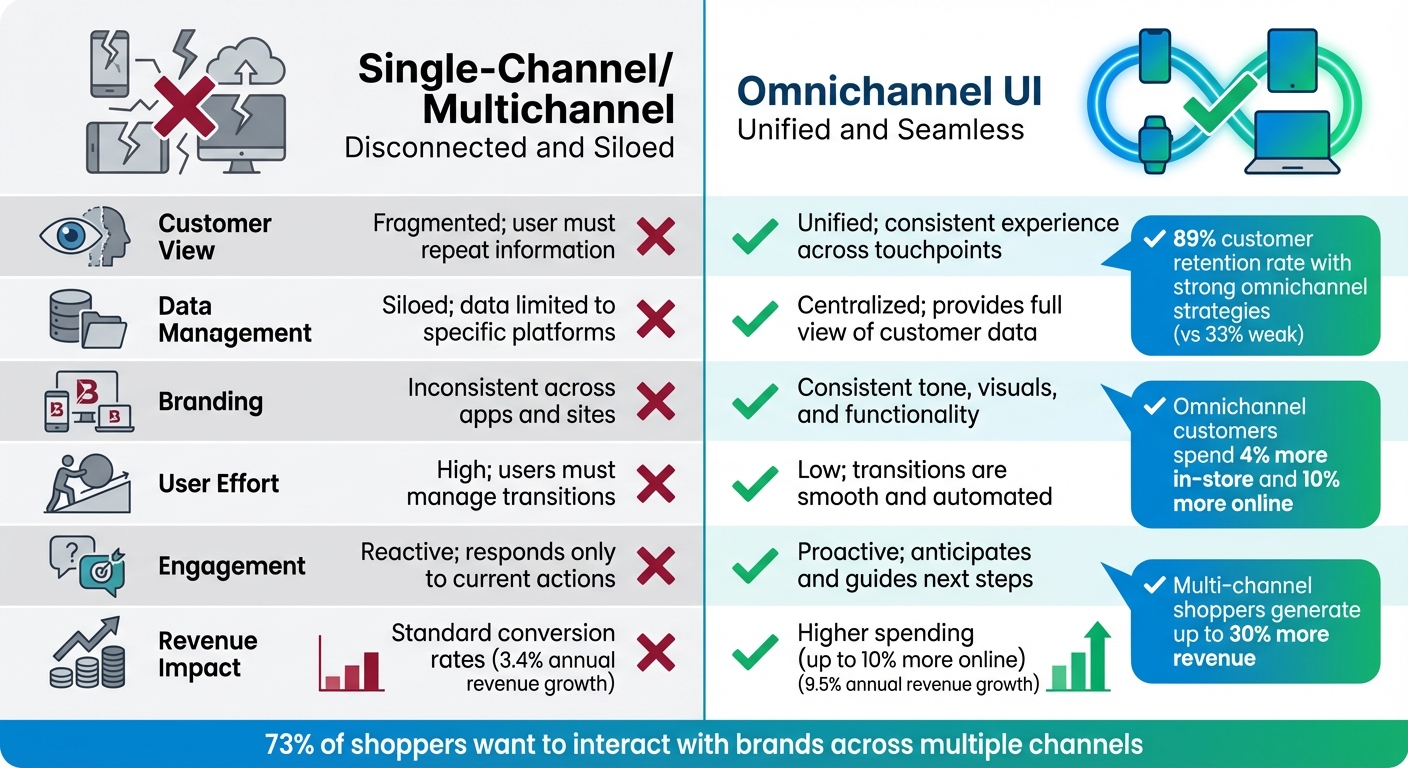
Single-Channel vs Omnichannel UI: Key Differences and Impact
What Is Omnichannel UI
Omnichannel UI brings together platforms like web, mobile, in-store, and social media by focusing on what customers need rather than just pushing products. It ensures that shopping carts, preferences, and progress stay consistent across all platforms. For example, if someone browses products on their phone during lunch and later switches to their laptop at home, they’ll see the exact same items in their cart - no need to search again or start over.
This seamless experience is powered by centralized systems like CDPs (Customer Data Platforms) or CRMs (Customer Relationship Management tools), which provide real-time customer data to every channel. It’s like having a single, attentive assistant who remembers every detail, as Qualtrics puts it.
Single-Channel vs. Omnichannel Comparison
Omnichannel strategies stand in stark contrast to single-channel approaches. Single-channel systems treat each platform as a separate entity, leaving customers to fill in the gaps themselves. This outdated method doesn’t align with today’s consumer preferences - 73% of shoppers now want to interact with brands across multiple channels. Despite this, many businesses still rely on disconnected systems.
| Feature | Single-Channel / Multichannel | Omnichannel UI |
|---|---|---|
| Customer View | Fragmented; user must repeat information | Unified; a consistent experience across touchpoints |
| Data Management | Siloed; data limited to specific platforms | Centralized; provides a full view of customer data |
| Branding | Inconsistent across apps and sites | Consistent tone, visuals, and functionality |
| User Effort | High; users must manage transitions | Low; transitions are smooth and automated |
| Engagement | Reactive; responds only to current actions | Proactive; anticipates and guides next steps |
| Revenue Impact | Standard conversion rates | Higher spending (up to 10% more online) |
This comparison highlights the benefits of integrated systems, including consistent branding and reduced customer effort. The financial advantages are clear: omnichannel customers spend 4% more in-store and 10% more online compared to single-channel shoppers. Multi-channel shoppers can generate up to 30% more revenue than those who stick to a single channel. Even more compelling, 86% of consumers say personalization heavily influences their buying decisions.
However, achieving this level of integration isn’t easy. Sixty percent of companies report that their marketing and sales teams are out of sync, leading to fragmented customer experiences. Breaking down these silos requires coordinated efforts across departments.
Research Methods for Omnichannel Journey Mapping
Field Studies and Diary Studies
Watching customers navigate real-life scenarios can reveal how they shift between channels. Field studies observe users in their natural environments, capturing those key moments when they switch devices. On the other hand, diary studies ask participants to document their interactions over time, helping uncover patterns that might take days or weeks to emerge.
In one standout example from September 2016, Nielsen Norman Group researcher Kim Flaherty followed a customer’s journey to purchase a baby swing from Walmart.com. The study logged 14 separate interactions and pinpointed five specific roadblocks. These included a barcode that wouldn’t scan at pickup and a system failure during an online return at a physical store. Frustrated by these issues, the customer ultimately abandoned the brand entirely.
"Diary studies help you understand experiences that unfold over time and provide data for customer-journey maps, which are important for identifying, analyzing, and streamlining situations when the journey breaks down."
– Kim Flaherty, Nielsen Norman Group
These methods highlight crucial transition points in the customer experience. For instance, research found that 49% of people email themselves a link to continue an activity on another device. Meanwhile, customers booking accommodations switch nearly six times between mobile and desktop websites on average. A 2015 diary study presented at the CHI conference even uncovered "resource-lending" behavior, where one participant used their laptop to organize music on their phone because the mobile interface was too restrictive. Additionally, only 33% of medium-complex customer journeys can be completed entirely online without any direct interaction with the organization.
These findings set the stage for deeper insights through direct conversations with customers.
Customer Interviews and Competitive Evaluations
Customer interviews reveal the "why" behind channel choices - something raw data can’t fully explain. Laddering interviews, in particular, dig into the underlying reasons for customer preferences, such as the urgency of a task, the complexity of the information needed, or even the user’s emotional state at the time. Often, these discussions uncover that what customers value most isn’t what organizations assume.
Competitive evaluations take a different approach by cataloging every touchpoint customers encounter - emails, app screens, SMS notifications, physical kiosks, and more. This process helps audit consistency across the entire ecosystem. When brands deliver seamless transitions, they raise customer expectations for every other company. For example, targeted improvements in omnichannel strategies have been shown to increase the use of self-service tools - referred to as "containment" - by nearly 20%. Similarly, businesses that integrate their marketing channels report a 35% boost in advertising effectiveness.
"To every single customer, a journey is one holistic interaction with your organization, one experience rather than a collection of individual experiences."
– Kim Flaherty, Nielsen Norman Group
Core Components of Omnichannel UI Design
Component Analysis and Impact
Effective omnichannel UI design revolves around five key components, all working together to create smooth transitions across devices and channels.
Consistency ensures that customers experience the same look, feel, and functionality no matter where they interact with your brand. This includes uniform button placement, tone of voice, and features across touchpoints. For example, when Lola's Cupcakes moved to Shopify's unified commerce platform in March 2025, they seamlessly integrated online and in-store loyalty data. This consistency helped them add 10,000 new members to their "Lola's Love Club" loyalty program while slashing their total cost of ownership by over 50%.
Optimization focuses on tailoring each interface to leverage the strengths of a specific device. For instance, mobile interfaces might prioritize GPS functionality, while desktops are better suited for tasks like complex data entry. Seamlessness eliminates friction by allowing users to switch between channels without having to redo tasks or re-establish context. Orchestration takes this a step further by using data to predict customer needs and streamline their journey, reducing effort along the way. Lastly, collaboration allows multiple devices to work together, such as using a smartphone as a remote control for a smart TV. Together, these components create a foundation for stronger user engagement and retention.
Here’s a breakdown of each component’s benefits and challenges:
| Component | Advantage | Challenge |
|---|---|---|
| Consistency | Builds trust and reduces the learning curve across channels | Requires coordination across departments and unified design systems |
| Optimization | Enhances device-specific functionality (e.g., GPS, camera) | Increases design and development costs for tailored interfaces |
| Orchestration | Anticipates user needs and personalizes journeys | Demands advanced data models, backend integration, and often AI |
| Collaboration | Simplifies interactions on less user-friendly devices (e.g., smart TVs) | Risks being dismissed as a "gimmick" if not genuinely useful; requires user awareness |
| Seamlessness | Boosts retention by eliminating friction in transitions | Requires significant backend updates and breaking down organizational silos |
These elements don’t work independently - they’re most effective when integrated. Retailers using unified commerce platforms to manage all five components report a 22% improvement in total cost of ownership, faster implementation of new features (up to 20%), and an 8.9% boost in annual sales. This unified approach is essential for delivering the cohesive experiences today’s customers expect.
sbb-itb-a84ebc4
How Omnichannel UI Affects Customer Engagement and Retention
Businesses with strong omnichannel strategies enjoy an 89% customer retention rate, compared to just 33% for those with weaker approaches. This striking gap highlights how seamless integration across channels can transform the way companies interact with their customers.
The financial benefits are just as compelling. Companies excelling in omnichannel engagement report a 9.5% year-over-year revenue growth, nearly three times the 3.4% growth seen by businesses with less cohesive strategies. Additionally, omnichannel shoppers tend to have a 30% higher lifetime value than those using a single channel. On top of that, they spend 10% more online and 4% more in-store. With 73% of consumers preferring to shop across multiple channels, it’s clear that meeting customers wherever they are isn’t just a nice-to-have - it’s a necessity. These numbers set the stage for real-world examples that show how omnichannel strategies play out in practice.
Take Publishers Clearing House, for instance. In 2024, they teamed up with MoEngage to leverage AI-driven predictions and customer segmentation on their digital entertainment platform. By identifying high-engagement paths and reactivating dormant users, they boosted daily active users by 23% and brought over 30,000 inactive app users back into the fold, achieving a 3.93% conversion rate. Similarly, Lola's Cupcakes transitioned to Shopify's unified commerce platform in March 2025. This move allowed them to integrate online and in-store loyalty data seamlessly, adding 10,000 new members to their loyalty program while cutting their total cost of ownership by over 50%.
Unified data integration is another piece of the puzzle, enabling brands to predict customer needs and reduce friction. A great example is Poshmark’s "Flow Versioning", which increased email open rates by 60% and sales conversions by 30%. When businesses connect systems like CRM, ERP, and e-commerce platforms, they can anticipate customer requirements and create a smoother journey from start to finish.
On the flip side, the consequences of a fragmented experience can be severe. Nearly 87% of consumers report frustration when they have to repeat information across channels, and 73% of them question their loyalty to the brand as a result. In fact, over 50% of customers now interact with three to five channels during a single journey, and the average consumer switches nearly six times between websites and mobile platforms when booking something like an online reservation. Even small hiccups in this process can push customers away. For businesses aiming to refine their customer journey, understanding these dynamics is critical.
For more practical advice and tools to enhance your multi-channel engagement strategy, check out the Marketing Funnels Directory, a curated resource designed to help businesses optimize every step of the customer journey.
Future Trends in Omnichannel UI
The evolution of omnichannel UI is steering away from managing isolated customer touchpoints to tackling broader, more complex goals. For instance, instead of focusing on a single purchase, it’s now about accomplishing larger missions, like redesigning an entire home. This transformation is being driven by networks of autonomous AI agents capable of handling intricate tasks with minimal human input, reshaping how customers interact with brands entirely. These advancements are paving the way for AI-powered tools and cutting-edge hardware that are redefining customer experiences.
Take Klarna, for example. In February 2024, the company introduced an OpenAI-powered assistant that performed the workload of 700 full-time agents. The results? A 25% drop in repeat inquiries, a resolution time reduced from 11 minutes to under 2 minutes, and an estimated $40 million boost in profits for the year.
Augmented reality (AR) and virtual reality (VR) are also making waves by seamlessly blending the digital and physical shopping worlds. In 2023, Canadian retailer EQ3 launched a web-native AR tool that allowed customers to visualize furniture without needing an app. The impact? A 112% increase in conversion rates and a doubling of average order values. Similarly, IKEA upgraded its AR platform to "IKEA Studio" in June 2022, offering users the ability to design entire rooms with 3D plans that recognize existing furniture and suggest new layouts. AR-powered product presentations, in particular, have shown a 94% higher conversion rate compared to those without.
Hardware is advancing just as rapidly. Meta and Ray-Ban’s collaboration on smart glasses exemplifies this shift. These glasses, equipped with built-in AI, can analyze surroundings, provide real-time translations, and even livestream, signaling the rise of ambient, screen-less interfaces.
"The shift from app-based operating systems to ambient, natural interfaces - such as voice, augmented reality, and eye movement - will accelerate as AI-powered devices become more intelligent and predictive".
Amazon has already embraced this vision. In March 2024, the company implemented AI-optimized warehouse robots, enabling 60% of Prime orders in the top 60 U.S. metropolitan areas to be delivered on the same or next day. These innovations are not just enhancing customer experiences - they’re delivering measurable financial gains.
Personalization in omnichannel experiences also holds immense potential. Studies show that tailoring interactions can increase company-wide revenue by 5%–15%. However, there’s a catch: while 66% of companies aim to personalize experiences for first-time visitors, only 38% of consumers actually want personalization at that stage. Kevin O'Connell of Grant Thornton poses a critical question:
"What AI experience do you want to deliver? And can your infrastructure support it?"
The future belongs to brands that use AI to interpret customer intent and personalize interactions at the right moment - only when customers are ready.
For more guidance on weaving these emerging UI trends into your customer journey strategy, check out the resources available at Marketing Funnels Directory.
Conclusion
Omnichannel UI marks a transformative approach to how customers connect with brands. Studies have shown that customers engaging across multiple channels tend to spend more and exhibit greater loyalty, making unified experiences a cornerstone of business success. The key to achieving this lies in five essential elements: Consistency, Optimization, Seamlessness, Orchestration, and Collaboration. These factors play a critical role in determining whether a customer completes their journey or abandons it midway. When users can effortlessly move between devices, skip redundant steps, and have their needs anticipated, the friction fades away. These principles pave the way for a smooth, integrated experience that drives long-term growth.
"A customer journey is the end-to-end process that a customer goes through in order to complete a task over time." – Kim Flaherty, Senior Vice President, Nielsen Norman Group
This insight highlights the importance of unified experiences: customers don't view channels in isolation - they see your brand as a cohesive whole. Every interaction is an opportunity to either build trust or erode it.
To succeed, businesses must break down internal silos, centralize customer data, and approach the journey as a connected ecosystem. For those ready to elevate their strategy, the Marketing Funnels Directory provides curated tools and solutions to deliver effective omnichannel experiences.
FAQs
How does a seamless omnichannel UI improve customer loyalty and spending?
A thoughtfully crafted omnichannel user interface ensures a smooth and unified experience across all customer touchpoints - whether it’s apps, websites, in-store kiosks, or chat platforms. This level of consistency not only simplifies interactions but also fosters trust in your brand while minimizing customer frustration - two critical factors for building long-term loyalty.
Leveraging data to personalize experiences can make a big difference. For example, suggesting products based on previous purchases or simplifying the checkout process can significantly enhance customer satisfaction and even increase spending. Studies reveal that customers who find their interactions effortless are more likely to return, spend more, and remain loyal over time.
For marketers looking to deliver these seamless experiences, the Marketing Funnels Directory provides valuable tools, resources, and expert guidance. It’s designed to help optimize every step of the customer journey, driving both retention and revenue growth.
What challenges do businesses face when designing an omnichannel user interface?
Creating a successful omnichannel user interface (UI) goes beyond simply offering multiple platforms. It’s about integrating technology, design, and processes to create a seamless and enjoyable experience for customers. However, there are a few major hurdles to overcome:
- Consistency across channels: The look, feel, language, and functionality need to match across platforms like web, mobile, in-store, and voice. Any mismatch can confuse users and damage their confidence in your brand.
- Effortless transitions between touchpoints: Customers should be able to move between devices or channels - say, starting a task on their phone and finishing it in-store - without losing progress or having to re-enter details.
- Team collaboration: Marketing, engineering, and product teams must work together, sharing data, design guidelines, and workflows. Silos can lead to misalignment and disrupt the customer experience.
Tackling these challenges requires solid user research, better communication between teams, and updated tools. To simplify the process, the Marketing Funnels Directory offers curated tools and resources designed to enhance omnichannel customer journeys.
How are AI and new technologies shaping the future of omnichannel user interfaces?
AI and new technologies are reshaping omnichannel user interfaces by making them smarter, more tailored, and easier to use. With AI-powered systems, businesses can predict what customers need in real time - whether it’s personalized product recommendations, support options, or relevant content. These systems work seamlessly across various devices, such as smartphones, smartwatches, or even in-store kiosks, ensuring a smooth and consistent experience no matter where or how a customer interacts with a brand.
Emerging tools like augmented reality (AR), virtual reality (VR), and the Internet of Things (IoT) are also changing how interfaces work by combining physical and digital worlds. Think virtual try-ons, live product visualizations, or sensor-driven prompts that adjust based on the user’s surroundings. As these technologies continue to advance, user interfaces will become even more intuitive and responsive, helping customers achieve their goals - whether they’re shopping or troubleshooting an issue.
For businesses eager to tap into these advancements, the Marketing Funnels Directory offers a comprehensive collection of tools, vendors, and resources to help design AI-powered interfaces and improve customer journeys across every channel.