B2B e-commerce businesses face complex buying processes, often involving multiple stakeholders and long decision cycles. Lifecycle automation tools simplify these processes by managing leads, personalizing engagement, and aligning sales and marketing efforts through insight selling.
This article reviews seven tools - HubSpot, Klaviyo, Salesmanago, ActiveCampaign, Drip, Brevo, and LeadSquared - highlighting their features, pricing, and strengths for lead nurturing and account-based marketing (ABM). Here's a quick summary:
- HubSpot: All-in-one platform with advanced ABM features but higher pricing starting at $800/month.
- Klaviyo: Ideal for e-commerce with AI-driven flows; pricing starts at $20/month for small contact lists.
- Salesmanago: Focuses on customer data and personalization, with modular pricing based on features.
- ActiveCampaign: Affordable starting at $15/month, with strong automation and CRM integration.
- Drip: Best for high-volume email and SMS campaigns; pricing starts at $39/month.
- Brevo: Budget-friendly with multi-channel support, starting at $9/month, but limited ABM tools.
- LeadSquared: Tailored for B2B teams, offering robust account-level automation at $2,000/year.
Each tool caters to different needs, from small businesses to enterprise-level operations. The choice depends on your budget, team size, and the complexity of your buyer journey.
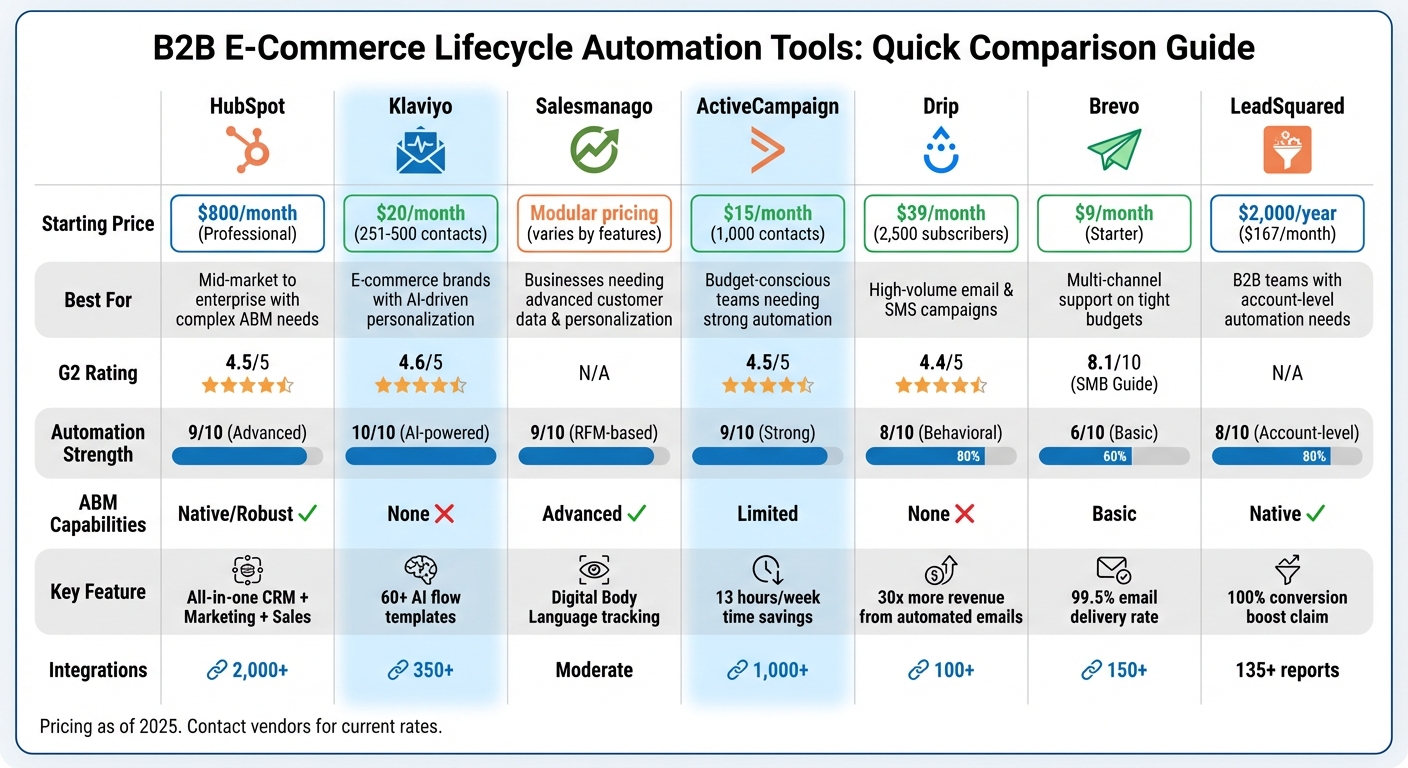
B2B E-Commerce Lifecycle Automation Tools Comparison: Features, Pricing & Ratings
The Truth About B2B Marketing Automation
sbb-itb-a84ebc4
1. HubSpot
HubSpot stands out in the B2B e-commerce space by offering a unified platform that simplifies engagement across multiple decision-makers. By combining CRM, marketing automation, and sales tools, it provides a seamless way to track interactions with all stakeholders within target accounts.
Pricing
HubSpot's Marketing Hub starts with a free basic version, while its Professional and Enterprise tiers are priced at around $800/month and $3,200/month, respectively. The Sales Hub follows a similar pricing structure, with onboarding fees for both Professional and Enterprise plans. For businesses needing both marketing and sales tools, the bundled Customer Platform starts at $1,139/month for the Professional tier (6 seats included) and $4,090/month for the Enterprise tier (8 seats).
With its pricing flexibility, HubSpot also delivers strong automation tools that enhance lead engagement.
Lead Nurturing Features
HubSpot uses "If/Then" logic to guide leads from Marketing Qualified Leads (MQL) to Sales Qualified Leads (SQL) based on their engagement. Its Smart Content feature adjusts dynamically, offering introductory content to new visitors and more advanced resources to returning clients.
The lead scoring system evaluates prospects based on their actions - like clicking links, requesting demos, or signing up for trials. Sales teams can leverage sequences, which are automated email series that stop automatically when a contact replies or schedules a meeting. These tools simplify the complexity of buyer journeys. For instance, the Expert Institute used HubSpot to run a single automated email campaign, achieving a 200% increase in conversions, a 20% boost in click-through rates, and a 60% rise in email open rates.
Account-Based Marketing (ABM) Capabilities
HubSpot's ABM tools are designed to handle the intricacies of multi-stakeholder purchase decisions. The platform identifies buying roles - such as Decision Maker, Budget Holder, Influencer, or Blocker - to deliver tailored messaging. Its Ideal Customer Profile (ICP) Tiering system automatically categorizes companies into tiers, helping teams focus on high-value accounts.
The Target Accounts Home dashboard gives teams a centralized view of account activity, including associated contacts, open deals, and tracked page views. Ryan Batter, Senior Manager at HubSpot, explains:
The beauty of using an ABM strategy is that it's customizable to a team's readiness and budget. Look for a CRM that enables strong integrations to ABM-specific tools to customize your strategy.
Additionally, HubSpot allows teams to sync LinkedIn Ads for precise targeting of key accounts and use Slack integration commands like /hs-report-company to pull instant metrics without leaving their workspace.
Integration Options
HubSpot connects with over 1,500 apps through its App Marketplace, plus an additional 3,000+ applications via Zapier. For B2B e-commerce, the Shopify integration centralizes customer and order data, enabling automated workflows like abandoned cart recovery and post-purchase follow-ups. Sales teams benefit from tools like LinkedIn Sales Navigator for prospecting, PandaDoc for tracking proposals, and communication platforms such as Zoom, Aircall, and Gmail, which automatically log client interactions.
These integration options make HubSpot a powerful choice for businesses looking to streamline automation and enhance their workflows.
2. Klaviyo
Klaviyo presents itself as an AI-driven platform tailored for e-commerce brands managing large-scale customer relationships. While traditionally focused on B2C, it also caters to B2B e-commerce by treating business buyers as individuals, capturing every interaction through Unified Customer Profiles. This unique approach helps Klaviyo stand out as we delve into its pricing and standout features.
Pricing
Klaviyo's pricing structure grows alongside your business. It offers a free tier, which supports up to 250 contacts and 500 email sends per month, including built-in flows and SMS capabilities. For those with larger needs, the Email Plan starts at $20/month for 251–500 contacts, while the Email + SMS Plan begins at $35/month for the same number of contacts. As your audience expands, you'll pay about $150/month for 10,000 contacts and roughly $720/month for 50,000 contacts. Cameron Faist, VP of Growth at Aura Bora, shared:
We look at Klaviyo as a no-cost channel. We absolutely saw a better P&L for our DTC side of the business as a result.
Lead Nurturing Features
Klaviyo shines when it comes to lead nurturing with its 60+ flow templates, which can be triggered by real-time behaviors, milestones, or subscriber data. Its advanced segmentation allows businesses to filter contacts by criteria like industry, role, company size, or lifecycle stage. On top of that, Klaviyo's AI-powered tools automate flow creation, optimize web forms, and use predictive analytics to forecast order dates or identify churn risks. For example, in 2025, Every Man Jack, a men’s personal care brand, replaced their static 30-day reminders with AI-driven personalized reorder predictions, leading to a 25% revenue boost from flows year-to-date.
The platform also employs conditional and trigger splits to customize flows based on cart value, product categories, or attributes like VIP status, making it easier to navigate complex B2B buyer journeys. John Pagni, Ecommerce Assistant at Wilkinson Sword, explained:
We retarget people based on what they've clicked within an email. After they click, we send them another email that's directly related to what they expressed an interest in. Through that we get really high open rates - around 60 percent.
Integration Options
Klaviyo integrates with over 350 pre-built tools and offers APIs to unify data from e-commerce, shipping, and advertising platforms. Popular native integrations include Shopify, WooCommerce, BigCommerce, and Magento, enabling real-time syncing of product catalogs and purchase histories. Through Zapier, Klaviyo connects to over 8,000 apps and 450 AI tools, streamlining lead management. For B2B users, it works seamlessly with Salesforce and HubSpot to sync key account data, and integrates with LinkedIn for full-funnel marketing and retargeting campaigns. Johnathan Ruggiero, Co-founder of Manly Bands, emphasized:
I'd have to buy 2–3 additional tools to replace everything Klaviyo offers. It's all under one roof with Klaviyo, and everything's working together.
These integrations make Klaviyo an excellent choice for businesses looking to consolidate their data and streamline workflows.
3. Salesmanago
Salesmanago is a Customer Data Platform (CDP) tailored for e-commerce businesses looking to scale their personalization efforts. Unlike tools that focus primarily on email marketing, Salesmanago tracks Digital Body Language, capturing real-time browsing activities like visited pages, time spent, search terms, and button clicks. This data builds detailed behavioral profiles. These insights fuel its RFM (Recency, Frequency, Monetary) Marketing Automation, which segments customers and creates workflows based on their actual buying habits. Pawel Dabrowski, Omnichannel Director at Nahdi, highlighted its impact:
Segmentation, personalization, automation of communication, and the CDP give us that edge we need to exceed the expectations of our website visitors and deliver exceptional business results.
Pricing
Salesmanago offers a Growth Framework with four tiers to match different business needs. The Single Store tier focuses on basic email marketing with minimal personalization. The Accelerating Growth tier includes multi-language support, SMS, and basic automation. For businesses ready to scale, the Increasing Customer Base tier introduces advanced personalization across multiple stores. The top-tier, 1:1 at Scale, delivers real-time data processing and orchestrates omnichannel experiences. Pricing is modular, so businesses can pay only for the features they need, such as Customer Data Value or Marketing Automation. Next, let’s dive into how Salesmanago enhances lead nurturing.
Lead Nurturing Features
Salesmanago uses automation tools to design intricate workflows that guide leads through automated marketing funnels using triggers, conditions, and actions. Communication is synchronized across email, SMS, web push notifications, social media, and live chat, ensuring a unified experience at every touchpoint. Dynamic emails sent through the platform achieve a 183% higher open rate compared to generic mass emails, and automated emails show a 177% higher click-through rate. Karol Bzymek, Head of Digital & IT CEE, shared:
Implementing process automation not only enhances customer engagement but also enables the reactivation of dormant customers at the opportune moment. Real-time monitoring functionalities aid in creating more refined segments.
Salesmanago's automation supports 31% of transactions in client stores, and email campaigns can see effectiveness increase by up to 1,200% when using dynamic messaging instead of standard mass communication. The platform also excels in Account-Based Marketing (ABM) for targeting high-value clients.
Account-Based Marketing (ABM) Capabilities
Salesmanago’s ABM tools focus on identifying and engaging high-value accounts. Its Customer Segmentation Center enables hyper-segmentation in real time. Using AI-driven recommendations and dynamic content, the platform delivers personalized experiences tailored to specific accounts. A company identification feature identifies visiting businesses, making it easier to reach decision-makers. Campaigns are coordinated across multiple channels, including email, SMS, mobile apps, web push, and social media. Some implementations have achieved a staggering 5,700% ROI with these features.
Integration Options
Salesmanago integrates with popular platforms like Shopify, WooCommerce, Zoho, and WordPress. For advertising, it connects to Facebook Ads and Google DoubleClick, supporting personalized remarketing campaigns. Businesses with unique needs can utilize the Open API and developer tools to integrate their proprietary systems. Valeria Barahona, Ecommerce Manager, noted:
SALESmanago allowed us to easily scale our eCommerce [...] Thanks to a very simple integration process, we were able to simplify our growth and make it faster and faster.
Salesmanago’s seamless integrations help centralize customer data, creating a comprehensive view that supports real-time monitoring and automated omnichannel workflows.
4. ActiveCampaign
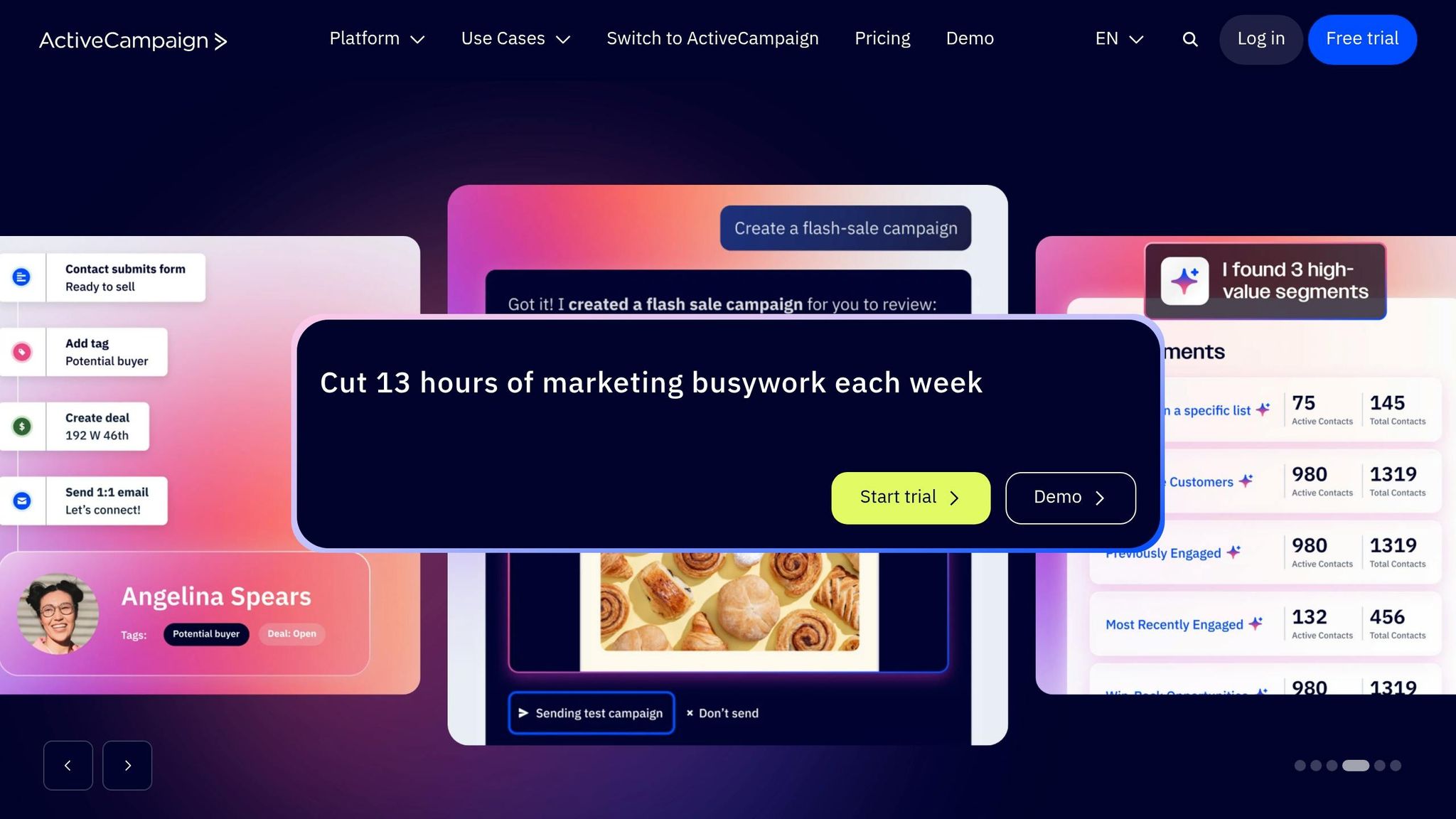
ActiveCampaign combines marketing automation with CRM tools, making it a go-to platform for over 150,000 businesses. With a strong 4.5/5 rating on G2, it stands out by seamlessly merging marketing and sales data using top marketing funnel software. Its Active Intelligence feature tracks user behavior in real time, automatically adjusting strategies. This not only improves efficiency but also saves businesses an average of 13 hours per week on repetitive marketing tasks. By building on earlier solutions, ActiveCampaign simplifies lead engagement and account targeting even further.
Pricing
ActiveCampaign offers four pricing plans tailored to different needs:
- Starter: $15/month for up to 1,000 contacts, including basic marketing automation and email tools.
- Plus: Adds site tracking and conditional content.
- Pro: At $79/month, it includes advanced segmentation, predictive content, and supports three users.
- Enterprise: Priced at $145/month, offering premium CRM integrations and dedicated support.
Optional features like Enhanced CRM, SMS, and WhatsApp messaging are also available.
Lead Nurturing Features
ActiveCampaign automates the entire customer journey, from welcoming new leads at the Top-of-Funnel (TOFU) to delivering personalized demos and case studies at the Bottom-of-Funnel (BOFU). Its dynamic lead scoring monitors engagement - tracking activities like email opens and site visits - and alerts sales teams when a lead becomes "hot".
For e-commerce, it efficiently handles abandoned cart recovery, personalized product recommendations, and automated reorder reminders. For example:
- Motrain saw a 120% increase in conversion rates and saved 15 hours weekly with personalized outreach.
- Morrow Audio improved its cart abandonment recovery to 26% - 3.7 times the industry average - bringing in $30,000 in recovered revenue.
Account-Based Marketing (ABM) Capabilities
ActiveCampaign’s ABM tools focus on high-value deals using account records, sales routing, and AI-driven Win Probability scores. It tailors landing page content dynamically based on factors like industry, location, or company size. Additionally, it integrates with platforms like Facebook, Google, and LinkedIn for coordinated follow-ups.
Features like the AI-powered builder and Predictive Sending further enhance workflow creation and email timing.
Integration Options
ActiveCampaign connects with over 950 native apps, including Shopify, WooCommerce, BigCommerce, Magento, Salesforce, and Microsoft Dynamics. Its Deep Data sync enables if/then automation based on product categories. Extensions for Chrome and Outlook allow users to manage CRM tasks directly from their inbox. Plus, with Zapier integration, businesses can tap into 8,000+ apps for custom workflows.
One example: Bonjoro saved tens of thousands of dollars annually by streamlining their nurturing process with custom fields.
5. Drip
Drip is an ECRM designed for behavioral tracking and customer insights, primarily aimed at B2C and DTC businesses. However, it also serves B2B e-commerce, particularly for high-volume, individual transactions. It scored 8.2 out of 10 on SMB Guide, receiving a strong 9/10 for its marketing automation and campaign tracking capabilities. Below, we’ll dive into its pricing, lead nurturing features, ABM limitations, and integration options.
Pricing
Drip’s pricing structure is based on the number of active contacts:
- $39/month for up to 2,500 subscribers
- $89/month for 2,501–5,000 contacts
- $154/month for 5,001–10,000 contacts
All plans include unlimited email sends, while SMS is offered as a pay-as-you-go option. A 14-day free trial is available, and no credit card is required to get started.
Lead Nurturing Features
Drip automates email and SMS campaigns using behavioral triggers, such as user actions or inactivity, to keep communication running smoothly. Its lead scoring relies on the FIT + PAIN methodology, which evaluates prospects based on demographics (e.g., job title, company size) and behavioral data (e.g., product engagement) to identify high-value opportunities. Automated emails have been shown to generate up to 30x more revenue compared to manual outreach.
The platform’s visual workflow builder comes with over 30 pre-built templates tailored for e-commerce, and its dynamic personalization uses IP data and browsing history to deliver tailored content. Drip supports the entire customer journey - from awareness (educational content) and consideration (product demos) to conversion (clear CTAs), engagement (onboarding), and renewal (automated follow-ups). Its segmentation tools allow filtering by factors like demographics, job title, journey stage, and purchase history, with segmentation accounting for roughly 23% of email engagement.
Account-Based Marketing (ABM) Capabilities
Although Drip excels in lead nurturing, its ABM features are limited. It doesn’t include account scoring, company-level hierarchies, or tools for aligning sales and marketing efforts. This makes it better suited for high-volume, individual-buyer transactions typical in B2C settings, rather than the complex, multi-stakeholder sales processes seen in B2B e-commerce. For businesses requiring advanced ABM tools, other platforms might be a better fit.
Integration Options
Drip connects with over 100 e-commerce platforms, including Shopify, Shopify Plus, WooCommerce, BigCommerce, and Magento, offering deep native integrations. It also syncs with payment processors like Stripe, PayPal, and Klarna, pulling real-time data - such as cart activity and inventory levels - into workflows for highly personalized campaigns. Multichannel retargeting is possible through integrations with Facebook Custom Audiences and Instagram. Additionally, Drip supports CRM synchronization with Salesforce and HubSpot, and its segmentation capabilities extend to over 70 unique events and zero-party data points.
"Drip automatically tracks every customer interaction with your store, from browsing behavior to purchase patterns, then uses that data to trigger hyper-targeted automation sequences." - Remy Frost, Author, Labnify
6. Brevo
Brevo is a multi-channel platform trusted by over 500,000 businesses, designed to streamline lifecycle automation with a volume-based pricing model that's particularly appealing for B2B e-commerce. With a 99.5% email delivery rate and reports of clients boosting revenue by 42%, Brevo stands out as a reliable option. Below, we’ll dive into its pricing structure, lead nurturing tools, ABM capabilities, and integration options.
Pricing
Brevo's pricing is based on email volume, making it flexible for businesses of different sizes:
- Free Plan: $0/month, allowing 300 emails per day (up to 9,000 emails monthly) and marketing automation for up to 2,000 contacts.
- Starter: Starting at $9/month, includes 5,000+ emails with no daily sending limits.
- Standard: From $18/month, adds A/B testing, send-time optimization, and landing pages.
- Professional: Starting at $499/month, supports 150,000+ emails, contact scoring, and multi-user access.
All plans come with multi-channel functionality, covering email, SMS, WhatsApp, and push notifications.
Lead Nurturing Features
Brevo simplifies lead nurturing with its drag-and-drop workflow builder. The visual editor allows users to create automated sequences for tasks like welcome emails or abandoned cart follow-ups using a profitable sales funnel. Lead scoring is another standout feature, assigning points based on engagement (e.g., email clicks, page visits) or specific attributes like email domain matches. Once a lead hits a predefined score (e.g., 80–90 points), workflows can automatically flag them as high-priority.
Personalization is a key focus, offering dynamic product recommendations, adaptive content, and AI-driven send-time optimization. Businesses using abandoned cart emails often see a 10–15% boost in revenue, while nurtured leads are 47% more likely to convert.
Segmentation tools further enhance campaigns by filtering audiences based on behavioral data (e.g., purchase history, last login), demographic details, and real-time web activity.
"I don't have time to spend hours understanding how to set things up. Brevo's campaign builder is very straightforward. I can create professional emails in minutes." - Paul Lacitinola, Owner, Vintage Camper Trailers
Account-Based Marketing (ABM) Capabilities
Brevo offers basic ABM features, including domain-based scoring and centralized data alignment. However, it lacks more advanced tools like detailed account-level tracking and sales orchestration. As a result, it’s better suited for B2B e-commerce businesses focused on high-volume transactions rather than those requiring intricate ABM strategies.
Integration Options
Brevo supports over 150 integrations, including major e-commerce platforms like Shopify, WooCommerce, PrestaShop, and Shopware. Through Zapier, it connects with more than 8,000 apps and 450 AI tools. Its robust API enables email, SMS, and WhatsApp integration, while SMTP relays and webhooks make CMS connections seamless.
The platform’s Data Platform helps unify customer profiles by importing data from databases, warehouses, FTP, or APIs. With a 4.5/5 rating on G2, users appreciate its user-friendly design and campaign flexibility, though some wish for a broader selection of pre-built email templates.
7. LeadSquared
LeadSquared is tailored for B2B sales and marketing teams navigating intricate buyer journeys. It claims to deliver a 100% boost in conversions through account-level automation, making it especially effective for managing multiple stakeholders within the same organization.
Pricing
LeadSquared offers two marketing automation plans, billed annually:
- Marketing Pro: Priced at $2,000 per account, this plan includes features like list segmentation, website event tracking, 100,000 emails per month, and basic automation.
- Marketing Super: At $3,500 per account, this plan adds advanced automation, 250,000 emails per month, an AI-powered email parser, and access to the LeadSquared Analytics Platform.
Both plans also include 1,000 to 2,000 chatbot sessions per month, depending on the tier. Let’s dive into how LeadSquared’s features enhance lead nurturing.
Lead Nurturing Features
LeadSquared’s drag-and-drop workflow designer simplifies mapping complex B2B buyer journeys. It allows for alternate paths based on user actions, such as downloading a whitepaper versus visiting a pricing page. Multi-channel engagement ensures prospects are reached through email, SMS, WhatsApp, or social media retargeting, catering to their preferred communication channels.
The platform’s behavioral lead scoring assigns points for high-intent actions. For instance, visiting a pricing page might score 15 points, helping sales teams zero in on the most promising leads. Additionally, real-time alerts notify sales reps when nurtured leads take key actions, significantly reducing response times - some users report an average response time of just 2.7 minutes.
"We now engage our customers through emails that are relevant, instead of flooding everybody's inbox with the same messages. There are multiple triggers and data points to design who gets what emails." - Srikanth Acharya, CEO, Offineeds
Account-Based Marketing (ABM) Capabilities
LeadSquared takes lead nurturing a step further with its Account Automation feature, which triggers workflows based on organization-level activities rather than individual actions. By mapping contacts to organizational accounts via email domains, it enables sales teams to manage multiple deals within a single account, assign different owners, and tailor follow-ups for various products or services.
Aniket Roy, Head of Inside Sales at DotPe, shared that LeadSquared helped his team track leads more effectively, leading to a 30X increase in leads. The platform has also been credited with reducing lead leakage to as low as 0.1%.
Integration Options
LeadSquared seamlessly integrates with popular e-commerce platforms like Magento and BigCommerce, syncing customer data and purchase intent in real-time. It also connects with communication tools such as WhatsApp Business API, RingCentral, and Ozonetel, centralizing B2B conversations. Additionally, it captures leads automatically from websites, chatbots, and social media platforms like LinkedIn and Facebook.
For more advanced customization, LeadSquared offers open REST APIs and a developer platform (Lapps) for building JavaScript-based processes. The platform supports over 135 real-time reports, enabling businesses to analyze everything from campaign performance to sales outcomes.
"LeadSquared saves 20-30% of my time. With a click of a button, I can analyze our marketing campaigns using detailed reports to find out what's working and what isn't." - Kayla Ferland, Business Development Manager
Pros and Cons
When it comes to B2B e-commerce tools, each platform brings its own strengths and limitations. Let’s break down the key details to help you weigh your options.
HubSpot is often seen as the go-to choice for mid-market companies. It’s earned a 4.5/5 rating on G2 and was named the #1 Marketing Product for small, mid-market, and enterprise companies in 2025. Its all-in-one platform delivers impressive results, with marketing customers reporting a 167% boost in website traffic and three times more inbound leads. However, this robust functionality comes with a steep price tag. Professional plans start at $800–$890 per month, and there’s also a required $3,000 onboarding fee. This pricing might be out of reach for smaller teams.
ActiveCampaign is a strong contender for B2B teams working with tighter budgets. Starting at just $15 per month for 1,000 contacts, it offers advanced automation with up to five triggers per workflow. The platform boasts a 94.2% deliverability rate, a 4.5/5 G2 rating from over 14,500 reviews, and customers using its AI features have reported 40% higher revenue. However, its CRM falls short when it comes to advanced forecasting for complex B2B sales cycles.
Klaviyo shines in the e-commerce space with its automation features, Shopify integration, and a revenue-focused dashboard. It holds a 4.6/5 rating on G2 and is free for up to 250 contacts, with paid plans starting at $45 per month. That said, Klaviyo is more suited for B2C businesses. It lacks crucial B2B CRM tools like deal pipelines and sales workflows, making it a less ideal choice for high-touch B2B sales.
"Klaviyo is great for basic ecommerce email. But when you need CRM, landing pages, and automation that actually scales, ActiveCampaign does what Klaviyo can't".
Brevo stands out for its affordability, offering a free tier and paid plans starting at $65 per month. It’s a solid pick for email-heavy campaigns and complies with EU data regulations. However, its automation capabilities score only 6/10, and it does not support account-based marketing (ABM), which limits its appeal for more sophisticated B2B strategies.
Drip focuses on e-commerce lifecycle automation and starts at $39 per month for up to 2,500 subscribers. While it delivers in automation, it lacks a built-in CRM, requiring third-party integrations to handle full-scale B2B sales management.
Here’s a quick comparison table to help you decide which tool aligns best with your business needs:
| Tool | Starting Price | Automation Depth | CRM Strength | ABM Support | Integrations | G2 Rating |
|---|---|---|---|---|---|---|
| HubSpot | $800/mo (Pro) | 9/10 | 8/10 | Native/Robust | 2,000+ | 4.5/5 |
| Klaviyo | $45/mo | 10/10 | 4/10 | None | 350+ | 4.6/5 |
| ActiveCampaign | $15/mo | 9/10 | 6/10 | Limited | 1,000+ | 4.5/5 |
| Brevo | $65/mo | 6/10 | 4/10 | None | Limited | 8.1/10 |
| Drip | $39/mo | 8/10 | 2/10 | None | Moderate | 4.4/5 |
This table highlights the standout features and limitations of each platform, making it easier to pinpoint the right fit for your B2B e-commerce goals.
Conclusion
Our analysis highlights how advanced lead nurturing and strategic account-based marketing (ABM) can deliver measurable results. The key lies in choosing a lifecycle automation tool that aligns with your business model and strengths. For B2B operations that require seamless CRM integration, ActiveCampaign offers robust automation starting at just $15–$29 per month, making it a strong option for small to medium businesses. Businesses that excel in lead nurturing can achieve 50% more sales-ready leads while reducing costs by 33%. Selecting a tool that complements your workflow is not just a choice - it’s an investment in growth.
For transactional e-commerce businesses, Klaviyo's predictive analytics make its pricing worthwhile. On the other hand, HubSpot continues to be the go-to solution for mid-sized and larger enterprises, with pricing starting at $800+ per month for its all-in-one platform. Each tool offers unique advantages, so your decision should reflect your specific operational needs and priorities.
"Automation should not drive your go-to-market strategy, it should implement it." – Omnibound
If budget is a concern, Brevo (formerly Sendinblue) provides multi-channel support, including email, SMS, and WhatsApp, starting at $25–$65 per month. Begin with a simple setup, then scale by mapping your buyer journey, integrating with your CRM or e-commerce platform, and focusing on a few key actions that bring "first value" to new customers. With 75% of B2B marketers planning to increase their automation budgets in 2025, the right platform can help turn nurturing sequences into a 15–30% boost in trial-to-paid conversions.
To maximize efficiency and conversions, aligning your funnel strategy with the right automation tool is essential. For more resources on building effective marketing funnels and improving your customer journey, check out the Marketing Funnels Directory. It offers curated tools, courses, and guides tailored for B2B e-commerce success.
FAQs
Do I need a CRM, or is email automation enough for B2B e-commerce?
For B2B e-commerce, email automation is great for running simple campaigns and keeping engagement fast and efficient. But when it comes to managing longer, more intricate sales cycles, tracking every interaction, and building lasting relationships, a CRM becomes essential. The best approach often combines both tools: email automation simplifies communication, while a CRM serves as a central hub for account-based marketing and lead management. Together, they help businesses build stronger connections and stay on top of customer activity.
How do I know if my business needs ABM features?
To figure out if ABM features fit your business, consider how much you focus on high-value B2B accounts, your marketing sophistication, and the resources you have available. If your strategy revolves around a select group of high-value accounts and you prioritize personalized campaigns, ABM tools can help improve targeting, engagement, and performance tracking. On the other hand, if your marketing approach is more general and not tailored to specific accounts, ABM features might not be the right fit just yet.
What integrations matter most before choosing a tool?
When picking a lifecycle automation tool for B2B e-commerce, it's crucial to focus on integrations that streamline operations and save time. Some of the most important integrations to look for include:
- CRM and ERP systems: These help with syncing data, streamlining order processing, and managing inventory efficiently.
- Marketing automation platforms: These are essential for driving lead nurturing and improving customer engagement.
Additionally, pay attention to features like custom mapping, bidirectional synchronization, and API support. These ensure smoother workflows and help maintain a consistent experience for your customers.