Influencer marketing in 2026 is all about deeper connections, smarter tools, and shifting consumer expectations. With the creator economy projected to hit $33 billion, brands are prioritizing influencer partnerships as key performance strategies. Here are the top trends shaping the industry:
- Content with Depth: Audiences prefer meaningful, behind-the-scenes posts over polished, AI-generated content. Engagement thrives on expertise and personal stories.
- Micro-Influencers: Smaller creators (10k-100k followers) deliver higher ROI and engagement than celebrity influencers, building trust within niche communities.
- Collaborative Campaigns: Brands and influencers are co-creating products and campaigns, moving beyond transactional partnerships.
- Long-Form Videos: Platforms like YouTube and TikTok are embracing longer formats as users seek detailed, value-packed content.
- AI Tools: Generative AI is revolutionizing content production, from editing to repurposing, saving time and boosting efficiency with AI-powered workflows.
- Virtual Influencers: These AI-generated personas are growing fast but face skepticism due to authenticity concerns.
- Short-Form Series: Episodic storytelling hooks viewers and creates routine engagement, blending entertainment with subtle brand promotion.
- Multi-Platform Presence: Diversifying across platforms ensures reach and resilience against algorithm changes.
These trends reflect a shift from vanity metrics to trust-driven, impactful marketing. Brands that focus on meaningful partnerships and authentic storytelling are seeing higher returns, with influencer campaigns delivering an average 5.2:1 ROAS versus 3:1 for traditional ads. To thrive, brands must balance innovation with human connection.
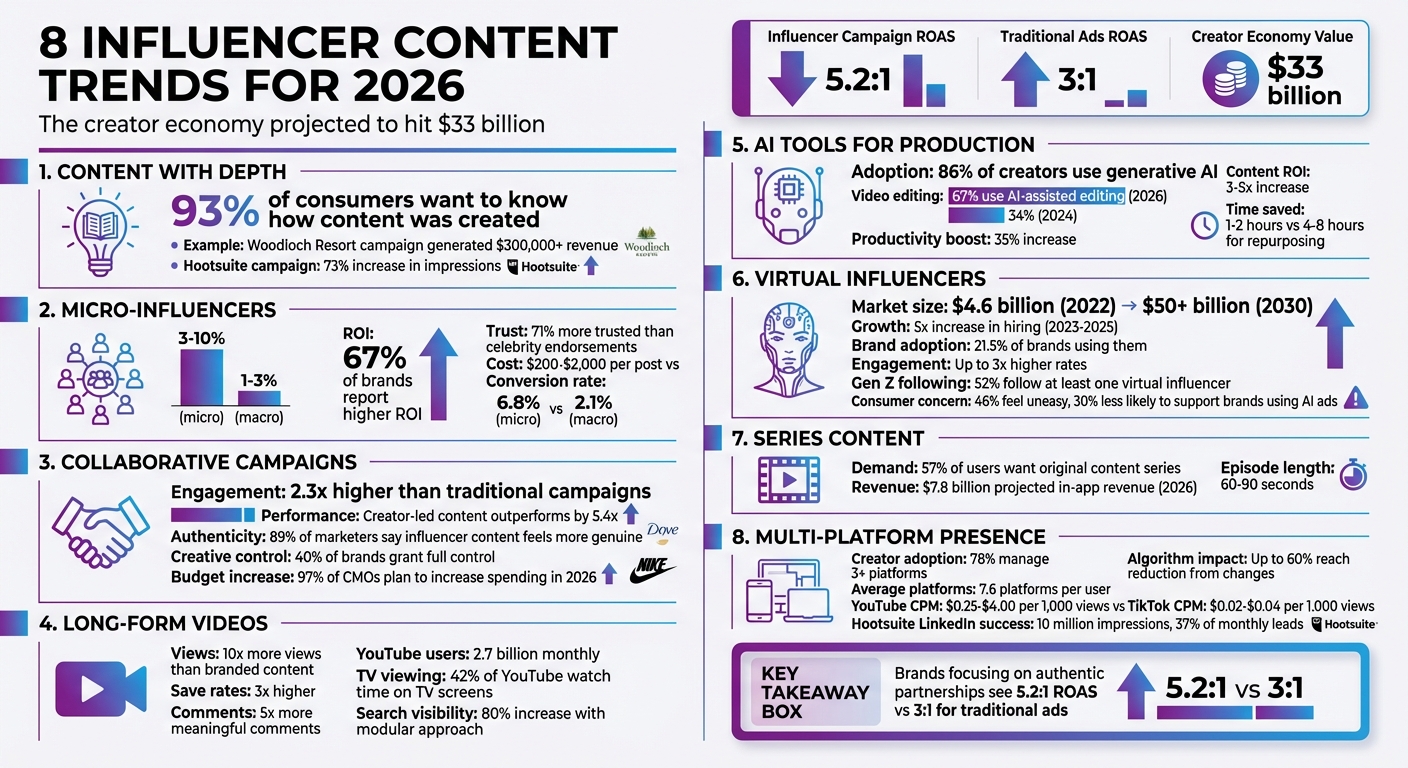
8 Influencer Marketing Trends for 2026: Key Statistics and ROI Data
Top 5 Influencer Marketing Trends & Predictions for 2026
sbb-itb-a84ebc4
1. Content with Depth and Value
As audiences grow weary of surface-level posts, the demand for meaningful, insightful content has skyrocketed. With AI-generated material flooding social media, people are gravitating toward creators who offer genuine information, personal experiences, and honest storytelling. In fact, 93% of consumers now believe it's important to understand how digital content was created or edited.
This shift highlights a craving for authenticity. Slight imperfections, unpolished behind-the-scenes clips, and unique personal touches are now seen as markers of quality. The Hootsuite Social Media Trends 2026 Report sums it up perfectly:
Audiences aren't rejecting AI tools; they're rejecting low-effort, uncurated output.
Brands embracing this trend are seeing real results. Take Woodloch Resort, for example. In early 2026, they teamed up with creators like @fitdadceo to share genuine family experiences through serialized storytelling. Under the leadership of Erica Bloch, their Associate Director of Communications, the campaign pulled in over $300,000 in revenue and drove significant engagement through saves and shares. Similarly, Hootsuite's influencer campaign focused on creators with trusted audiences rather than sheer follower numbers, leading to a 73% increase in impressions and over 1,000 content downloads.
The takeaway? Credibility trumps reach. Audiences value creators who bring expertise to the table - whether it's a chef demonstrating a technique, a historian providing context, or a parent sharing practical tips. Content that offers actionable knowledge continues to drive engagement in 2026.
For brands aiming to create impactful marketing campaigns, resources like the Marketing Funnels Directory provide tools and courses to help craft authentic, value-rich content for social media and beyond.
2. Micro-Influencers and Niche Communities
The world of influencer marketing is evolving fast. Instead of pouring budgets into celebrity endorsements with millions of followers, brands are realizing that smaller creators often deliver better results. Micro-influencers - those with follower counts between 10,000 and 100,000 - are achieving engagement rates of 3% to 10%, while macro-influencers with 500,000+ followers typically see rates between 1% and 3%. In fact, research shows micro-influencers can generate 5 to 40 times higher engagement rates compared to their larger counterparts.
The numbers speak volumes. A whopping 67% of brands report higher ROI from micro-influencer campaigns compared to macro-influencer efforts. Additionally, audiences trust micro-influencers’ recommendations 71% more than traditional celebrity endorsements. A direct-to-consumer skincare brand tested this theory in 2025: a macro-influencer campaign delivered a 2.1% conversion rate, but reallocating the same budget across micro-influencers with 15,000 to 50,000 followers resulted in a 6.8% conversion rate - and at a lower overall cost.
This trend highlights a shift toward more personal, trust-driven interactions. Industry strategist Jem Leslie notes a growing emphasis on "smaller, closed-off communities." Many micro-influencers are now creating private spaces - like Discord servers, Substack newsletters, and WhatsApp groups - where they can connect with their most engaged followers. These spaces allow for deeper, more meaningful interactions. When a micro-influencer recommends a product in such a setting, it feels less like an ad and more like advice from a trusted friend.
Brands are adapting by collaborating with 15 to 40 micro-influencers at once, enabling them to diversify their campaigns and target highly specific niche communities. This approach not only reduces the risk of a single influencer controversy derailing the campaign but also makes financial sense. Micro-influencers typically charge $200 to $2,000 per post, a fraction of the $10,000 to $100,000+ that macro-influencers command.
3. Collaborative Content Creation
As content strategies evolve, brands are increasingly turning to collaborative content creation, where influencers play a central role as partners rather than mere amplifiers. This shift emphasizes deeper engagement and authenticity, moving away from traditional influencer marketing to a more integrated approach.
Brands are no longer treating influencers as simple tools for reach. Instead, they’re involving creators from the very beginning - viewing them as strategic collaborators. This change, from "influencer-as-reach" to "creator-as-counsel", is transforming how products are conceived, marketed, and launched. By tapping into creators’ unique perspectives early on, brands are aligning themselves with the growing demand for more genuine and relatable content.
Take Dove, for example. In June 2025, the brand launched its #ShareTheFirst campaign, partnering with over 100 global creators who were given complete creative freedom over the tone, visuals, and storytelling. Within just 48 hours, the creators produced live content that was later displayed on digital screens at Liverpool Street Station, a hub for over 60 million passengers annually. The result? Collaborative efforts like this boast engagement rates 2.3x higher than traditional campaigns. Such partnerships are redefining how brands in the beauty industry connect with their audiences.
Some beauty brands are taking collaboration a step further by involving influencers in product development. In July 2025, Tower 28 worked with micro-influencer Toni Bravo, known as the "CEO of Blush", to create two blush shades designed for deeper skin tones. Bravo wasn’t just a face for the product - she was deeply involved in its creation. The limited-edition launch led to immediate sales success and a surge in user-generated content from her followers. Similarly, The Beauty Crop joined forces with creator Aisha Asunramu in May 2025 to develop a new lip kit after she highlighted the need for more inclusive shades in their lineup.
The data supports this collaborative approach. Creator-led content outperforms brand-first creative assets by 5.4x, and 89% of marketers agree that influencer-generated content feels more genuine than what brands produce internally. Additionally, 40% of brands now grant creators full creative control over their projects, while 97% of CMOs plan to increase budgets for creator marketing in 2026.
"We're making the shift from influencer-as-reach to creator-as-counsel." - Eve Lee, Founder, The Digital Fairy
This model of collaboration goes beyond marketing - it builds campaigns and products that genuinely resonate with audiences. By leveraging creators’ expertise and personal experiences, brands can craft offerings that feel authentic and meaningful, driving both engagement and innovation in their industries.
4. Long-Form Video Content
Long-form video content is making a strong comeback in 2026, offering audiences the depth they crave. With viewers growing weary of endless 15-second clips, they're now actively seeking content that provides real value and substance. The data backs this up: long-form creator content generates 10x more views than traditional branded content and achieves 3x higher save rates along with 5x more meaningful comments compared to short-form videos. This format not only boosts audience engagement, improves search performance, and allows brands to monitor social media for real-time feedback.
Social media platforms are adapting to this shift. For instance, 40% of Gen Z now treat social platforms as their primary search engines. Whether it’s product reviews or in-depth tutorials, people want comprehensive answers - something long-form videos deliver. Platforms like TikTok and Instagram have expanded their video length limits to 10 minutes and 15 minutes, respectively, while YouTube remains a powerhouse with 2.7 billion monthly users. Interestingly, 42% of YouTube's watch time now happens on TV screens, highlighting its dominance in the long-form space.
Creators and brands are capitalizing on this trend. In 2025, Gen Z creator Madeline Argy gained massive traction by releasing raw, 40+ minute videos exploring complex topics. Similarly, YouTube creator Druski introduced "Coulda Been House", a Big Brother-style reality series with a structured, limited format that kept viewers hooked. Even brands are getting creative - GoPro partnered with influencer Susi Vidal to produce a long-form cooking video shot entirely on the HERO13 Black, showcasing the product's versatility through relaxed, relatable storytelling.
"Today's buyers are consuming at least 13 pieces of long-form content before making a purchasing decision. They're researching you on YouTube, Reddit, LinkedIn, and TikTok long before your sales team even knows they exist."
- Irina Novoselsky, CEO, Hootsuite
The financial benefits of long-form content are undeniable. It delivers higher Revenue Per Mille (RPM) and creates more natural opportunities for sponsorships and affiliate marketing compared to short-form videos. Many creators are also adopting a modular approach - producing 10–20 minute videos and repurposing sections into short clips or platform-specific edits, which increases search visibility by 80% while extending reach without additional production time.
5. AI Tools for Content Production
AI has become a game-changer for influencers aiming to boost their output without exhausting themselves. In fact, 86% of global creators are already tapping into generative AI to streamline their content production. These tools take on tasks that used to demand full production teams - like video editing, captioning, trend analysis, and even content repurposing. This level of efficiency has made AI a must-have for creators.
One of the most common applications is automated video editing. Tools such as Descript allow users to edit videos by simply editing text, cutting out the need for complicated timeline-based software. As InfluenceFlow aptly describes it, "It's video editing for people who think like writers". The adoption of AI-assisted editing has surged, with 67% of video creators using these features in early 2026, compared to just 34% in 2024. These tools can handle tasks like removing backgrounds, resizing videos for different platforms (e.g., turning YouTube videos into TikTok-ready clips), and generating captions with over 95% accuracy.
AI also excels in content repurposing, saving creators hours of work. Many use a "Hub-and-Spoke" framework, where one long-form piece - like a podcast, blog post, or YouTube video - becomes the foundation for multiple smaller pieces of content. With AI, this process takes just 1–2 hours instead of 4–8 hours. The result? A 35% boost in productivity and a 3–5x increase in content ROI for those implementing these tools.
But it doesn’t stop there. AI-powered tools also provide predictive insights to guide creators. They analyze niche-specific data to suggest trending topics, recommend the best times to post, and even estimate a post’s potential reach before it goes live. This allows influencers to experiment more quickly and focus on strategies that deliver results. As Aspire explains, "AI won't replace talent. Instead, brands and creators will use AI to optimize performance, accelerate testing, and free up time for strategy".
"AI generation and cost-cutting measures let brands do more with less and contribute additional funds to their creative budgets."
6. AI-Generated Virtual Influencers
AI tools have already transformed how human creators produce content, but virtual influencers take this innovation to another level. These fully computer-generated personas don’t just assist creators - they are the creators. Designed to look and act like real people, virtual influencers create content, engage with followers, and collaborate with brands, all while being entirely controlled by creative teams or AI systems.
The industry is growing at an astonishing pace. In 2022, the global virtual influencer market was estimated at $4.6 billion, with projections suggesting it could surpass $50 billion by 2030. Between 2023 and 2025, the hiring of virtual influencers is expected to grow fivefold, with 21.5% of brands incorporating them into their strategies. This surge is largely because virtual influencers offer brands complete creative control. Unlike human influencers, these digital personas eliminate risks like public scandals or off-brand behavior, making them a safer choice for many campaigns.
Performance-wise, virtual influencers are no slouch. They often outperform their human counterparts, boasting engagement rates up to three times higher. Additionally, their appeal among younger audiences is undeniable - 52% of Gen Z consumers follow at least one virtual influencer. For instance, in late 2022, Nike teamed up with agency AKQA on an AI-powered campaign celebrating its 50th anniversary. The campaign reached 1.7 million viewers and increased Nike’s engagement by over 1,000% compared to typical benchmarks.
However, virtual influencers face some hurdles. One of the biggest challenges is their perceived lack of authenticity. While they offer consistency and scalability, 46% of consumers admit to feeling uneasy about brands using AI influencers. Furthermore, 30% say they’re less likely to support a brand if they know its advertisements are AI-generated. As ZenCreator aptly pointed out:
A virtual influencer cannot give a 'personal testimonial' about using a product they obviously can't use.
Because of these limitations, most brands are opting to use virtual influencers alongside human creators rather than as replacements. Virtual influencers excel in areas like high-concept campaigns, product demonstrations, and evergreen content. Meanwhile, emotionally engaging work - where genuine human connection is crucial - is still reserved for real people. This hybrid approach reflects a broader trend: embracing digital tools while preserving the authenticity that resonates with audiences.
Transparency plays a critical role in this balance. By 2026, platforms like TikTok and regions such as the EU will require brands to disclose AI-generated content. Brands that openly identify virtual influencers with hashtags like #VirtualInfluencer or #PoweredByAI can build trust, while those that conceal their use risk backlash. Virtual influencers shine when used strategically for specific purposes, but they’re no substitute for the human connection that drives genuine influence.
7. Series and Short-Form Drama Content
Influencers are stepping into the world of episodic storytelling, creating what some call a "brand universe." These series not only keep audiences coming back for more but also encourage routine viewing habits with scheduled episode drops. And the numbers back this shift - there’s a clear demand for this kind of content.
A whopping 57% of global social media users say they want original content series. This trend aligns with the growing appetite for engaging, relatable content that’s reshaping influencer marketing. On top of that, in-app revenue for micro-series is projected to hit $7.8 billion in 2026, more than doubling from the previous year. These short dramas, typically lasting 60–90 seconds, rely on sharp plot twists and cliffhangers to keep viewers hooked.
Brands are already jumping on this trend with notable success. Take Alexis Bittar, for example. In 2024, the jewelry brand launched "The Bittarverse", a mockumentary-style series featuring quirky recurring characters like Margeaux Goldrich and Jules/Hazel. The series cleverly showcased products within fun, social-first storytelling instead of relying on traditional ads. Similarly, the finance platform Bilt created "Roomies", a show about New York City roommates that focused on building emotional connections rather than directly promoting products. This approach helped foster goodwill among viewers.
So, why does this format work so well? It’s all about emotional investment. These series create the same kind of connection audiences feel with traditional TV shows. As creator Coco Mocoe puts it:
The routine that long-form creators give their audience through weekly podcast or YouTube uploads is something that even the most viral TikTokers and short-form creators fail to replicate... To transcend algorithms, you have to give your audience routine.
The interactive nature of these series also plays a big role. Fans often discuss unfolding storylines in the comments, creating a feedback loop that helps shape future episodes.
This strategy ties into what experts refer to as the "content barbell" - focusing on either ultra-short posts to grab quick attention or long-form series to build deeper engagement. Chad Woolard from B5K Digital explains it perfectly:
You either earn attention fast, or you earn it deeply. Everything in the middle is harder to justify.
Serialized storytelling taps into this deep engagement, making it a powerful tool for influencers and brands alike. It’s a trend that fits seamlessly with other emerging shifts in influencer marketing.
8. Multi-Platform Presence
Putting all your eggs in one basket when it comes to platforms can backfire - algorithm changes have been known to cut reach by up to 60% in certain niches. That’s why 78% of creators now manage content across at least three platforms. Diversifying isn’t just a nice-to-have anymore; it’s a way to protect your reach and stay relevant.
Let’s talk numbers: YouTube pays creators between $0.25 and $4.00 per 1,000 views, while TikTok offers a much smaller range - just $0.02 to $0.04. Meanwhile, the average social media user actively engages on 7.6 platforms. To connect with your audience, you need to meet them where they are.
Take Hootsuite’s CEO, Irina Novoselsky, for example. In 2025 and 2026, she leaned into LinkedIn with a video-heavy strategy that earned 10 million impressions in just three months. This effort helped drive 37% of the company’s monthly leads. Another success story comes from Woodloch Resort, which shifted from occasional PR stays to a long-term, multi-platform brand ambassador program. By tracking engagement metrics like saves and shares, they generated over $300,000 in revenue.
The key is being strategic. You don’t need to be on every platform, but you do need a thoughtful approach. Tamilore Oladipo from Buffer sums it up well:
Creators are using social feeds as the front door, while deeper relationships (and often revenue) live somewhere more controlled.
Fast-moving platforms like TikTok and Instagram Reels are great for discovery, but the goal should be to guide your audience to spaces you control - like newsletters or Discord - where algorithms can’t disrupt your progress. Allocating 10–15% of your creative energy to new and emerging platforms can also give you a head start before they become overcrowded. This ties into the broader trend of focusing on genuine connections with your audience.
AI-powered algorithms increasingly favor creators who maintain a consistent presence across platforms. In 2026, this multi-platform strategy isn’t just about expanding your reach - it’s about staying resilient, maximizing revenue opportunities, and ensuring you’re visible wherever your audience (and the algorithms) might be looking.
Conclusion
The eight trends discussed highlight a major shift in the influencer marketing landscape - moving away from surface-level metrics to strategies that focus on deeper, ecosystem-driven engagement. Algorithms are now favoring authentic interactions over vanity metrics like follower counts. At the same time, consumer skepticism toward AI-generated content is growing, with 53% of people reporting a lack of trust in AI-powered search results. This makes authenticity not just important, but essential for standing out.
The data backs up the power of influencer marketing: in 2025, brands saw an average Return on Ad Spend (ROAS) of 5.2:1 from influencer campaigns. That’s nearly double the typical 3:1 ROAS for paid ads. Whether your focus is on micro-influencers, leveraging social search, or building long-term partnerships with creators, success increasingly depends on having the right tools for discovering, tracking, and managing these efforts. Platforms like the Marketing Funnels Directory can provide the software, courses, and strategies you need to turn influencer content into real, measurable revenue.
The most successful brands in 2026 won’t just run influencer campaigns - they’ll create interconnected ecosystems. This means repurposing creator content across channels like email, paid ads, and websites while prioritizing metrics such as Customer Acquisition Cost (CAC) and Average Order Value (AOV) over simple likes or shares. As Sanchit Sareen from impact.com explains:
The most significant trend will be the holistic integration of the creator into the core marketing engine, which will see the traditional lines between 'brand' and 'performance' budgets finally blur.
If you’re looking to stay ahead, start small by testing partnerships with micro-creators. These focused collaborations can help you build authentic, scalable ecosystems that resonate with your audience. The opportunity to establish your brand as a trusted voice is here - but it won’t last forever.
FAQs
How do I pick the right micro-influencers?
To find the best micro-influencers in 2026, prioritize engagement quality, community trust, and audience alignment over sheer follower numbers. Aim for creators with follower counts between 10,000 and 100,000, focusing on those with solid engagement rates (typically 3–10%) and genuine connections within their niche. Assess their relevance to your brand by reviewing their past content, credibility, and how well their values match your own. This approach ensures they can help achieve your goals and provide measurable returns on investment.
What metrics matter most beyond likes and followers?
Key metrics that go beyond just likes and followers include engagement rates, audience demographics, sentiment analysis, and predictive growth forecasting. These provide a clearer picture of audience behavior and influence, helping brands refine their strategies for 2026.
When should brands use virtual influencers?
Brands can turn to virtual influencers when looking for fresh, reliable, and budget-friendly ways to connect with their audience. These digital personas are great at keeping a brand's image consistent, trying out different content styles, and tapping into specific, hard-to-reach markets. They shine when it comes to futuristic branding, delivering clear and precise messages, and fitting seamlessly into tech-focused strategies like social commerce or live shopping. This makes them an ideal choice for campaigns that aim to be immersive and cutting-edge.