Most A/B tests should run for at least 2 to 4 weeks - and never less than one full 7-day cycle. I’d set the length before launch based on traffic, conversion rate, minimum lift worth detecting, and your confidence target.
Here’s the short answer:
- High-traffic checkout tests: often 7 to 14 days
- Mid-traffic signup or trial tests: often 14 days to 4 weeks
- Low-traffic B2B lead-gen tests: often 3 to 6 weeks
- Less than 7 days: often too short because weekday and weekend behavior can skew results
- 95% confidence and pre-set stop rules are common defaults
- Many teams wait for 1,000 conversions per variant before making a call
A simple rule I’d use:
- Calculate the sample size you need per variant
- Divide that by daily traffic per variant
- Make sure the test also covers at least one full 7-day cycle
- Don’t stop early just because one version looks ahead
For example, if I need 10,000 visitors per variant and I get 250 visitors per variant per day, the test will take about 40 days. If that’s too long, I’d change the test - not force a short timeline.
| Funnel type | Common run time | Notes |
|---|---|---|
| Checkout | 7 to 14 days | Higher traffic, faster read |
| Signup/trial | 2 to 4 weeks | Mid-funnel, needs more volume |
| Lead gen/demo | 3 to 6 weeks | Lower volume, slower downstream data |
The main point is simple: test length should come from math and calendar coverage, not impatience. The best stopping point is the shortest window that hits sample size, covers weekly behavior, and fits your funnel stage.
How Long to Run A/B Tests And Why Peeking Hurts
sbb-itb-a84ebc4
How to Calculate Test Length From Traffic and Conversion Rate
Set a target run time before you launch. That common 2-to-4-week range only makes sense if your traffic and conversion volume can support it.
The Four Inputs That Set Duration
| Input | What It Means | Effect on Duration |
|---|---|---|
| Daily traffic per variant | Unique visitors seeing each version per day | More traffic → shorter test |
| Baseline conversion rate | Your current conversion rate before the test | Lower rate → longer test |
| Minimum detectable effect (MDE) | The smallest lift you actually care about | Smaller MDE → longer test |
| Confidence level | How certain you need to be the result isn't random | Higher confidence → longer test |
These four inputs drive test length: traffic, baseline conversion rate, MDE, and confidence level. More traffic shortens the run. Lower conversion rates, smaller MDEs, and higher confidence push it out longer. A good default is 95% confidence, and many teams hold off on a decision until they see at least 1,000 conversions per variant.
Turning Required Sample Size Into Days or Weeks
Once your sample-size tool gives you the required visitors per variant, turn that into time with a simple formula: divide required visitors per variant by daily visitors per variant.
Say each variant needs 10,000 visitors and you have 500 daily visits split evenly across versions. That puts the test at about 40 days. And this is where funnel depth matters. A CTA-click test can fill up fast. Tests tied to checkout, SQL, booked calls, or purchases usually take much longer because fewer people make it that far.
Hitting sample size doesn't always mean you're done, either. Calendar effects can still stretch the run.
What to Do When Traffic Is Too Low
If the math says the test will take too long, change the experiment - don't force the timeline. When traffic is low, you can test a bigger change, move the test to a page with more traffic, or track an earlier step in the funnel. For example, measuring CTA clicks or Add to Cart actions instead of completed purchases will usually get you to a read faster.
Next, check whether the test window covers the full weekly cycle.
Why Weekday Effects and Business Cycles Change the Answer
Calendar timing matters because conversion behavior changes across the week.
Run Long Enough to Cover Weekday vs. Weekend Behavior
Traffic quality and buyer intent shift from one day to the next, so the test should run for at least one full 7-day cycle. Running it for 14 days gives you two full weekly cycles to compare against each other. That helps cut down the risk of calling a winner based on an early spike, messy chart movement, or just one odd week.
Once your test window covers a full weekly cycle, set the stop rule before launch and leave it alone.
Match the Test Window to the Funnel Stage
The deeper the metric, the longer the test usually needs to run. Top-of-funnel tests often hit sample size sooner, but downstream metrics like lead-to-sale rate or revenue per visitor need more time to settle.
That issue shows up even more in low-volume B2B funnels, where a longer run is often unavoidable. In that case, use a proxy metric that has a proven link to revenue, while still tracking final revenue and quality guardrails. It gives you something usable to act on without making an early call from noisy downstream data.
Even when the calendar window is set up the right way, pre-set stop rules are what stop early noise from steering the decision.
Why Early Winners Mislead and How Stop Rules Prevent Bad Calls
What Peeking Does to Your Results
Once you set the test window, leave it alone.
Peeking is when you check results before the test ends and stop as soon as one variant looks like it’s ahead. That’s where teams get into trouble. Early jumps in conversion data happen all the time, and they often come from random noise - not a real pattern.
If you stop during one of those jumps, you can end up picking a false positive - a winner that vanishes after launch. And the more often you check, the more likely you are to react to noise instead of signal. Set the schedule before launch, then stick to it.
Set Stop Rules Before Launch
Write your stop rules before the test goes live.
Use three rules: a minimum sample size, a minimum runtime, and at least 95% confidence. Then pair the sample-size rule with the runtime you already planned. Once those rules are on paper, don’t move the goalposts because the chart starts looking good.
Those rules also shape which testing method makes sense.
Fixed-Horizon, Sequential, and Bayesian Testing: A Comparison
Different testing methods deal with early stopping in different ways.
| Testing Approach | Early Stopping | Best Fit |
|---|---|---|
| Fixed-Horizon (Frequentist) | Not allowed - must reach pre-set sample size and time | Stable, high-traffic funnel tests |
| Sequential Testing | Allowed - can stop as soon as significance is reached | Teams needing to cut spend on losing variants fast |
| Bayesian Testing | Moderate - based on chance of being best | Teams focused on probability-based risk decisions |
Fixed-horizon is a good fit for stable, high-traffic tests. Sequential testing lets you stop early without pushing up false positives. Bayesian testing works well when the team wants a probability-based view of risk.
From here, the next step is matching the method - and the test length - to your funnel type and traffic level.
How to Choose the Right Test Length: A Working Framework
A/B Test Duration by Funnel Type, Traffic & Risk Level
Recommended Duration by Funnel Type and Traffic Level
Use the sample-size target above to turn traffic into an actual test window. Test length comes from traffic, conversion rate, and funnel depth - not from a fixed date on the calendar. Funnel stage helps you estimate the likely minimum. Traffic tells you whether that timeline is even possible.
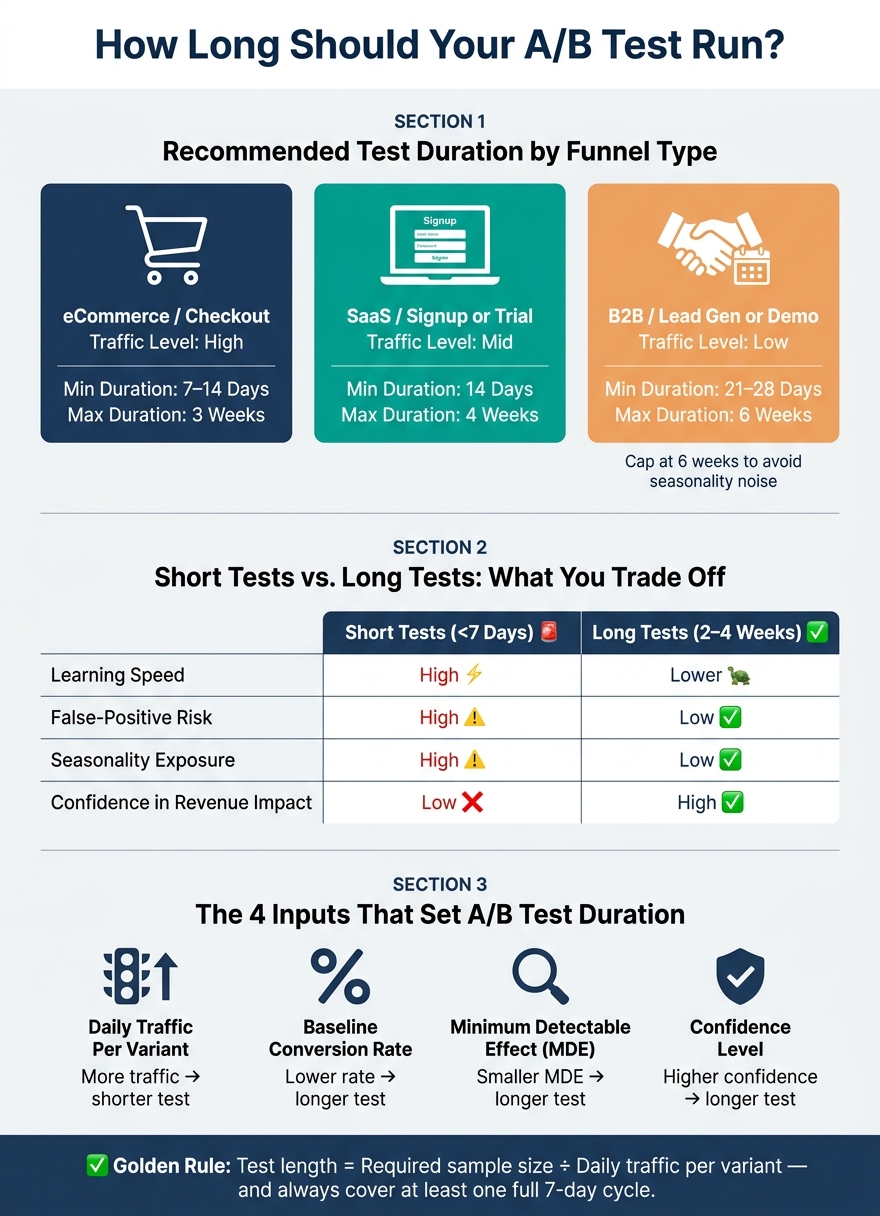
High-traffic checkout tests can wrap up in 7-14 days. Mid-traffic SaaS signup or trial tests usually need 14 days to 4 weeks. For low-traffic B2B lead-gen tests, cap the run at about 6 weeks before seasonality starts adding noise to the results.
The table below gives you a practical starting point by funnel type.
| Funnel Type | Traffic Level | Min. Days | Max. Weeks |
|---|---|---|---|
| eCommerce (Checkout) | High | 7-14 Days | 3 Weeks |
| SaaS (Signup/Trial) | Mid | 14 Days | 4 Weeks |
| B2B (Lead Gen/Demo) | Low | 21-28 Days | 6 Weeks |
Short vs. Long Tests: Speed, Risk, and Reliability
Once you know the likely range, the next call is simple: how much speed are you willing to trade for confidence?
Tests that run for less than 7 days often miss normal weekday-to-weekend swings. They're also more likely to produce false positives. A 2-4 week test takes longer, but it usually gives you a steadier read on what changed and whether that change matters.
| Feature | Short Tests (<7 Days) | Long Tests (2-4 Weeks) |
|---|---|---|
| Learning speed | High | Lower |
| False-positive risk | High | Low |
| Seasonality exposure | High | Low |
| Confidence in revenue impact | Low | High |
Conclusion: Plan Your Test Length Before You Launch
Calculate your required sample size before the test goes live. Tools like Evan Miller's or Optimizely's calculators make that part easy. Cover at least one full 7-day cycle. Use your pre-set stop rule.
Plan the window before launch, then stick to it unless sample size or cycle coverage is still incomplete. The goal is the shortest window that hits sample size, covers at least one full 7-day cycle, and matches your funnel depth.
FAQs
What is a good minimum sample size for an A/B test?
There’s no universal minimum sample size for an A/B test. It depends on a few things:
- your baseline conversion rate
- the minimum detectable effect you want to spot
- your desired statistical power, which is often set at 80%
Work out the required sample size before you start the test. That helps keep the results statistically reliable.
Small samples are a trap. They can produce misleading results and false positives, which means you may think a change worked when it didn’t.
Should I use a proxy metric if my final conversion takes too long?
Yes. When final conversions take too long to show up, proxy metrics can help you test faster.
In a marketing funnel, early signals like click-through rate, page views, engagement, form starts, and scroll depth can show whether users are moving in the right direction before a purchase or lead comes through.
The key is simple: pick a proxy that tracks closely with your end goal. If that link is weak, you can end up improving a number that looks good on a dashboard but does little for the business.
You still need solid statistical controls for bottom-funnel tests. Proxy metrics can speed up learning, but they shouldn't replace the final conversion metric.
When should I choose sequential or Bayesian testing instead of fixed-horizon testing?
The provided sources don’t discuss sequential or Bayesian testing, so they don’t say when you should pick those methods instead of fixed-horizon testing.
What they do cover is fixed-horizon testing:
- Calculate your sample size before the test starts
- Run the test for at least 1-2 weeks so you pick up both weekday and weekend behavior
- Don’t stop early just because the result looks significant at first glance
In plain English: set the test length and sample target up front, let it run, and avoid calling a winner too soon.