If I had to boil this article down to one point, it’s this: personalization works best when I use it on high-intent moments like search, email, product pages, and carts. Across these 10 cases, brands saw lifts like 300% higher CTR, 88% more revenue per user, 145% more email revenue, and 39.1% better ROAS.
Here’s the short version:
- I saw the biggest wins when brands matched offers and products to live shopper behavior
- The best use cases were homepage modules, search results, email flows, and minicart upsells
- Teams got better results when they used A/B tests, control groups, or clear before-and-after measurement
- Many brands mixed rules with AI instead of picking one or the other
- The safest way to start is simple: pick one page, one KPI, and one test
This article covers all 10 examples, including:
- Marc Jacobs
- ECCO
- Torani
- Kiehl’s
- Credo Beauty
- Dreams
- Blue Q
- Matas
- Brighton
- Eberjey
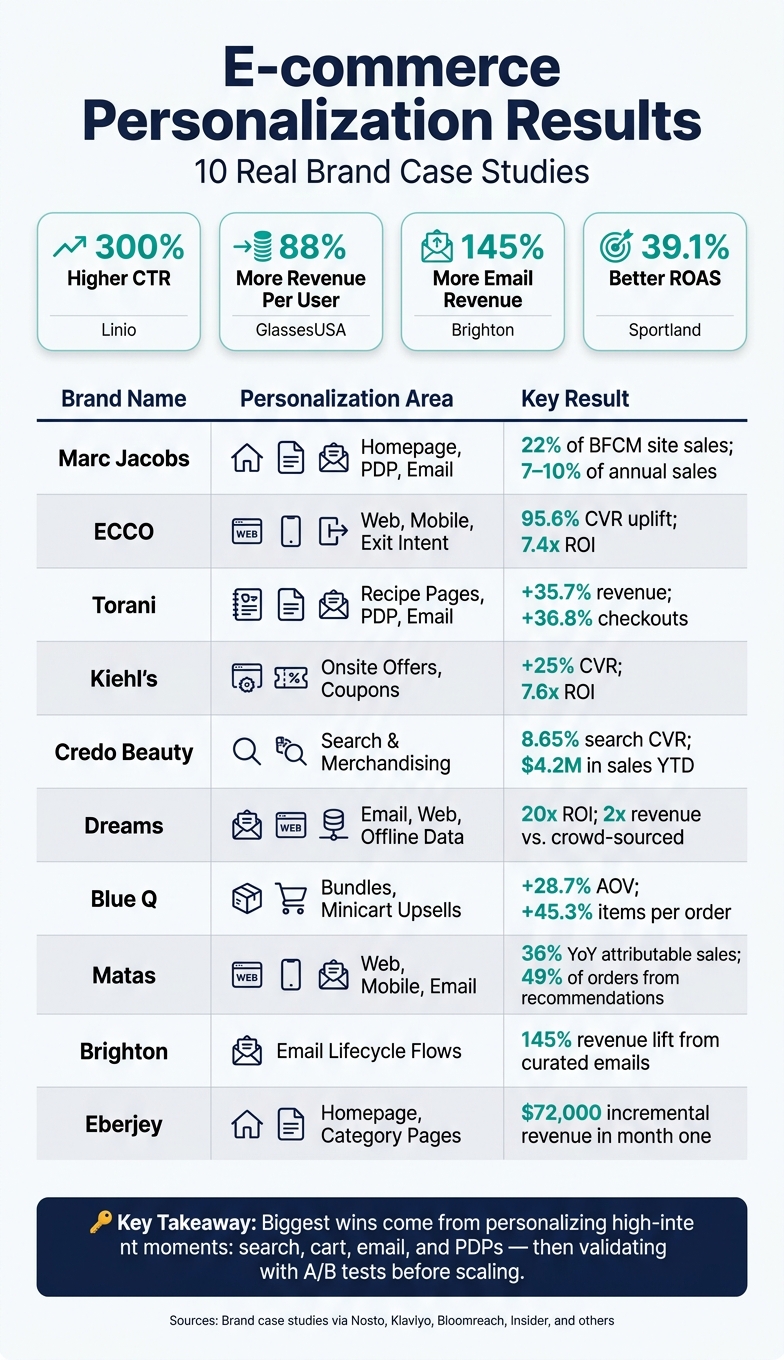
E-commerce Personalization Results: 10 Brand Case Studies at a Glance
Moonpig Case Study: Unlocking the Future of Personalised eCommerce With a Modernised Tech Stack
Quick Comparison
| Brand | Main Area | Reported Result |
|---|---|---|
| Marc Jacobs | Homepage, PDP, Email | 22% of BFCM site sales; 7%–10% of annual sales |
| ECCO | Web, mobile, exit intent | 95.6% CVR uplift; 7.4x ROI |
| Torani | Recipe pages, PDP, Email | 35.7% more revenue; 36.8% more checkouts |
| Kiehl’s | Onsite offers, coupons | 25% higher CVR; 7.6x ROI |
| Credo Beauty | Search | 8.65% search CVR; $4.2 million in sales YTD |
| Dreams | Email, web, offline data | 20x ROI; 2x revenue vs. crowd-sourced data |
| Blue Q | Bundles, minicart upsells | 28.7% higher AOV; 45.3% more items per order |
| Matas | Web, mobile, email | 36% YoY attributable sales; 49% of orders from recommendations |
| Brighton | 145% more revenue from emails with curated blocks | |
| Eberjey | Homepage, category pages | $72,000 in incremental site revenue in month one |
What stood out to me is how often the same pattern showed up: use shopper behavior fast, test the change, then scale only after it proves out in dollars.
Homepage and Product Recommendation Personalization Cases
These examples show what happens when brands use live browsing signals to shape the homepage and recommendation areas. The basic idea is simple: if someone has already shown interest, change the first screen to match it.
Linio: Dynamic Yield Homepage Modules and Product Recommendations
Linio used Dynamic Yield's Audience Explorer to reach visitors based on their 30-day category browsing history, then A/B tested those banners against generic promotions using dynamic content personalization.
The result was hard to miss. Personalized banners drove a 300% uplift in CTR, a 30% increase in CVR, and a 23% boost in revenue per user. Linio also cut bounce rates for first-time search visitors who landed on product detail pages by adding a category-based recommendation bar at the bottom of those pages.
GlassesUSA.com: Deep Learning Homepage Recommendations
GlassesUSA.com swapped out collaborative filtering in its homepage recommendation widget for Dynamic Yield's AdaptML model, which used both past behavior and in-session behavior to predict engagement.
That one widget change led to a 45% increase in add-to-cart rates and an 88% increase in revenue per user.
Leroy Merlin South Africa: Guided-Selling Banner Below the Fold
Leroy Merlin South Africa focused on homepage visitors who scrolled below the fold without clicking. It then showed those users a "Welcome" banner with promotions and personalized recommendations.
That move produced a 3.62% uplift in purchases and a 2.35% increase in add-to-cart rates.
Across all three tests, the pattern is the same: browsing behavior shaped product discovery in a way that improved click and buying activity. The next set of cases shifts to search, where intent is even sharper.
Search and Discovery Personalization Cases
These examples show what happens when search data does more than help people find products. It can also sharpen product relevance and bring shoppers back after they leave.
Shopify Plus Brand Using Nosto for Personalized Search
Credo Beauty, a clean beauty retailer on Shopify Plus, manages a catalog of more than 5,000 SKUs with a lean ecommerce team. Before Nosto, merchandising took more manual work. After the switch, the team used AI-driven search rules to push bestsellers higher, feature house-brand items, and hide out-of-stock products from search results.
One big plus: the team could change those rules without needing developer help. That matters when a small team has a lot to manage.
Credo Beauty reported an 8.65% search CVR and $4.2 million in year-to-date sales from personalized search.
That same search intent can also power recovery flows once a shopper drops off.
Tea Brand Using Nosto and Klaviyo for Search Abandonment
Search abandonment gets a lot more useful when you treat it like a follow-up signal instead of a dead end. Harney & Sons used Nosto and Klaviyo to turn search abandonment into an email re-engagement flow and a matching landing page.
When a visitor searched and left without making a purchase, they got a personalized email. That email sent them to a dynamic landing page with "continue browsing" and "stock up" blocks.
The results were strong: $2 in revenue per recipient and a 5.64% average conversion rate on the landing page. As Emeric Harney, Marketing Director at Harney & Sons, explained:
"We're able to recover opportunities we would have otherwise missed, drive incremental revenue, and do it all while maintaining the premium, curated experience that defines our brand."
sbb-itb-a84ebc4
Email, Cart, and CDP-Driven Personalization Cases
Lower-funnel personalization helps turn intent into revenue through conversion optimization. These three cases show what happens when brands move past generic email blasts and build triggered flows instead. The same browsing signals used in search and homepage personalization can keep working after someone leaves the site. That means a visit, a search, or an abandoned cart doesn't just disappear.
Ruroc: Klaviyo Behavioral Email Flows
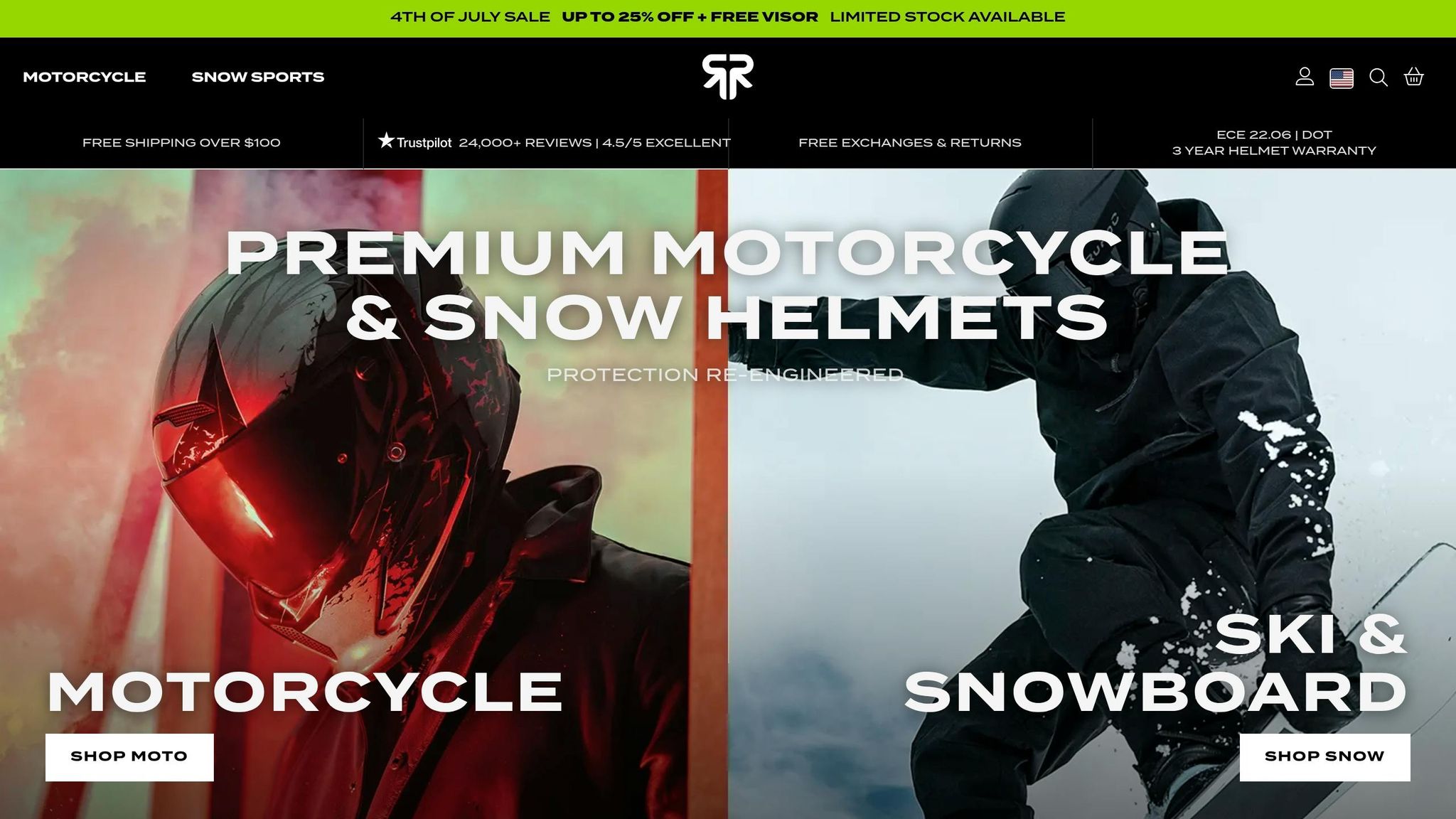
Ruroc, a UK-based helmet brand, replaced MailChimp with Klaviyo and tagged profiles by product line and language preference. From there, the team built automated journeys around those tags. Cart abandonment and browse abandonment flows used those profile details to send more relevant messages instead of the same email to everyone.
Paul Cartwright, Head of CRM & Web at Ruroc, described the integration this way:
"The Magento integration was so simple and has immediately given us access to more customer data than we ever had with MailChimp or than I've seen on any other email service platform (ESP)."
The numbers were hard to ignore. Automated emails reached a 31% average click-through rate, email-attributed revenue grew 80% year over year, and email now drives 38% of total company revenue.
Sportland: Bloomreach CDP for Multi-Channel Personalization

Once email stretches across several markets, a CDP starts to act like the control center. Sportland, a Baltic sportswear retailer, moved to Bloomreach CDP in March 2026. The brand connected backend purchase data with onsite behavior tracking, built RFM-based segments, and synced predictive audiences straight into Meta and Google Ads.
Multi-step cart abandonment and post-purchase flows were then adjusted to match local behavior patterns in each market. That setup led to a 20.6% increase in orders, a 25.1% lift in average order value, a 10.4% revenue increase, and a 21.3% drop in marketing spend, all measured against pre-migration baselines. After syncing CDP audiences with paid media, ROAS improved by 39.1%.
Brighton: Nosto AI Recommendations Inside Email
The same real-time logic can also shape the email itself. Brighton, a jewelry and accessories brand, switched to AI-driven "Just For You" recommendation blocks from Nosto. These blocks pulled real-time browsing affinity at the exact moment each email was opened.
As Daniel Drasdo, Email Marketing Manager at Brighton, put it:
"We switched to always including it [personalized recommendation block] in every email and only removing it if needed. That made everything faster and more effective."
Making personalized blocks the default led to a 145% revenue lift from emails that included those curated blocks.
Comparison Table: Tool Stacks, Test Methods, and Results Across All 10 Cases
Looking at all 10 cases in one place makes it much easier to see what’s driving performance. This table lines up the channel, tool stack, validation method, and reported impact across all 10 examples. You can also see how outcomes change across homepage, search, email, and cart personalization. The next section digs into the shared patterns behind those numbers.
| Brand | Personalization Area | Tool Stack | Test/Validation Method | Reported Impact |
|---|---|---|---|---|
| Marc Jacobs | Homepage, PDP, Email | Nosto, Klaviyo | A/B testing framework | 22% of BFCM site sales; 7%–10% of annual sales |
| ECCO | Web, mobile, exit intent | Insider | ROI/uplift tracking | 95.6% CVR uplift; 7.4x ROI |
| Torani | Recipe pages, PDP, Email | Breinify, Shopify | Post-launch tracking | +35.7% revenue; +36.8% checkouts |
| Kiehl's | Onsite offers, segmented coupons | Insider, Salesforce Commerce Cloud | A/B testing | +25% CVR during peak season; 7.6x ROI |
| Credo Beauty | Search, app, merchandising | Nosto, Shopify Plus, Tapcart | Continuous A/B testing | 8.65% search CVR; $4.2M in sales YTD |
| Dreams | Email, Web, Offline Data | Dotdigital, Fresh Relevance | A/B test (AI vs. crowd-sourced data) | 20x ROI; 2x revenue vs. crowd-sourced data |
| Blue Q | Bundles, Minicart Upsells | Maestra, Shopify | Engaged vs. non-engaged comparison | +28.7% AOV; +45.3% items per order |
| Matas | Web, Mobile, Email | Algonomy | Attribution analysis | 36% YoY attributable sales; 49% of orders from recommendations |
| Brighton | Email Lifecycle Flows | Nosto, Klaviyo | Email revenue tracking | 145% revenue lift from emails with curated recommendations |
| Eberjey | Homepage, Category Pages | Insider One, Shopify | A/B testing site navigation | $72,000 incremental site revenue in the first month |
How to Use the Table to Compare Cases
If you’re looking for examples from lean teams, start with Torani, Eberjey, and Kiehl's.
If you want cross-channel setups, look at Dreams, Brighton, and Matas.
One thing matters a lot here: compare the test method first. It tells you whether the reported lift came from a controlled test, like an A/B test, or from a broader attribution model. That difference sets up the pattern analysis in the next section.
Patterns Across the 10 Cases and Final Takeaways
What the Highest-Impact Setups Have in Common
The table shows the results. These patterns show what pushed those results.
Across the 10 cases, the biggest gains came from matching each tool to the right touchpoint and then measuring lift.
A few themes show up again and again. First, manual curation gives way to automation at scale. Brands stopped spending so much time hand-picking products and used AI-driven tools to scale personalized recommendations across more touchpoints. Second, the highest-intent moments are the best places to personalize. That means the cart, search, product detail pages (PDPs), and lifecycle email flows. Third, timing matters as much as content. Teams that performed well triggered re-engagement based on behavior, not fixed timers. Fourth, fallback rules are a must. The best setups don't dump generic content on anonymous visitors. They adjust in real time using session signals like clicks and dwell time, even without account history.
The strongest programs also check changes with A/B tests or control groups before rolling out a personalized experience at scale. And the best personalization feels like helpful merchandising, not creepy targeting. Visual continuity helps here. For example, matching a landing page hero to the ad click feels more natural and less intrusive.
How to Apply These Lessons to Your Store
Those patterns lead to a simple rollout sequence.
Start with one use case. Eberjey proved the model with a single Smart Recommender module. That's the model worth copying: one focused use case, one main tool, and one measurable outcome.
In practice, that means:
- Pick one high-intent page.
- Connect your data source with a native integration.
- Define one KPI, such as Revenue Per Visitor, AOV, or conversion rate.
- Run a controlled A/B test before you expand.
Don't scale until you've shown lift in actual dollars.
FAQs
Where should I start with ecommerce personalization?
Start by auditing your site to spot the highest-impact opportunities for your customer base. Then put a solid first-party data base in place using browsing behavior, search queries, and purchase history.
From there, start with low-effort tactics. Good early moves include fallback logic for anonymous visitors and announcement bars or banners tailored to real-time session behavior.
Do I need AI, or can rules-based personalization work?
You don’t need AI on day one. For many small to midsize businesses, rules-based personalization does the job just fine.
It’s a good fit for simpler use cases like geo-targeted offers, product suggestions based on past purchases, and hiding pop-ups for repeat customers. Clean, simple, and easy to set up.
As your store adds more SKUs and gets more traffic, AI starts to make more sense. It helps you scale personalization, predict intent, and handle real-time content across more complex customer segments.
How should I measure personalization results?
Use A/B or A/B/n testing to compare control and test groups. That gives you a clean way to isolate the lift from personalized experiences instead of guessing what moved the numbers.
Track key metrics such as revenue per visitor, conversion rate, click-through rate, and average order value. It also helps to watch return rates. One more thing: each platform uses its own attribution windows and measurement methods, so reported ROI and revenue can vary from one tool to another.