Data-driven storytelling turns raw numbers into narratives that persuade and drive action. In B2B marketing, where decisions involve longer cycles and multiple stakeholders, storytelling bridges the gap between data and decision-making. Here’s what you need to know:
- Why it matters: Companies using data effectively outperform competitors by 23x. Yet, only 42% of marketers feel they fully understand their audience.
- Key challenge: Marketing budgets dropped 15% in 2024, increasing pressure to prove ROI and make every dollar count.
- Strategy: Combine first-party data, CRM insights, and qualitative feedback to craft stories that resonate with decision-makers at every funnel stage.
- Structure: Use a customer-focused narrative (problem, solution, outcome) that appeals to both logic and emotion.
- Personalization: Tailor stories by funnel stage and stakeholder role, leveraging tools like Account-Based Marketing (ABM) for hyper-targeted messaging.
- Metrics: Track beyond clicks - focus on pipeline velocity, lead quality, and customer lifetime value (CLV).
This approach ensures your marketing efforts align with business goals, delivering measurable results while connecting with your audience on a deeper level.
The Power of Storytelling in B2B: Hero's Journey & Case Studies
1. B2B Data-Driven Storytelling
B2B storytelling is a whole different ball game compared to consumer marketing. On average, a B2B buyer reads three to seven pieces of content before deciding to make a purchase. Add to that the involvement of multiple stakeholders - from end-users to executives in the C-suite - and it’s clear that crafting a compelling story requires careful planning. You need to get the data right, frame the narrative effectively, and measure its impact.
Data Sources
Great storytelling starts with great data, and in B2B, that often means collecting insights directly from your audience. First-party data - like information gathered from gated downloads, newsletter sign-ups, and website interactions (think page scrolls or completed forms) - is your most reliable source for understanding your audience.
Pairing CRM platforms with marketing automation tools can take your storytelling to the next level. By combining customer history, sales data, and behavioral insights, you can build narratives rooted in actual patterns instead of guesswork.
Don’t stop at numbers, though. Qualitative data adds the context that numbers alone can’t provide. Social listening, for example, lets you monitor @-mentions and comments on LinkedIn to understand the “why” behind the data. Conversations from sales teams and customer support can reveal the real pain points your audience is facing - these become the emotional core of your story. With a solid foundation of both quantitative and qualitative data, you’re ready to craft a meaningful narrative.
Narrative Structure
In B2B storytelling, the Customer Story + Industry Story formula works wonders. This approach frames the customer as the hero tackling a broader industry challenge, while your product plays the supporting role as the tool that helps them succeed.
"Your product is just a tool - a tool that transforms businesses, sure, but still a tool. You're selling them the reality of being a better marketer or accountant or leader." – Uberflip
To build a strong narrative, include these five elements: a protagonist (your customer persona), a challenge (their pain point), a solution (your offering), a clear outcome (measurable ROI), and a lesson learned. Even though B2B decision-making often seems purely logical, research shows that 95% of purchasing decisions are emotional. Buyers care about their careers, confidence in their choices, and trust in your brand. A well-crafted story can address these emotional factors in a way raw data never could.
Personalization Depth
A one-size-fits-all story won’t cut it in B2B. Companies that surpass their revenue goals are 71% more likely to use buyer personas to tailor their messaging. This means creating different narratives for different stages of the funnel and for various stakeholders.
For example:
- Top-of-funnel content should target end-users.
- Mid-funnel content needs to speak to decision-makers.
- Bottom-funnel content should focus on executives who control the budget.
Account-Based Marketing (ABM) takes personalization even further. By leveraging LinkedIn ads and intent data, you can craft hyper-targeted stories for high-value accounts. For instance, a B2B logistics firm tested two narratives: one offering a "free shipping analysis" and another promoting a "comprehensive logistics audit." The audit-focused story performed 24% better, as their data revealed buyers were more interested in improving overall logistics strategy than just cutting costs. With insights like these, personalization becomes not just a tactic but a game-changer for engagement and revenue.
Measurement Metrics
The real magic of B2B storytelling lies in tracking the right metrics. It’s not enough to focus on Marketing Qualified Leads (MQLs); you need to go deeper. Metrics like pipeline velocity, cost per qualified lead, and customer lifetime value (CLV) show how your storytelling impacts revenue, not just vanity numbers like clicks or traffic.
Full-funnel tracking ensures alignment between sales and marketing teams. At the top of the funnel, monitor page scrolls, content sign-ups, and social engagement. In the middle, look at lead quality and webinar downloads. At the bottom, success is reflected in win rates, contract values, and CLV.
Here’s a real-world example: Finch Brands implemented a data-driven content strategy in 2021, targeting specific keywords and topics. The result? Organic impressions jumped by 90.28%, unique pageviews rose by 92.71%, and they climbed 706 Google SERP positions. Meanwhile, Elite Ops, a B2B fulfillment company, used Conversion Rate Optimization (CRO) tools to test a single Call-to-Action button change, leading to a 46% increase in onsite conversions.
These examples highlight how data-driven storytelling, when done right, can deliver measurable success at every stage of the funnel.
2. B2C Data-Driven Storytelling
B2C storytelling thrives on understanding individual behaviors and emotions. Unlike B2B strategies that cater to multiple stakeholders, B2C storytelling focuses on sparking quick, emotion-driven decisions. The type of data you collect and how you craft your narrative reflect this key difference.
Data Sources
In B2C, data is all about tracking individual actions. This includes shopping habits, social media interactions, and personal demographics like age and location. While B2B leans on company-related data, B2C hones in on what people do online - what they click, share, and purchase.
Tools like social media analytics, combined with purchase history and website activity, allow for segmentation based on behavior rather than just demographics. These insights help you create stories that connect emotionally, whether through humor, a sense of urgency, or offering a great deal.
Narrative Structure
B2C storytelling often mirrors the Hero’s Journey, where the customer is the hero and your brand is the tool that helps them achieve their goals. A common structure breaks the story into five parts: identifying new trends (The World Has Changed), highlighting challenges (Change Creates Challenge), redefining the problem (A Shift in Thinking), showcasing the solution (Enter the Hero), and encouraging sharing (The Viral Question).
"B2C buyers are more motivated by emotion, entertainment, and getting a good deal. And while B2C buyers may make impulse purchases, this is rare in B2B." – Segment
Since B2C funnels are shorter and involve just one decision-maker, your story needs to grab attention quickly. Visual content plays a huge role here - web pages with images or infographics get 650% more engagement than text-only pages. And embedding facts into stories makes them 22 times more memorable than presenting raw data. This approach ensures your storytelling captures attention and resonates with your audience.
Personalization Depth
Personalization in B2C happens on an individual level. Behavioral data allows you to create highly tailored stories that respond to specific actions, like abandoned carts or browsing habits. For example, segmented email campaigns based on data insights can boost email revenue by 760%.
The challenge lies in scaling this level of personalization while keeping it genuine. AI tools now make it possible to adapt stories in real-time based on user preferences and behavior. For instance, someone who abandoned their cart might see a follow-up story tailored to their interests, while a first-time visitor encounters a different narrative.
Measurement Metrics
Measuring success in B2C storytelling involves tracking a mix of metrics. At the top of the funnel, monitor impressions, website traffic, and engagement. Mid-funnel, focus on newsletter sign-ups, click-through rates, and time spent on your site. At the bottom, track conversion rates, sales, and cart abandonment.
But the story doesn’t end at the purchase. Post-sale metrics like sentiment analysis, referral rates, review volume, and customer lifetime value (CLV) reveal how well your story continues to resonate. With 96% of website visitors not ready to buy on their first visit, retargeting and consistent storytelling across all touchpoints are essential. Conversion Rate Optimization (CRO) tools help refine these touchpoints, delivering an average ROI of 223%.
sbb-itb-a84ebc4
Pros and Cons
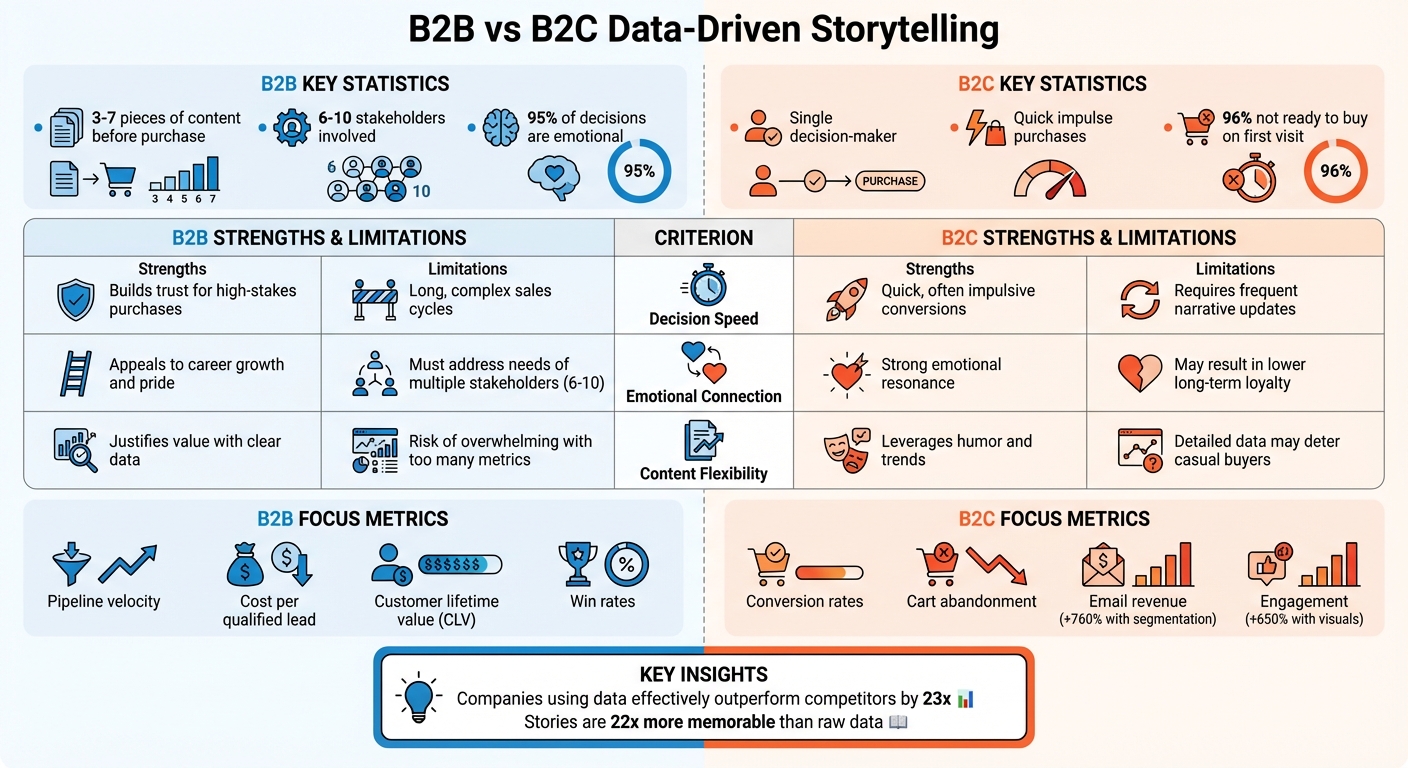
B2B vs B2C Data-Driven Storytelling: Key Differences and Metrics
B2B and B2C data-driven storytelling each bring their own strengths and challenges, making it essential to choose the right approach based on your audience and sales funnel.
B2B storytelling shines when it comes to simplifying complex products through data insights. It helps decision-makers see the value of a product by highlighting metrics like ROI (Return on Investment) and ROE (Return on Effort). At the same time, it taps into emotional drivers such as career growth and professional pride - key factors that can influence decisions when functional benefits are comparable. However, B2B storytelling often involves catering to multiple stakeholders, maintaining engagement over longer sales cycles, and avoiding an overload of metrics that could bog down the narrative.
B2C storytelling, on the other hand, focuses on building immediate emotional connections with individual decision-makers. This approach enables quicker - and sometimes impulsive - purchases. It also allows for more creative freedom, incorporating humor, entertainment, and trending topics. The downside? It may lead to lower long-term customer loyalty if the narrative doesn’t evolve. Additionally, detailed technical information can alienate consumers who are looking for quick, straightforward solutions.
| Criteria | B2B Strengths | B2B Limitations | B2C Strengths | B2C Limitations |
|---|---|---|---|---|
| Decision Speed | Builds trust for high-stakes purchases | Long, complex sales cycles | Quick, often impulsive conversions | Requires frequent narrative updates |
| Emotional Connection | Appeals to career growth and pride | Must address needs of multiple stakeholders (6–10) | Strong emotional resonance | May result in lower long-term loyalty |
| Content Flexibility | Justifies value with clear data | Risk of overwhelming with too many metrics | Leverages humor and trends | Detailed data may deter casual buyers |
These differences highlight the importance of tailoring your storytelling strategy to fit the context and expectations of your audience.
"While business requirements and features matter, personal rewards and emotional attributes can tip the scales for B2B decision makers when they elevate multiple options." – Praveen Krishnamurthy, Product Marketer, Adobe
Whether you’re addressing businesses or consumers, the best results come from a storytelling approach that blends analytical insights with a genuine human touch.
How to Implement Data Storytelling in B2B Funnels
To make data storytelling work within your B2B funnel, you need to focus on four key elements: understanding your audience, gathering relevant data, creating clear visualizations, and crafting a strong narrative. These steps help turn raw numbers into stories that resonate and drive action.
At the top of the funnel, start by using social listening tools to uncover trends in how people discuss your brand and gauge audience sentiment. This helps you create attention-grabbing content that addresses specific pain points. For awareness-stage campaigns, lean on demographic and firmographic data to produce educational content that feels relevant and engaging. A great resource for this is the Marketing Funnels Directory (https://topmarketingfunnels.com), which provides tools for social media insights and content creation, helping you craft narratives that work well at this stage.
Moving into the consideration stage, focus on refining the customer journey with behavioral insights. Tools like identity resolution software can combine data from multiple sessions and devices, giving you a clear picture of the customer’s path. Behavioral data - such as webinar attendance or downloads of guides - can help you address specific objections with tailored solutions. For instance, one company analyzed digital campaign data to adjust their strategy, resulting in a 15% boost in off-season bookings.
When you reach the bottom of the funnel, the goal is to convert high-intent leads using precise, impactful data. Lead scoring platforms can help you determine when to share case studies or testimonials to nudge prospects toward a decision. Deep-funnel metrics like ROI calculators and product comparisons are particularly persuasive for C-suite executives and finance teams. When presenting data to stakeholders, start with a secondary insight and save your strongest data point for the end to leave a lasting impression. Keep it simple - highlight 2–3 metrics that directly align with business objectives to avoid overwhelming your audience.
"Data-driven storytelling breaks down complex information into simple, actionable insights." – Anton Marchenko, SEO Lead, BrightBid
Conclusion
B2B storytelling takes a unique approach, targeting multiple decision-makers and emphasizing ROI and long-term benefits, while B2C storytelling leans into personal emotions and individual connections. With 77% of B2B buyers describing their last purchase as complex or challenging, your data stories need to do more than inform - they must educate, simplify, and resonate with various stakeholders.
Even in B2B, emotions play a huge role, driving 95% of purchasing decisions. To connect effectively, your data stories should combine solid evidence with a human touch. Show how your solution can enhance careers, reduce stress, or solve pressing problems. As Paula Ferrai from WeAreBrain puts it:
"Behind every business decision stands a person, driven by both rational and emotional factors".
When crafting your data stories, align them with the buyer’s journey: use broad insights to attract attention at the top of the funnel, behavioral data to nurture interest in the middle, and ROI-focused details to close deals at the bottom. With marketing budgets shrinking by 15% in 2024, down to 7.7% of revenue, every dollar spent must prove its worth.
To refine your B2B funnel strategy, check out the Marketing Funnels Directory. It features tools, courses, and vendor listings tailored for B2B marketing, offering solutions for lead scoring, data visualization, and real-time analytics. These resources can help you turn raw data into compelling narratives that drive meaningful results.
FAQs
How does data-driven storytelling enhance ROI in B2B marketing?
Data-driven storytelling takes raw numbers and transforms them into compelling narratives that show how marketing efforts contribute to revenue. By weaving together metrics like click-through rates, account-based marketing (ABM) engagement, and pipeline velocity, marketers can explain the why behind the data. This approach not only gives leadership actionable insights but also aligns sales and marketing teams with shared objectives, cutting down on inefficiencies and unnecessary spending.
For example, showcasing real-world outcomes - like a LinkedIn campaign that led to a 45% increase in qualified leads and closed a $1.2 million deal - offers concrete proof of value. These stories make complex data easier to understand, shorten sales cycles, improve conversion rates, and help decision-makers clearly see the return on investment (ROI) of your solution. By routinely tracking metrics such as ROI per story and cost per qualified lead, businesses can fine-tune their strategies and achieve measurable growth.
What makes a great B2B marketing story?
A compelling B2B marketing story resonates with its audience by centering on a protagonist - often a real customer or a buyer persona - who is tackling a relatable challenge. Your product or service takes the spotlight as the solution, backed by clear, impactful data that highlights measurable results. The narrative concludes with a positive outcome, like improved efficiency or increased revenue, and includes a call to action that nudges the audience toward the next step.
To keep the story engaging, focus on a single, well-defined challenge. Add personality with quotes or anecdotes, and use data to support your narrative without overshadowing it. Many marketers turn to the Hero’s Journey framework, where the buyer navigates obstacles with the help of your solution and emerges transformed. This storytelling method makes complex offerings feel more relatable and gives prospects the confidence to move forward.
How does personalization change throughout the B2B marketing funnel?
In a B2B marketing funnel, personalization shifts and deepens as potential customers move through the stages of awareness, consideration, decision, and beyond. Each phase calls for a unique approach to make interactions more relevant and engaging.
At the awareness stage, the focus is on grabbing attention with relevance. This is where firmographic data (like company size or industry), intent signals, and content preferences come into play. Businesses use this information to craft ads, blog posts, or industry-specific content that resonates with the audience and sparks interest.
Moving to the consideration stage, personalization becomes more contextual. Here, behavioral data - such as which pages a prospect has visited, webinars they’ve attended, or content they’ve downloaded - guides the strategy. This data helps create dynamic website experiences, targeted email campaigns, and account-specific case studies that address the specific challenges or goals of each prospect.
At the decision stage and beyond, personalization reaches its most detailed level. Insights like past purchase history and product usage metrics help businesses craft tailored proposals, customized pricing options, and support strategies. After the sale, personalization doesn’t stop - it’s key to maintaining a strong relationship. Businesses can offer personalized upsell recommendations, send renewal reminders, or develop success plans that align with the customer’s ongoing needs, ensuring a smooth and relevant experience throughout the journey.