When running digital ad campaigns, picking the right payment model is crucial to avoid wasting your budget. Here’s a quick breakdown of the three main pricing models:
- CPM (Cost Per Mille): Pay for every 1,000 ad impressions. Best for brand awareness but doesn’t guarantee clicks or engagement.
- CPC (Cost Per Click): Pay only when someone clicks on your ad. Ideal for driving traffic to your website or landing page.
- CPA (Cost Per Action): Pay only when a specific action, like a purchase or sign-up, is completed. Perfect for conversion-focused campaigns.
Key Takeaways:
- Match the model to your campaign goals:
- Use CPM for awareness (top of the funnel).
- Use CPC for engagement (middle of the funnel).
- Use CPA for conversions (bottom of the funnel).
- Avoid common pitfalls: Research shows 70% of marketers choose the wrong model, leading to wasted ad spend.
- Combine models strategically: Start with CPM for visibility, transition to CPC for traffic, and finish with CPA for conversions. This progression is essential when you build high-converting sales funnels that scale.
Each model has distinct advantages and drawbacks, so aligning them with your goals is key to maximizing ROI.
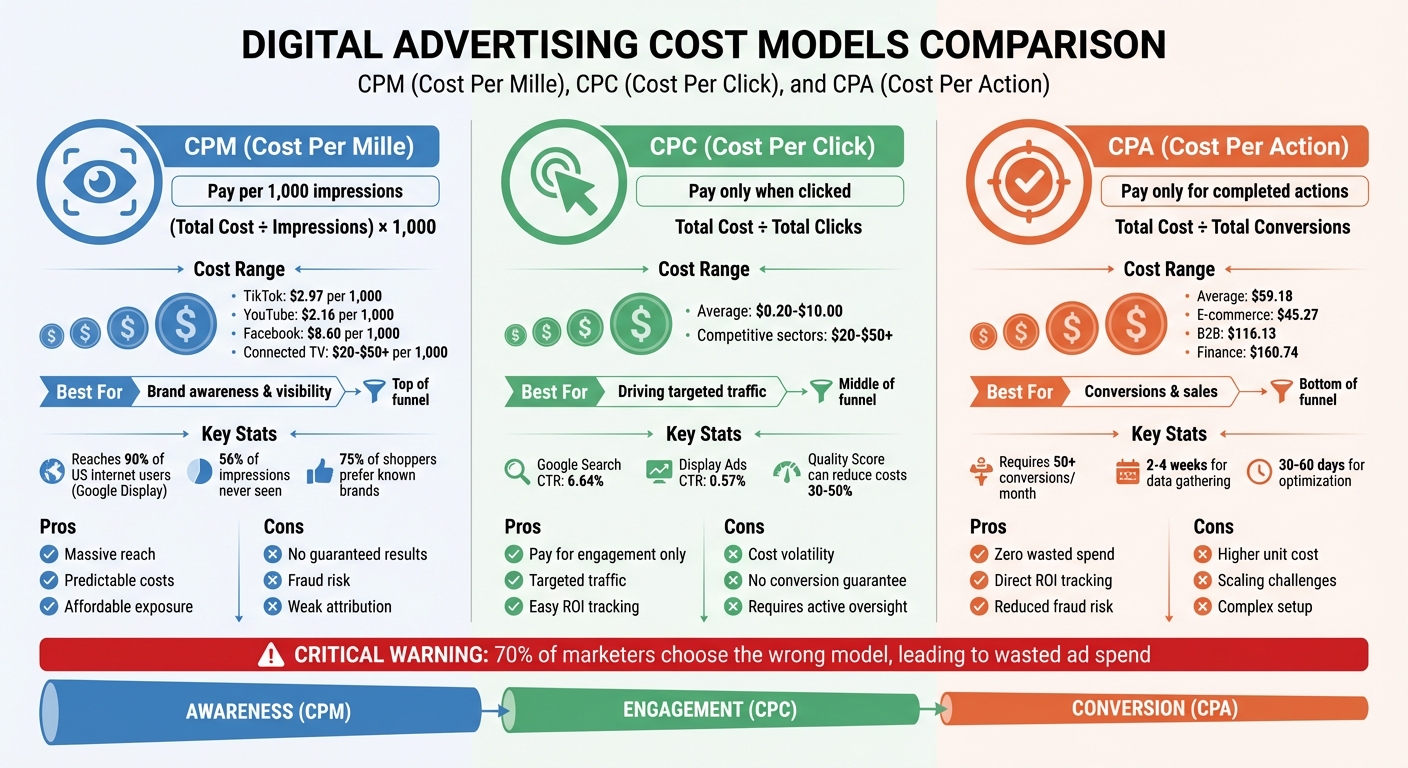
CPM vs CPC vs CPA: Digital Advertising Cost Models Comparison
CPM: Cost Per Mille for Brand Awareness
How CPM Works
CPM, or Cost Per Mille, is a pricing model where advertisers pay a fixed rate for every 1,000 ad impressions. The formula is simple: CPM = (Total Campaign Cost ÷ Total Impressions) × 1,000. For example, if a campaign costs $1,000 and generates 133,333 impressions, the CPM would be $7.50.
An impression counts every time your ad loads - regardless of whether it's clicked or even fully visible. To address this, vCPM (viewable CPM) charges advertisers only when at least 50% of the ad is visible on the screen for at least one second. This adjustment matters because about 56% of ad impressions are never actually seen, as they may load below the fold or in background tabs.
When to Use CPM
CPM is a great choice when your goal is broad visibility, such as building brand recognition or introducing a new product. For example, the Google Display Network can reach over 90% of internet users in the United States.
Why does visibility matter? Because familiarity drives action. Around 75% of shoppers are more likely to buy from brands they know. Additionally, exposure through platforms like Microsoft Audience Ads has been shown to increase brand-related searches by 2.2×. Repeated exposure through CPM campaigns can lay the groundwork for future conversions within your sales funnel.
CPM rates vary significantly depending on the platform and placement. As of 2025, TikTok averages $2.97 per 1,000 impressions, YouTube is around $2.16, and Facebook charges approximately $8.60. Premium ad spaces, such as connected TV, can cost anywhere from $20.00 to over $50.00 per 1,000 impressions.
Before diving into CPM, it’s important to weigh its strengths and limitations to see if it aligns with your goals.
CPM Advantages and Disadvantages
| Advantages | Disadvantages |
|---|---|
| Massive Reach: Ideal for product launches or brand awareness. | No Guaranteed Results: High impressions don’t always translate to clicks or sales. |
| Predictable Costs: Easy to budget for a specific audience size. | Fraud Risk: Susceptible to bot activity and ad stacking. |
| Affordable Exposure: Often the lowest cost per impression compared to other models. | Visibility Challenges: Ads might load in areas users never see, like below the fold. |
| Versatile Formats: Works with display, video, connected TV, and native ads. | Weak Attribution: Hard to measure direct ROI or campaign impact. |
One of CPM's biggest challenges is its focus on exposure rather than engagement. A campaign could generate 100,000 impressions without a single click. This makes it crucial to monitor your click-through rate (CTR) to see if your ad resonates with the audience. Tools like invalid traffic (IVT) detection and frequency caps (e.g., limiting impressions to three per user) can help reduce wasted spending on low-quality or repetitive views.
"CPM is designed to build brand awareness. Brand awareness is good, but the main downside to CPM is that you may not get a single click from your ad." – Tapstone
sbb-itb-a84ebc4
CPC: Cost Per Click for Driving Traffic
How CPC Works
Unlike CPM, which focuses on impressions, CPC zeroes in on engagement by charging advertisers only when someone clicks on their ad. The formula is simple:
CPC = Total Campaign Cost ÷ Total Number of Clicks.
For example, if you spend $500 and receive 100 clicks, your CPC comes out to $5.00.
Platforms like Google Ads use an auction system for CPC. You set a maximum CPC bid, which is the highest amount you're willing to pay per click. However, the actual amount you pay is often lower, thanks to factors like Quality Score. A high Quality Score - based on expected click-through rate, ad relevance, and landing page quality - can reduce your actual CPC by 30% to 50%. Ad Rank, which determines your ad's position, combines your bid, Quality Score, and other factors like device type, user location, and time of search.
Optimizing your ad's Quality Score is crucial for keeping costs down and improving ad performance. This makes CPC a solid choice for campaigns where user engagement is a priority.
When to Use CPC
CPC works best for mid-funnel campaigns, where the goal is to drive targeted traffic from users who are actively searching or showing interest. Unlike CPM, which casts a wider net, CPC ensures you pay only when someone clicks - indicating a level of interest. It’s particularly effective for directing traffic to marketing funnel assets like landing pages, product pages, or blog content where engagement can be measured.
Here’s a quick look at some stats: The average click-through rate (CTR) for Google Search Ads is about 6.64%, while Google Display Ads typically see a CTR of 0.57%. Costs per click vary widely depending on the industry, ranging from $0.20 to $10.00. However, competitive sectors like finance or legal services often see CPC rates climb to $20.00–$50.00 or more.
CPC Advantages and Disadvantages
| Advantages | Disadvantages |
|---|---|
| Pay for Engagement: You’re only charged when users click, not for passive impressions. | Cost Volatility: Competitive bidding can make costs rise quickly in crowded markets. |
| Targeted Traffic: Attracts users already showing interest in your offering. | No Conversion Guarantee: A high number of clicks doesn’t always lead to sales. |
| Easy ROI Tracking: Helps measure traffic volume and cost per visitor directly. | Click Fraud Risk: Susceptible to bots or low-quality clicks driven by curiosity. |
| Quick Testing Feedback: Provides fast insights into the effectiveness of keywords and ad creatives. | Requires Active Oversight: Needs frequent monitoring and bid adjustments. |
To maximize the value of CPC campaigns, make sure your ad copy aligns closely with your landing page content. This can improve your Quality Score and reduce costs.
"CPC is your go-to for measurable engagement. Align ad copy with landing pages to boost Quality Score and cut costs." - Sarah Kim, PPC Strategist.
Next, we’ll dive into CPA and how it’s tailored for conversion-focused campaigns.
CPA: Cost Per Action for Conversions
How CPA Works
CPA, or Cost Per Action, is an advertising model where you only pay when a user completes a specific action - like making a purchase, filling out a form, or downloading an app. The formula to calculate CPA is simple:
CPA = Total Campaign Cost ÷ Total Conversions.
For instance, if you spend $1,000 and generate 20 sales, your CPA is $50.
This model relies on various tracking methods, including cookie tracking (typically for 15–30 days), unique call tracking numbers, promotional codes, UTM parameters, and server-to-server postback URLs. Since you're paying only for verified conversions, CPA helps reduce wasted spend on bot traffic or invalid referrals.
When to Use CPA
CPA works best at the lower end of the marketing funnel, where the focus is on driving revenue rather than building awareness. It’s particularly effective for retargeting audiences who have already engaged with your CPM or CPC campaigns. For context, the average CPA on Google Ads in 2025 is projected to be about $59.18. However, this figure varies by industry - E-commerce averages around $45.27, B2B campaigns hover around $116.13, and finance tops the list at approximately $160.74.
To make CPA campaigns successful, aim for a solid volume of conversions - ideally 50 or more per month - to give machine learning enough data to optimize. Campaigns typically require 2–4 weeks to gather actionable insights, with noticeable improvements coming around the 30–60 day mark. Another advantage? CPA is less prone to ad fraud because bots rarely complete the multi-step actions needed for conversions.
CPA Advantages and Disadvantages
| Advantages | Disadvantages |
|---|---|
| Zero Wasted Spend: You’re paying only for actual business results, not for impressions or clicks. | Higher Unit Cost: Conversions often cost more than clicks or impressions. |
| Direct ROI Tracking: Every dollar spent ties directly to a revenue-generating action. | Scaling Challenges: Limited conversion opportunities and high competition can make it tough to scale quickly. |
| Reduced Fraud Risk: Bots rarely complete the complex steps required for conversions. | Complex Setup: Requires advanced tracking systems like server-to-server postback URLs. |
| Risk Shift: Publishers bear the performance risk, not advertisers. | Volume Dependency: Successful optimization hinges on achieving a minimum number of monthly conversions. |
To get the most out of CPA campaigns, ensure your tracking is airtight. Use tools like CRM systems or even something as simple as a "How did you find us?" field. Calculate your target CPA by subtracting fulfillment costs and your desired profit margin from the Customer Lifetime Value. For more tips on refining your marketing strategy, check out the Marketing Funnels Directory (https://topmarketingfunnels.com).
"CPA is the gold standard for performance marketing. Nail your tracking, and it's a game-changer." - Priya Patel, Performance Marketing Expert.
Now that we’ve broken down CPA, let’s dive into how to choose the best cost model for your campaign goals.
How to Choose the Right Model for Your Campaign
Matching Cost Models to Funnel Stages
Your marketing funnel is divided into three key stages, each requiring a tailored approach to ad pricing. At the top, CPM (cost per thousand impressions) is your go-to for creating awareness. This model is all about visibility - getting your brand in front of as many people as possible. As you move to the middle, CPC (cost per click) becomes crucial, charging you only when someone clicks through to learn more. Finally, at the bottom, CPA (cost per action) ensures you only pay when a specific action - like a sale, form submission, or app download - is completed.
Here’s an eye-opener: about 70% of marketers use the wrong pricing model for their campaigns. The solution? Align your cost model with your audience’s position in the funnel. Use CPM for broad awareness, CPC to drive engaged traffic, and CPA for conversions. This alignment helps you guide potential customers step-by-step toward the final goal.
Cost Model Recommendations by Scenario
Different campaign goals call for different cost models. Here’s a quick guide to match models with objectives:
| Scenario | Recommended Model | Why It Fits |
|---|---|---|
| Launching a new product | CPM | Ensures your brand reaches a large audience quickly, boosting awareness. |
| Driving blog/website traffic | CPC | Pays only for users actively interested enough to click through. |
| Increasing e-commerce sales | CPA | Ties costs directly to actions that generate revenue, like purchases. |
For instance, if you’re introducing a new skincare product, start with CPM on platforms like Instagram or YouTube to build awareness. Once people recognize your brand, shift to CPC campaigns on Google Search to attract users actively searching for solutions like your "anti-aging serum." Finally, use CPA campaigns to retarget cart abandoners, encouraging them to complete their purchase. This sequential strategy ensures each stage of the funnel builds on the last, steadily warming up your audience.
Testing and Combining Multiple Models
To get the most out of your campaigns, consider testing and blending different cost models. For example, you can combine CPM, CPC, and CPA across the funnel to optimize performance. Start small - use A/B testing to compare models on the same creative, then allocate more budget to the model delivering the best returns.
"Run split tests with CPC and CPA on small budgets. Data reveals what drives your ROI." - John Lee, Digital Marketer
Before diving into automated CPA bidding, follow the "30/30" Rule: gather at least 30 conversions over 30 days. This gives machine-learning algorithms enough data to optimize effectively. Another smart move? Use tracking pixels in your CPM campaigns to create "exposed" audiences, then retarget them with CPC or CPA ads. This layered approach minimizes risk and ensures you’re not overspending on unproven strategies.
For more actionable tips on refining your funnel strategy, check out the Marketing Funnels Directory at https://topmarketingfunnels.com. By layering and testing models, you can fine-tune your campaigns for maximum impact. Stay tuned for the next steps in campaign optimization.
Conclusion and Key Takeaways
Summary of CPM, CPC, and CPA
Each pricing model plays a unique role in shaping your marketing strategy. CPM (Cost Per Mille) typically offers lower to mid-tier charges for every 1,000 impressions. It’s ideal for creating brand awareness at the top of the funnel but places financial risk on the advertiser since engagement isn’t guaranteed. CPC (Cost Per Click) costs a few dollars per click and targets the middle of the funnel. It splits the risk between advertisers and publishers while driving more engaged traffic. CPA (Cost Per Action) varies significantly depending on the desired actions, focusing on bottom-funnel outcomes like sales, sign-ups, or leads. Here, the publisher shoulders most of the risk.
The distinction between these models lies in their focus. CPM is about visibility but risks inefficiency if ads go unnoticed. CPC fosters interest but doesn’t promise sales. CPA offers the best return on investment but can be challenging to scale due to limited premium inventory. The rise of performance-based models reflects the industry’s demand for measurable results.
These insights provide a foundation for optimizing your marketing efforts.
Final Recommendations
To avoid overspending due to mismatched cost models, start by defining a single, clear KPI - whether it’s reach, traffic, or revenue. Misalignment can inflate your costs by up to three times. Matching your cost model to your campaign goals ensures you can maximize results at every stage of the funnel. For instance, use CPM for awareness, CPC for engagement, and CPA for conversions. If you’re considering CPA bidding, collect at least 30 conversions over 30 days before making the switch.
"CPA is the gold standard for performance marketing. Nail your tracking, and it's a game-changer." - Priya Patel, Performance Marketing Expert
Start small by testing budgets across models and comparing ROI before scaling up. For CPC campaigns, improving your Quality Score can reduce costs by up to 50%. In CPA campaigns, set click caps to avoid overspending when conversion rates dip. With billions of dollars at play, choosing the right model is critical.
For more guidance on building effective marketing funnels and improving your customer journey, visit the Marketing Funnels Directory at https://topmarketingfunnels.com.
The ABCs of Programmatic Pricing Models: CPM, CPC, CPA and Beyond
FAQs
How can I choose the best pricing model for my campaign goals?
Choosing the right pricing model hinges on your campaign's goals. If your primary aim is brand awareness and reaching a wide audience, CPM (Cost Per Mille) is a solid choice since it charges you for every 1,000 ad impressions. For campaigns focused on driving traffic or engagement, CPC (Cost Per Click) is the way to go - you only pay when someone actually clicks on your ad. And if you're targeting conversions like sales or signups, CPA (Cost Per Acquisition) ensures you only pay when a specific action is completed.
A helpful way to decide is by aligning the pricing model with your campaign's stage in the marketing funnel. CPM is perfect for top-of-funnel efforts aimed at building awareness. CPC fits the middle of the funnel, where engagement is key. CPA, on the other hand, works best for bottom-of-funnel conversions. To get the most out of your ad spend, make sure to test different approaches and track performance carefully.
What are the potential risks of CPM, CPC, and CPA advertising models?
Each advertising model carries its own challenges and potential downsides:
- CPM (Cost Per Mille): Advertisers are charged based on the number of impressions their ad receives. However, this approach comes with risks like impression fraud or invalid traffic. Plus, just because an ad is seen doesn't mean it will drive engagement or conversions.
- CPC (Cost Per Click): With this model, advertisers only pay when someone clicks on their ad. While that sounds appealing, it can still fall short if those clicks don’t translate into actual conversions, leading to inefficient ad spending.
- CPA (Cost Per Action): Here, the burden shifts to publishers, as they only get paid when a specific action, such as a purchase or sign-up, occurs. This makes it harder for publishers to maintain steady income, especially if the required actions are difficult to achieve.
By weighing these risks, marketers can better align their choice of model with their campaign objectives and how much risk they’re willing to take on.
Can I combine different pricing models to improve my campaign performance?
Yes, mixing different pricing models can fine-tune your campaign and help you hit specific targets. For instance, you could use CPM (cost per mille) to boost brand awareness, while relying on CPC (cost per click) or CPA (cost per action) to focus on driving clicks or conversions.
This hybrid strategy lets you align your approach with various stages of the customer journey or marketing funnel, helping you balance both broad reach and measurable outcomes.