Broken link building is a smart way to boost your SEO by fixing broken links on other websites and replacing them with your content. This strategy is a key component when you build a profitable online business through sustainable traffic growth. This approach benefits both parties: webmasters get functional links, and you gain backlinks. Here's a quick breakdown of the process and why it works in 2026:
- Why it matters: Search engines now prioritize contextual links and high-quality content. Broken link building aligns perfectly with these trends, offering higher response rates than traditional outreach.
- How it works: Find broken links, create better replacement content, and reach out to webmasters with a solution.
- Key tactics: Use tools like Ahrefs or SEMrush to identify broken links, analyze competitors' backlink profiles, and target resource pages for opportunities.
- Success rates: Personalized outreach can achieve response rates of 15-25%, with 5-8% converting into backlinks.
Broken link building is one of the most effective white-hat SEO strategies today. Whether you're targeting resource pages, competitor backlinks, or dead pages in your niche, this method helps you secure high-quality links while improving the web. Let’s dive into the details.
Broken Link Building in Action (Strategies, Outreach Emails and Stats Revealed)
sbb-itb-a84ebc4
Competitor Backlink Analysis: A High-ROI Strategy
Competitor backlink analysis builds on the basics of broken link building by tapping into the proven linking histories of rival websites. The idea is simple: find dead pages on competitor sites that still have active backlinks (often called "lootable" links) and use these opportunities to create content that fills the gap. This approach targets sites that have already linked to similar content, giving you a better chance of success compared to starting from scratch with cold outreach.
For example, a single dead page about "SEO tips" was found to have backlinks from 177 unique referring domains. Even more striking, a page on Search Engine Land about the "Google Penguin Update" had 1.2K referring domains, despite redirecting to a generic and irrelevant page. Opportunities like these can be a goldmine for building a strong backlink profile.
"Mastering how to do competitor backlink analysis is one of the highest-leverage skills in SEO. By understanding where your competitors earn their links, you gain a proven roadmap for building your own backlink profile." - BacklinkGrid
Step-by-Step Guide to Competitor Backlink Analysis
To get started, use tools like Ahrefs Site Explorer or SEMrush Backlink Analytics. Plug in your competitor's domain and head to the "Best by Links" or "Indexed Pages" report. Then, filter the results to show "404 Not Found" or "Broken Pages". This will give you a list of dead pages that still have active backlinks.
Once you have the list, sort it by the number of unique referring domains. This helps you focus on the pages with the most SEO value. Prioritize opportunities where the dead page has at least 30 referring domains and a Domain Rating (DR) or Authority Score (AS) of 30 or higher. To ensure you're chasing high-quality links, use the Toxicity Score filter in SEMrush to weed out any harmful backlink sources.
Next, use the Wayback Machine to review the dead URL's original content. This step helps you understand what the page was about so you can create an improved version. Additionally, tools like Ahrefs' Link Intersect report can identify domains that link to multiple competitors but not to your site. These domains are prime targets since they’ve already shown interest in your niche.
This research lays the foundation for building relationships with resource pages and linkers who are already primed to engage.
Why Competitor Backlink Analysis Works
This strategy stands out because it focuses on link profiles that are already proven to work. Sites linking to a competitor’s inactive content have shown interest in your topic, making them more likely to respond positively to your outreach. Instead of guessing whether a site might care about your content, you’re targeting linkers with a history of engagement in your niche.
Another major benefit is uncovering gaps caused by 301 redirects. Competitor analysis can highlight pages that redirect to irrelevant or poorly matched content, creating a bad user experience. When you offer these linkers a better, more relevant resource, you provide real value, which often leads to higher conversion rates compared to traditional cold outreach.
Targeting Resource Pages for Broken Links
Resource pages are a goldmine for broken link opportunities. These pages are specifically curated to share useful tools, guides, and websites, making them highly receptive to link suggestions. Unlike regular blog posts, which use links to support their narrative, resource pages exist to provide value through external links. This makes them ideal for outreach campaigns aimed at fixing broken links.
Here’s a telling stat: 24% of SEO professionals actively use resource page link building as a core tactic, ranking it as the second most popular strategy in the industry. The approach is backed by solid engagement metrics.
"Resource page link building is one of the most reliable white-hat link building strategies. Resource pages exist specifically to link to helpful content - making your outreach a genuine service rather than a cold pitch."
– SEO Backlinks Team
Another key reason to target resource pages is their link density. A page with 187 external links is 38 times more likely to have at least one broken link compared to a page with only 5 links. Since resource pages are packed with outbound links, they’re far more likely to experience “link rot.” This creates plenty of opportunities for you to step in with a replacement link. When combined with competitor analysis, this strategy zeroes in on pages that are already designed to feature curated content.
How to Find Resource Pages in Your Niche
Google search operators are your best friend when hunting for resource pages. Use queries like:
- [keyword] + "useful resources"
- [keyword] + "helpful links"
- [keyword] + "recommended sites"
For higher-authority targets, you can refine your search with operators such as:
site:edu [keyword] "resources"site:gov [keyword] "helpful links"
Don’t overlook smaller resource sections embedded within longer blog posts. Queries like [keyword] + "further reading" or [keyword] + "favorite tools" can help you locate these hidden gems.
| Search Operator Type | Example Query | Opportunity |
|---|---|---|
| General | [keyword] + "useful resources" | Curated link lists |
| URL-Specific | inurl:resources + [keyword] | Pages dedicated to industry tools |
| Educational | site:edu [keyword] "recommended sites" | University resource lists |
| Section-Specific | [keyword] "further reading" | Blog posts with resource sections |
Another effective approach is to reverse-engineer competitor backlinks. Tools like Ahrefs or SEMrush can help you analyze their profiles and filter for pages containing terms like "resources" or "links".
Once you’ve identified potential resource pages, use tools such as "Check My Links" or "Link Miner" to scan for broken links. Prioritize pages with a Domain Rating (DR) of 30+ and signs of outdated maintenance, such as old copyright dates or multiple broken links. These indicators suggest that the site owner might be open to updating their content.
How to Replace Broken Links on Resource Pages
Before reaching out, use the Wayback Machine to see what the broken link originally pointed to. Was it a tool, a detailed guide, or a piece of research? Make sure your replacement aligns with the original format but goes a step further. For example, include updated data, better visuals, or fresh case studies to make your content stand out.
When it’s time to craft your outreach email, focus on providing value. Mention the specific broken link and its location on the page, framing your email as a helpful notification rather than a self-serving pitch. If you spot multiple broken links on the same page, highlight them all. Tools like "Check My Links" can help you identify these, increasing the chances that the webmaster will update the page.
"Broken link building is effective because it's focused on adding value and reciprocity. You're not just asking the other person to link to you, rather you're giving them value upfront."
– AbdulGaniy Shehu, Founder, Your Content Mart
Personalization is key. Suggest exactly where your link might fit on the page. For example, say something like, “It might make a nice addition under the [Section Name],” to make the webmaster’s job easier. Send a polite follow-up email 5 to 7 days after your initial pitch, and if there’s still no response after two attempts, move on to avoid being flagged as spam.
Focus on resource pages that have been updated within the last 12 to 18 months. Pages untouched for over three years are less likely to have active webmasters. Also, steer clear of pages that exclusively link to .gov or .edu sites, as these are less likely to accept links from commercial or personal websites.
Finding Dead Pages with Backlinks in Your Niche
Dead pages with backlinks represent a hidden goldmine in SEO. These 404 pages still attract backlinks from other websites, making them prime candidates for reclaiming lost link equity. Think of it as a twist on resource page outreach - except here, you're targeting abandoned pages that once held value. The logic is simple: these pages earned backlinks for a reason, and now they're up for grabs. Here's an eye-opener: 66.5% of links to websites created in the last nine years are now dead. That's a massive pool of untapped opportunities waiting to be explored.
Unlike searching for pages that link to broken resources, this strategy flips the process. You’re hunting for the broken resources themselves, giving you a broader view of potential opportunities across your niche.
"The ideal solution... would be searching the web for broken pages with backlinks about a particular topic. The only tool we're aware of that allows you to do this is Ahrefs' Content Explorer."
– Joshua Hardwick, Head of Content, Ahrefs
Here’s a real-world example: in early 2026, a search of the Content Marketing Institute's website uncovered 134 dead pages. One of these - a page on "what is content marketing" - still had backlinks from over 50 unique referring domains. For anyone in the marketing niche, recreating this page and reaching out to those 50 linkers could be a high-ROI move. This is exactly the type of opportunity you're looking for: pages that once held value but are now abandoned.
Using Tools to Find Dead Pages
The Ahrefs Content Explorer is your go-to tool for this approach. Start by searching broad niche keywords in "In title" mode, then apply the "Broken" filter. To save time, set a minimum threshold of 20+ referring domains to zero in on worthwhile targets.
For a more competitor-focused strategy, Ahrefs Site Explorer can help you analyze a competitor's domain. Use the "Best by links" report and apply a "404 not found" filter. This will reveal dead pages on their site that still have active backlinks, sorted by referring domains for maximum link equity potential.
Another angle? Check the "Broken Links" report in Site Explorer. This report identifies external dead pages that your competitors are linking to. If one site in your niche is linking to a dead resource, chances are others are doing the same.
Once you’ve identified a dead page, use the Wayback Machine to view its original content. This helps you craft a replacement that aligns with the original intent of the backlinks. For instance, in January 2025, an analysis of the graphic design niche revealed a broken "free logo maker" tool on Zyro. Despite having 384 referring domains, the old URL wasn’t redirected to Hostinger’s updated version, leaving a huge opportunity to reclaim those backlinks.
How to Prioritize High-Impact Opportunities
After identifying potential dead pages, the next step is to evaluate their SEO potential. Focus on pages with at least 10–20 referring domains and an average Domain Rating (DR) of 40+. These metrics ensure that the backlinks come from authoritative websites worth pursuing.
Here are additional tips for prioritizing:
- Filter for dofollow links and exclude low-value sources like forums, subdomains, and directories.
- Look at the freshness of linking pages. Dead pages linked from content published or updated within the past year are more likely to result in successful outreach. Pages untouched for over three years often indicate inactive webmasters.
- Examine the link context. Determine whether backlinks are "general links" (referencing the entire resource) or "deep links" (pointing to specific details or stats). Deep links may require more tailored content but often yield better results.
Avoid dead pages where backlinks explicitly reference a competitor's brand name or proprietary tool. Editors are less likely to replace these links with a general resource.
| Priority Level | Referring Domains | Avg. Domain Rating | Traffic Value |
|---|---|---|---|
| Tier 1 (High Value) | 20+ RDs | DR 50+ | $500+ |
| Tier 2 (Moderate) | 10–20 RDs | DR 40+ | Moderate |
| Tier 3 (Low Value) | <10 RDs | Low DR | Negligible |
Lastly, verify that linking domains receive at least 20+ monthly organic visits. This ensures the links remain "active" in Google's eyes. Be cautious of dead pages where all backlinks come from a single site network, as this could indicate a Private Blog Network (PBN).
The 4-Stage Broken Link Building Workflow
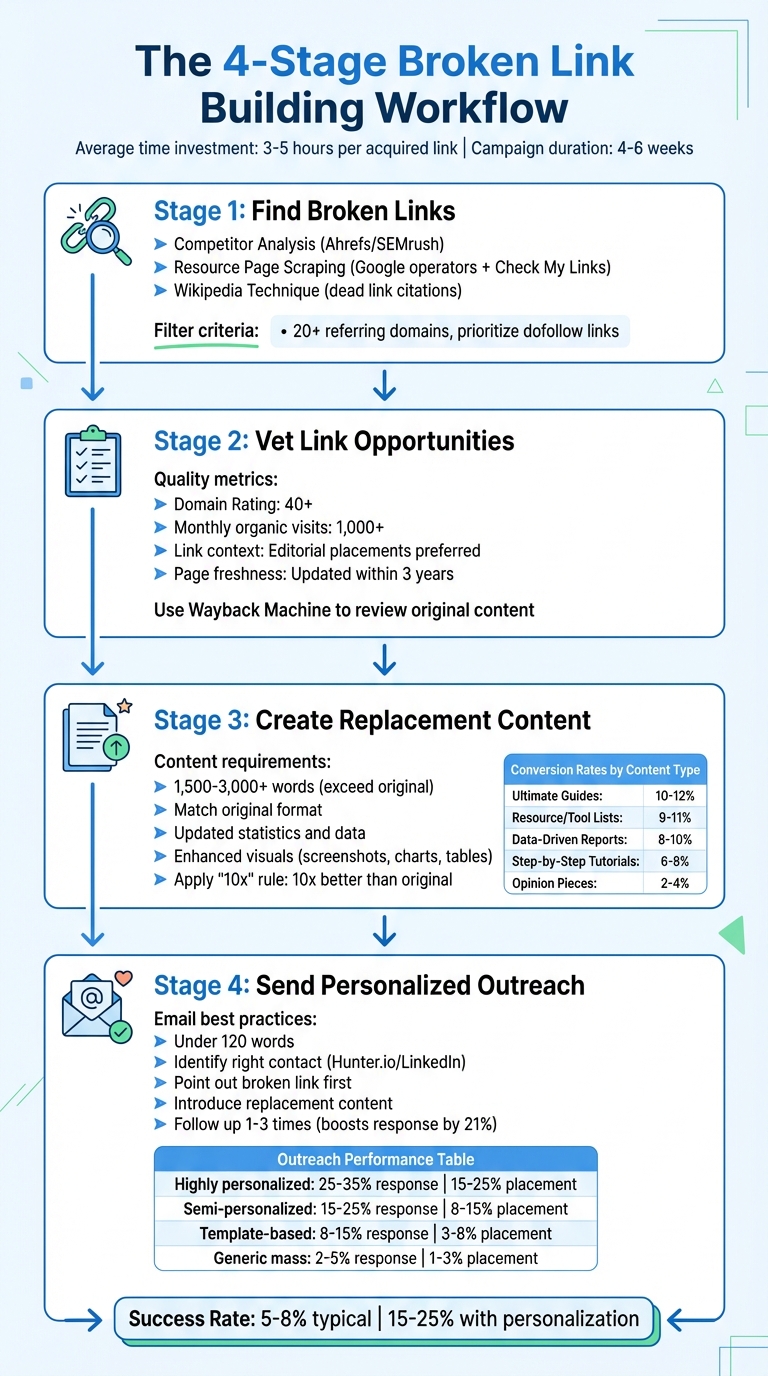
4-Stage Broken Link Building Workflow for SEO Success
A broken link building campaign thrives on a structured approach. The process involves four key stages, each building upon the last. While the idea seems simple, the execution determines your success. Typical campaigns see a 5% to 8% success rate, but with highly personalized efforts, you can achieve 15% to 25% conversion rates. These stages help you focus your efforts where they matter most, boosting your SEO impact.
This workflow is all about smart targeting, thorough evaluation, and strategic outreach. By filtering opportunities at each step, you can focus on links that make a real difference. On average, you should expect to spend 3 to 5 hours of work per acquired link.
Here’s a detailed breakdown of each stage to help you get started.
Stage 1: Find Broken Links
Finding broken links is the foundation of your campaign. The goal is to locate broken links on authoritative sites that attract relevant traffic. Here are three effective methods:
- Competitor Analysis: Tools like Ahrefs or SEMrush can help you analyze competitors' backlink profiles. Look for 404 pages with existing backlinks - these often reveal valuable content ideas that resonate in your niche.
- Resource Page Scraping: Use Google search operators like
[your topic] + "useful links"orintitle:resourcesto find curated lists of resources. A browser extension like "Check My Links" can quickly identify dead outbound links. - Wikipedia Technique: Search Wikipedia using queries like
site:wikipedia.org "[your topic]" "dead link". This uncovers broken citations, which you can use to identify other sites linking to outdated sources.
To maximize your efforts, apply filters. Focus on pages with 20+ referring domains and prioritize dofollow links from sites with high URL ratings.
Stage 2: Vet Link Opportunities
Once you’ve identified broken links, it’s time to evaluate their potential. Not every opportunity is worth pursuing, so focus on quality and relevance. Start by assessing the site's authority and traffic - look for sites with a Domain Rating above 40 and at least 1,000 monthly organic visits.
Next, check the context of the link. Editorial placements within article content carry more weight than links buried in footers or comments. Use the Wayback Machine to review the dead page’s original content. Understand why others linked to it - was it a detailed guide, a useful tool, or a key statistic? Your replacement content should match that intent.
"The decision of whether or not to add your link is a NO BRAINER... swoop in with a close replacement."
– Brian Dean, Backlinko
Also, evaluate the linking page’s freshness. Avoid pages that haven’t been updated in over three years. Steer clear of links tied to competitors or proprietary tools.
| Content Type | Avg. Conversion Rate | Best Use Case |
|---|---|---|
| Ultimate Guides | 10–12% | Replacing comprehensive educational resources |
| Resource/Tool Lists | 9–11% | Replacing directories or "best of" lists |
| Data-Driven Reports | 8–10% | Replacing original research or statistics |
| Step-by-Step Tutorials | 6–8% | Replacing "how-to" content with visuals |
| Opinion Pieces | 2–4% | General thought leadership (lower success rate) |
Stage 3: Create Replacement Content
Your replacement content must exceed the quality of the original. This is where the "10x" rule comes in - create content that’s not only better but also more relevant for 2026. Update data, improve visuals, and address any gaps in the original resource.
If the dead page had about 1,200 words, aim for 1,500 to 3,000+ words to establish authority. Match the original format - if it was a directory, create a new directory; if it was an infographic, design a better one. Include updated statistics, examples, and engaging elements like screenshots, charts, or tables to make your content stand out.
Stage 4: Send Personalized Outreach
Outreach is where many campaigns falter. Generic templates usually yield 2% to 5% response rates, but personalized emails can achieve 25% to 35%. Personalization is key - your pitch should highlight how you’re helping the webmaster fix a broken link while offering a superior replacement resource.
Start by identifying the right contact, such as content managers or editors. Use tools like Hunter.io or LinkedIn to verify email addresses. Keep your email short (under 120 words) and to the point. Begin by pointing out the broken link as a helpful gesture, then introduce your replacement content. If you don’t get a response, follow up 1 to 3 times - follow-ups can boost response rates by 21%.
| Outreach Approach | Avg. Response Rate | Avg. Link Placement Rate |
|---|---|---|
| Highly personalized + perfect match content | 25–35% | 15–25% |
| Semi-personalized + good match content | 15–25% | 8–15% |
| Template-based + relevant content | 8–15% | 3–8% |
| Generic mass outreach | 2–5% | 1–3% |
A hybrid approach works well - deeply personalize emails for high-authority sites while using semi-automated templates for lower-priority targets. This balances efficiency with strong results.
Tools and Automation for Scaling Campaigns
Automated crawls across countless sites can significantly increase the number of quality links you secure. Take Ahrefs, for example. Its AhrefsBot, ranked just behind Google, updates backlink data every 15 minutes. This near-real-time tracking helps you spot new broken links as they appear, providing a solid base for scaling your broken link-building efforts.
If you're after an all-in-one solution, SEMrush offers a "Link Building Tool" (starting at $139.95/month) that combines discovery and management in one place. This eliminates the need for juggling multiple spreadsheets, simplifying your workflow. For larger-scale technical audits, Screaming Frog SEO Spider ($279/year) can crawl entire domains, identifying every internal and external 404 error.
Best Tools for Broken Link Building
Choosing the right tools can make or break your broken link-building strategy. For quick manual checks, Check My Links is a free Chrome extension that highlights broken links directly on a webpage in real time - perfect for scanning resource pages. When it comes to finding the right contact, Hunter.io (starting at $34/month) helps locate verified email addresses of webmasters and editors, ensuring your outreach lands in the right inbox.
"In the world of 2026 SEO, a verified email address is often more valuable than the SEO metric itself." – Online Money Spinner
For marketers on a tighter budget, Linkody ($14.90/month) offers affordable backlink tracking, while the Broken Link Checker WordPress plugin ($1.50/month) helps maintain internal link hygiene. The key is to align your toolset with the scale of your campaign.
How to Use Automation to Save Time
Beyond selecting tools, automation can take your campaigns to the next level by handling repetitive tasks, freeing you up to focus on building relationships. For example, you can schedule daily or weekly crawls in Ahrefs or SEMrush to quickly detect new dead links. Automation can also personalize your outreach by using dynamic fields to auto-fill recipient details like names, page titles, and anchor text, making your emails feel more tailored.
"Automation shines in repetitive, rules-driven tasks... It should never replace judgment on content quality, publisher relevance, or outreach tone." – Single Grain
Adopt a tiered approach to outreach: craft personalized emails for high-authority sites (Domain Rating 70+), while using semi-personalized templates for mid-tier targets. Automated follow-up sequences, like sending a reminder email 2 to 4 days after your initial pitch, can also improve response rates. Just be sure to review high-value or brand-sensitive targets before triggering automated outreach to maintain quality and control.
Conclusion: Improving SEO with Broken Link Building
Key Takeaways for Marketers
Broken link building continues to be one of the most reliable white-hat SEO strategies in 2026. Why? It solves a real problem for webmasters while earning high-quality backlinks. With link decay being such a widespread issue, marketers who are willing to invest the effort can tap into countless opportunities. In fact, well-planned campaigns often achieve reply rates of 15%–25%, far outpacing the 5%–10% typically seen with cold guest posting. Personalized outreach emails perform even better, delivering a 32% higher response rate compared to generic templates, and a single follow-up can increase responses by an additional 21%. The secret lies in approaching outreach as a way to help site owners fix 404 errors, which improves their user experience and SEO performance.
To succeed, there are three must-haves for broken link building:
- High-quality replacement content: Your content should be as good as - or better than - the original dead resource.
- Personalized outreach: Tailor emails specifically to the recipient for maximum impact.
- Careful opportunity selection: Focus only on websites with a Domain Rating of 40 or higher and meaningful organic traffic.
By combining these principles with structured workflows and tools like Ahrefs, SEMrush, and Screaming Frog, marketers can achieve sustainable SEO growth. While tools can help streamline the process, human judgment remains critical to maintain quality. These steps lay the groundwork for long-term success.
Next Steps for Getting Started
Ready to dive in? Start by auditing your own site for broken inbound and outbound links. Fixing these not only recovers lost link equity but also immediately improves your site's user experience. Once your site is in shape, test a single strategy, such as competitor analysis or targeting resource pages within your niche.
Keep track of your efforts by logging prospect URLs, outreach dates, response rates, and the resulting impact on organic traffic in a spreadsheet. On average, expect to spend 3–5 hours per acquired link and allow 4–6 weeks for each campaign, from research to placement. Use the Wayback Machine to study the value of the original dead content, then create updated, more comprehensive replacement content. Add fresh data, better visuals, and deeper insights to make it stand out.
FAQs
How do I choose the best broken-link targets to pursue?
To find the best broken-link opportunities, look for authoritative websites that are closely related to your niche and offer high-quality content. Use tools to locate broken links, and make sure the original content was both relevant and useful. Focus on links from trusted, high-authority sites, and always evaluate the context of the link and the site's overall credibility. This approach ensures stronger, long-term SEO results.
What should my replacement page include to earn the link?
When creating a replacement page, focus on producing high-quality content that is directly relevant to the original topic. Make sure the content addresses the needs or interests of your audience by providing useful, actionable information or valuable resources.
The key is to offer something that genuinely helps users - whether that's through detailed explanations, helpful tips, or well-researched insights. By doing this, you increase the chances of earning backlinks, as others will see your page as a credible and worthwhile resource to share.
How can I scale outreach without getting flagged as spam?
To expand your outreach without triggering spam filters, leverage AI-powered tools to automate tasks like identifying broken links and managing outreach. The key is to keep your messages personalized and relevant. Avoid blasting out identical emails to everyone - take the time to tailor each message to the recipient.
Another important tip: space out your emails. Sending too many in a short period can hurt your sender reputation. Using targeted prospecting tools can also help you focus on the right audience, boosting your chances of positive responses while keeping your email practices clean and professional.