Maintaining a consistent brand across all channels is essential to building trust and driving revenue. Research shows that consistent branding can increase revenue by 10–20%, and 75% of consumers expect uniform experiences across platforms. This guide breaks down five actionable steps to ensure your brand stays recognizable and professional everywhere:
- Create a Brand Style Guide: Define your logo, colors, typography, voice, and imagery in a detailed document. Make it accessible to everyone involved.
- Audit Your Brand Presence: Review where your brand appears - social media, emails, ads, etc. - and fix inconsistencies in visuals and messaging.
- Centralize Brand Assets: Use a Digital Asset Management (DAM) system to store logos, templates, and guidelines in one place for easy access.
- Train Your Team: Conduct regular training to ensure all teams apply the guidelines correctly. Use shared content calendars for alignment.
- Monitor and Adjust: Track metrics like brand recognition and asset accuracy. Use analytics tools to identify and fix issues.
These steps help ensure your brand delivers a unified experience, builds trust, and stands out in a crowded market.
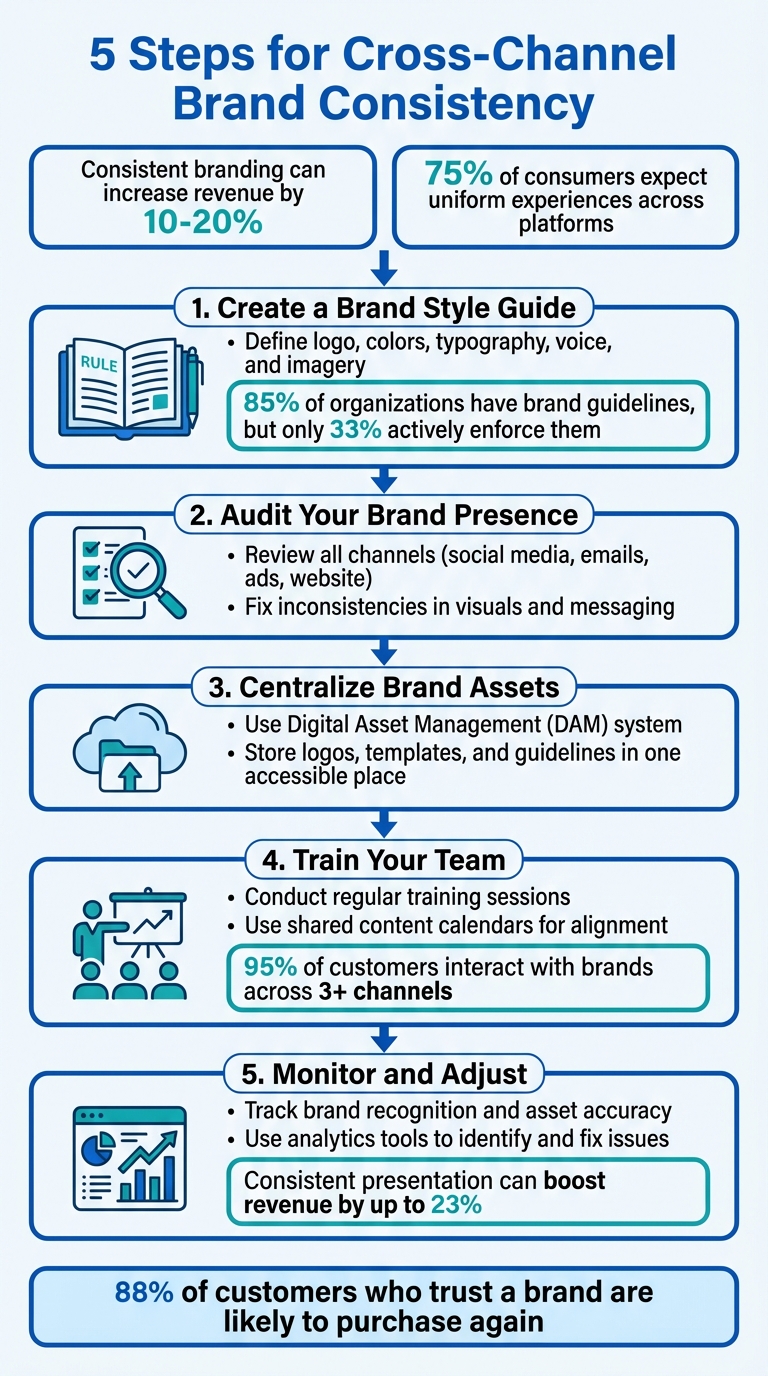
5 Steps to Achieve Cross-Channel Brand Consistency
How Brand Consistency Builds Trust and Drives Business Growth
Step 1: Create a Brand Style Guide
A brand style guide is essentially your brand's rulebook - a detailed reference that ensures your brand looks, sounds, and behaves consistently across every platform. Without one, teams might use mismatched logos, colors, or messaging, which can quickly undermine customer trust.
"A branding kit is the system that stops this chaos. It's not a vague idea; it's a technical toolkit of scalable vector logos, exact colour codes, and font rules that make your brand look professional, every single time." - Stuart L. Crawford, Creative Director, Inkbot Design
Here’s a striking statistic: while 85% of organizations have brand guidelines, fewer than 33% actively enforce or follow them. This gap between creating guidelines and actually using them is where inconsistencies creep in. A well-structured and accessible style guide eliminates confusion, empowering everyone - whether they’re part of your in-house team or external freelancers - to maintain a unified brand identity.
Define Your Core Branding Elements
Your style guide should capture the essence of your brand, both visually and verbally. Start with your logo system: include your primary logo, alternate layouts, monochrome versions, and icons. Clearly define the minimum clear space around your logo to prevent it from being crowded by other design elements.
For your color palette, document exact codes needed for both digital and print use. Digital teams will need HEX and RGB values for websites and social media, while print designers will rely on CMYK and Pantone codes for materials like business cards and packaging. To keep designs balanced, follow the 60/30/10 rule - 60% primary color, 30% secondary, and 10% accent.
Typography plays a huge role in your brand's identity. Specify font families, weights, and sizes, along with clear guidelines for hierarchy (e.g., H1 to H4), line heights, and spacing. Consistency here avoids guesswork and ensures a polished look across all platforms.
Your brand voice and tone should reflect your brand's personality. Think of it as describing your brand as a person - is it professional, playful, formal, or conversational? Include editorial guidelines, grammar preferences, and even a "do/don't" word list to help copywriters stay on track. For imagery and iconography, outline your preferences for photography styles (e.g., bright and airy vs. moody and dramatic), illustrations, and any custom icon sets.
Don’t forget your brand story - document your mission, vision, values, and history. This context helps your team understand the "why" behind branding decisions. Use visual examples to show correct and incorrect applications of your branding, such as how to use logos in social media posts or email headers.
| Core Branding Element | Key Components to Include |
|---|---|
| Logo System | Primary/secondary logos, monochrome versions, clear space rules, and usage "don'ts" (e.g., no stretching) |
| Color Palette | Primary and secondary color codes (HEX, RGB, CMYK) and contrast ratios for accessibility |
| Typography | Font families, weights, sizes, and web-safe fallback options |
| Voice & Tone | Personality traits, grammar preferences, and emotional tone for different contexts |
| Imagery | Guidelines for photography style, lighting, and subject matter |
Once these elements are defined, make sure your guide is easily accessible so everyone can stay aligned.
Share the Guide with All Teams
A style guide is only effective if it’s accessible to everyone who needs it. Store it in a centralized digital location, such as a DAM (Digital Asset Management) system, so both internal teams and external partners can always access the latest version. Modern style guides are dynamic, updating in real time and offering search functionality for distributed teams.
Organizations like the Kansas City Chiefs and Telefónica have used centralized brand platforms to save time and maintain consistent visuals across all channels. To further simplify the process, provide pre-approved templates for common needs like social media posts, presentations, and email headers. You can also conduct regular training sessions and quarterly audits to catch and correct any visual or messaging inconsistencies before they become a problem.
Step 2: Audit Your Current Brand Presence
After crafting your brand style guide, the next step is to review every place your brand appears and ensure it aligns with your guidelines. This includes everything from your website and social media profiles to email campaigns, paid ads, packaging, and even how affiliates or external partners represent your brand. Customers interact with your brand in various ways, and even small inconsistencies can chip away at their trust.
"Your brand isn't just built through ads or logos - it's shaped through dozens of small, seemingly minor interactions across every touchpoint." - Funic Tech
Start by organizing a comprehensive list of all the platforms and channels where your brand is visible. A master spreadsheet or a tool like Notion can help you track these touchpoints. Then, compare each element against your style guide. Are your logos displayed with the correct spacing? Are the HEX codes for your colors consistent across social media and other digital assets? Is your tone of voice cohesive across platforms, or does it vary - too formal on your website but overly casual on Instagram? These inconsistencies, often unnoticed, can dilute your brand. Research shows that 75% of global consumers expect a consistent brand experience across all channels. Yet, many businesses unintentionally allow "brand drift" to creep in. Once you've identified where things are off, focus on both visual and messaging elements to address these gaps.
Review Visual and Messaging Elements
Start with a deep dive into your visuals - logos, colors, typography, and imagery. Check that your logos are used correctly in terms of size, spacing, and proportions. Ensure your color codes (HEX, RGB, CMYK, or Pantone) are consistent across digital and print platforms. Typography is another important area - review your font hierarchy to confirm that headings, body text, and calls-to-action follow the same rules everywhere.
Next, turn your attention to your brand's voice. Ensure your messaging feels consistent, whether it's on your website, in customer support emails, or on social media. Mixed tones or personality shifts can confuse your audience and weaken your brand identity. Don’t forget to audit user experience (UX) elements like error messages, checkout prompts, and navigation labels to ensure they reflect your brand's tone and personality.
To streamline this process, consider using AI-powered tools that can scan your website and social media for guideline violations, such as incorrect colors, off-brand typography, or inconsistent tone. If you’re managing this manually, schedule quarterly brand audits to catch and fix discrepancies before they become entrenched. Additionally, ensure your visuals comply with Web Content Accessibility Guidelines (WCAG) by checking for proper color contrast ratios and alt text for images. Once your visuals and messaging are in sync with your guidelines, it’s time to gather input from your audience.
Collect Feedback from Your Audience
While data and metrics provide valuable insights, customer and team feedback can fill in the gaps. Use surveys, online reviews, and input from internal teams to gauge whether your brand feels consistent and clear. Your sales, customer success, and support teams are often the first to notice when something about your branding feels off or confusing.
Leverage tools like CRM platforms, analytics, and A/B testing to measure how well your messaging resonates and engages your audience. For instance, if your email campaigns have strong open rates but low click-through rates, it could indicate a disconnect between your email content and the landing pages they lead to.
"Trust is the new conversion rate. The more consistent your brand is across every touchpoint, the more your audience will believe in what you offer." - Funic Tech
Step 3: Organize Your Brand Assets in One Place
After completing your brand audit, the next step is to bring all your assets together in one centralized location. When logos, templates, or brand guidelines are scattered across emails, chats, and personal folders, teams waste precious time searching - or worse, they might end up using outdated materials. A central hub ensures everyone has access to the most current, approved assets, saving time and avoiding mistakes.
This centralization also ensures consistency across teams. Whether your sales team in Dallas or your marketing team in New York is working on a project, they’ll be pulling from the same, up-to-date library of assets. It eliminates the risk of someone accidentally using last year’s logo or an old tagline. Plus, version control becomes automatic - older drafts are archived and clearly marked as outdated, so there’s no confusion.
Set Up a Digital Asset Management System
A Digital Asset Management (DAM) platform is the perfect tool for creating this central hub. It stores everything your brand needs - logos, fonts, video files, presentation templates, and more. Many modern DAM systems come with features like metadata tagging and AI-powered search, making it easy to find exactly what you need in seconds. For instance, Datacom used a DAM to centralize 45,000 assets, which improved their brand consistency by 50% and reduced approval delays by up to five hours per request.
When choosing a DAM platform, look for one that offers role-based permissions. This ensures that external partners or regional teams only see the assets relevant to their work. Another useful feature is automatic expiration dates for time-sensitive materials, such as seasonal ads or licensed images. This helps prevent accidental misuse. Before moving your files into the system, take the time to audit your assets - remove duplicates, get rid of outdated materials, and establish a clear naming convention (e.g., AssetType_Campaign_Region_Date_Version) to make files easier to locate.
"Brandfolder is like a Google Image Search for my own company's assets." – Kathryn Castle, Director of Design & Creative Services
DAM platforms are also a game-changer for non-designers. Teams like sales, HR, or operations can use pre-approved, editable templates to create business cards, social posts, or presentations without having to wait for the creative team. For example, at Bosch, a small team of just four people manages the brand design space for over 100,000 users worldwide using Frontify. This ensures that brand consistency is maintained, even as the organization scales.
Once your DAM is up and running, you’ll have a solid foundation to explore additional tools that can further streamline your workflow.
Find Tools in the Marketing Funnels Directory
The Marketing Funnels Directory is a great resource for finding tools to enhance your operations. It offers curated recommendations for DAM platforms, content calendar tools, and workflow training. Whether you’re looking to simplify asset management or optimize your overall marketing processes, this directory is a helpful starting point for improving cross-channel consistency and boosting your marketing funnel’s performance.
sbb-itb-a84ebc4
Step 4: Train Your Team and Plan Content Together
Once your assets are centralized (see Step 3), the next step is making sure your team knows how to use them effectively. Without proper training and planning, even the best guidelines can fall flat. By building on your organized resources and audited brand presence, you can ensure your brand stays consistent across every customer interaction.
It’s critical to create a shared understanding of your brand’s identity across all teams involved in customer-facing content. This includes marketing, social media, sales, customer support, and even HR. When everyone speaks the same "brand language", your customers enjoy a seamless experience - whether they're scrolling through a social post, chatting with a sales rep, or reaching out for support.
Schedule Regular Brand Training Sessions
Brand training shouldn’t be a one-and-done onboarding task. Regular sessions are essential to prevent "brand drift", where small, unofficial changes slowly erode your brand identity over time.
Effective training goes beyond theory. Show practical, real-life examples of how your brand guidelines should be applied. For instance, HubSpot uses specific training rules like requiring contractions in customer communication and backing every claim with data. This approach eliminates subjectivity when reviewing brand voice. Salesforce takes it even further by offering brand training to all employees - not just those in marketing - ensuring alignment company-wide.
Train all relevant teams, including marketing, sales, customer service, product teams, and even external partners, to maintain a cohesive brand identity. This is especially important because 95% of customers interact with a brand across three or more channels during a single engagement. To keep things consistent, appoint "brand stewards" in each department. These individuals can monitor adherence to guidelines and train others within their teams. Some companies also use rotation programs, allowing team members to spend time in different departments to better understand how various channels work together.
Once everyone is on the same page, you can streamline your efforts by using a shared content calendar.
Use Shared Content Calendars
A shared content calendar is a powerful tool that ties your training efforts together. It ensures that messaging stays unified across platforms and prevents conflicting or disjointed campaigns. The numbers back this up: 64% of the most successful companies use a documented content strategy that includes a content calendar.
Your content calendar should go beyond simple posting dates. Include details like the target platform, content type (blog post, video, social media post), draft copy, creative assets, calls to action, and approval status. To make it user-friendly, consider color-coding entries by campaign, platform, or content theme. This level of organization helps you balance evergreen content with timely posts and ensures no channel is overused or neglected.
The real magic happens when calendars are used to coordinate across departments. For example, marketing, sales, and customer service teams can align their messaging to maintain a consistent tone throughout the customer journey. Establish clear workflows with defined roles and approval stages (e.g., Draft, Pending, Approved) to keep things moving smoothly. It’s also a good idea to leave some flexibility in your schedule for reactive posts. This way, you can jump on trending topics or industry news without disrupting your planned content. To boost efficiency, batch similar tasks like copywriting or asset creation, which helps maintain a cohesive narrative across all channels.
Step 5: Monitor and Adjust Regularly
Once your team is trained and workflows are in place, the work doesn’t stop there. Ongoing monitoring is essential to maintain consistency. Why? Because presenting a cohesive brand doesn’t just look good - it can significantly boost revenue and meet customer expectations. Regular check-ins can help you catch “brand drift” - those subtle, unofficial changes that can slowly chip away at your identity - before it becomes a bigger issue.
Set Up Key Performance Indicators
You can’t fix what you don’t measure. Setting up the right KPIs gives you the data you need to evaluate whether your brand consistency efforts are paying off. Focus on two main types of metrics: outcome metrics (what your audience experiences) and operational metrics (how well your internal processes are working).
Here are some metrics to track:
- Brand recognition rate: The percentage of people who correctly identify your brand from visual elements.
- Message consistency score: The percentage of content that aligns with your brand guidelines across all channels.
- Sentiment analysis: Measures whether your tone and messaging resonate with your audience.
- Asset accuracy rate: Tracks how often teams use the correct, approved versions of brand assets.
- Content reuse rate: Indicates whether teams are using approved templates or creating off-brand materials.
- Review turnaround time: Measures how quickly content moves through the approval process.
For example, using a consistent signature color can increase brand recognition by 80%, and 88% of customers are more likely to repurchase from a brand they trust. Companies with strong brand trust can even outperform competitors by up to 400% in market value.
Once you’ve defined your metrics, the next step is turning that data into actionable insights.
Track Performance with Analytics
Analytics tools make it easier to identify issues and measure your progress. AI-powered platforms, for instance, can scan your website, social media, and digital assets to flag off-brand content - like outdated logos or incorrect colors - before it reaches your audience. Natural Language Processing (NLP) tools can also assess written content to ensure consistency in tone, phrasing, and terminology across platforms.
Centralized dashboards are invaluable here. They consolidate data from multiple channels into one view, helping you quickly spot gaps in consistency and track improvements over time. During quarterly audits, calculate your brand compliance rate by dividing the number of compliant materials by the total audited materials, then multiplying by 100. This simple formula gives you a clear picture of how well your team is sticking to the guidelines.
Don’t forget to include sentiment analysis in your audits. Social media monitoring tools can reveal if there’s a disconnect between how you want your brand to be perceived and how your audience actually sees you. This feedback is critical - especially since 89% of people say they’re willing to trust a business again after a mistake, provided the company is transparent about how it’s fixing the issue.
Lastly, remember that your brand guidelines aren’t set in stone. They should evolve as you gather more data. Use what you learn to refine your audits and balance standardization with adaptability. By focusing on core values rather than rigid rules, your team can adjust to new trends or platform-specific needs without losing sight of what makes your brand stand out. This approach ensures your brand remains relevant while staying true to its essence.
Conclusion
Maintaining consistent branding across all channels builds trust and delivers results. By creating a brand style guide, auditing your current presence, centralizing assets, training your team, and monitoring performance regularly, you establish a system that ensures your brand is instantly recognizable and consistently professional. Research shows that consistent presentation can boost revenue by up to 23%. Additionally, 88% of customers who trust a brand are likely to purchase from them again. This approach brings every aspect of your brand identity into a unified framework.
"The most successful brands don't see consistency as a constraint but as a powerful tool for standing out in a crowded marketplace." - Growth Engines
Statistics highlight that 75% of consumers expect a seamless experience with your brand, regardless of the channel they use. Meeting this expectation isn’t just about maintaining a standard - it’s about carving out a distinct place in a competitive market.
By aligning your brand identity with customer perception, you reduce confusion, enhance recognition, and create a sense of familiarity in every interaction. With clear guidelines, centralized resources, and ongoing team training, your brand can be represented confidently and consistently at every touchpoint.
To take this further, tools like those in the Marketing Funnels Directory offer curated solutions for managing digital assets, planning content, and utilizing AI-powered monitoring. These tools help you maintain consistency at scale, turning it into a competitive edge that strengthens your brand presence across all platforms.
FAQs
How does a Digital Asset Management (DAM) system help maintain brand consistency?
A Digital Asset Management (DAM) system serves as a centralized hub for all your brand assets - logos, images, videos, and even brand guidelines. By storing everything in one place, it ensures your team always has access to the latest, approved materials. This reduces the chances of outdated or off-brand content being used or shared, which can help maintain a unified brand image.
Many modern DAM systems come packed with features like dynamic brand guidelines, access controls, and version tracking. These tools simplify workflows by making it easier to enforce brand standards, manage permissions, and track updates. They also help prevent unauthorized use of assets, ensuring only approved materials make their way into your marketing campaigns, social posts, or customer-facing content. With consistent branding across all channels, a DAM system not only boosts efficiency but also reinforces your brand identity.
What should a brand style guide include to ensure consistency?
A brand style guide is the backbone of keeping your brand consistent everywhere it shows up. It outlines essential elements like logo usage, color schemes, typography, and design templates. These details work together to create a unified look, making your brand instantly recognizable across all platforms.
But it’s not just about visuals. A style guide also defines your brand voice and tone, ensuring your messaging stays consistent - whether it’s on your website, social media, or in advertising campaigns. It can even include tips for tailoring your communication to fit specific platforms while keeping your core message intact.
Think of a style guide as your brand’s playbook. It helps align everything - visuals, words, and experiences - so your audience sees a reliable and cohesive identity. This consistency builds trust and makes your brand memorable.
Why is team training essential for ensuring brand consistency?
Regular team training plays a key role in maintaining brand consistency. It ensures that everyone in your organization is on the same page when it comes to following brand guidelines. This shared understanding fosters trust, builds recognition, and encourages loyalty by offering customers a seamless and consistent experience across all interactions.
With marketing tools and channels constantly changing, regular training helps your team stay aligned with updated brand standards and practices. It minimizes the risk of inconsistencies that could confuse customers or dilute your brand's identity. When you invest in ongoing training, you equip your team to deliver a unified brand experience, reinforcing customer trust and supporting steady business growth.