Authority bias can lift clicks, improve lead quality, and help close deals - but only when the person promoting the product has direct subject knowledge. In B2B, buyers put more weight on job titles, past work, peer comments, and outside validation than on fame alone. The article’s main point is simple: use expert-led content to cut buyer doubt, carry the same proof from social post to landing page, often built using high-converting landing page tools, and disclose paid partnerships clearly.
If I had to boil it down, I’d focus on 4 things:
- Pick experts, not just big audiences.
- Match the expert’s background to the product category.
- Use proof that buyers can check - examples, workflows, benchmarks, and case details.
- Track impact past the click with branded search, direct traffic, brand mentions, CRM tags, and form fields.
A few numbers stand out:
- 252% higher CTR for LinkedIn Thought Leader Ads vs. standard single-image ads
- 5x more engagement on personal profiles vs. company pages
- $80-$250 CPL for creator partnerships vs. $150-$450 CPL for LinkedIn paid social
- 44% of buyers use creator content to support pricing decisions
- 38% of buyers contact sales after seeing creator content
- 82% of B2B buyers say creator content affects purchase decisions
One more point: authority is not the same as social proof or fame. Authority comes from domain knowledge and job experience. Social proof comes from peer behavior. Fame gets attention, but it often lacks the depth needed for long sales cycles.
So if you want this to work, I’d keep the playbook simple: choose people who have done the job, keep their proof visible across the funnel, and avoid inflated claims.
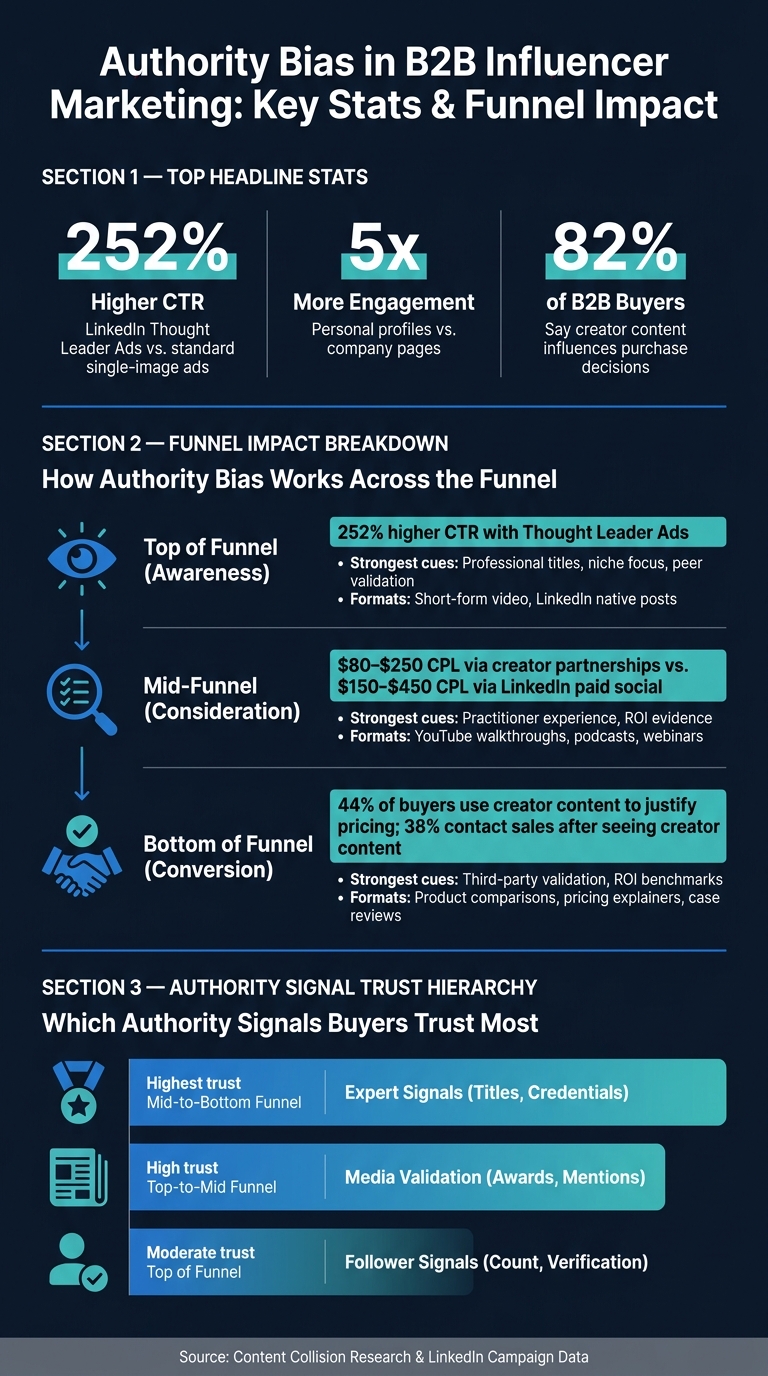
Authority Bias in B2B Influencer Marketing: Key Stats & Funnel Impact
The authority signals that shape buyer decisions
Expert signals: titles, credentials, and niche focus
When a buyer scans a sponsored post or bio, they usually check one thing first: has this person actually done the job?
A title like VP of Engineering, Head of Growth, or Supply Chain Analyst gives that person operator credibility. It tells the buyer, in plain terms, that the creator has worked on the same kind of problem before.
Niche focus makes that signal stronger. A creator with 8,000 followers who publishes original machine learning analysis can matter more to a technical buyer than a generalist with 500,000 followers posting broad motivational content.
Buyers also look for practitioner "receipts" - screenshots of actual workflows, tested frameworks, admitted mistakes, and specific outcomes. That tends to land better than generic advice because it shows the work, not just the opinion.
If titles alone don't do enough, buyers look for proof from somewhere else.
Media mentions, awards, and third-party validation
Third-party validation moves credibility off the creator and onto outside proof. Buyers read these signals as a sign that someone else has already checked them out. "As seen in" logos, analyst mentions, and industry awards all add weight.
Former analyst roles at firms like Gartner or Forrester can matter a lot because they bring institutional trust. These cues tend to work best at the top and middle of the funnel, when the job is to build category trust before a buyer starts comparing vendors up close.
"By the time a qualified lead arrives in a sales pipeline, there is a high probability that a creator they follow has already shaped their perception of the category and the vendors in it." - Dinda Anandita, Account Director, Content Collision
That’s why these cues matter most before vendor comparison starts.
Follower count, engagement, and verification badges
In B2B, follower count shows reach. Peer engagement shows trust. Verification badges on LinkedIn help too because they confirm identity on LinkedIn.
But engagement quality is the signal that matters most. Peer comments, saves, and technical back-and-forth tell you more than a pile of emoji reactions ever will. When target buyers see other peers pushing on an influencer's ideas in the comments, that becomes a second layer of authority.
Here’s how these signals usually stack up for campaign planning:
| Signal Type | Perceived Trust | Speed of Impact | Best-Fit Funnel Stage |
|---|---|---|---|
| Expert Signals (Titles, Credentials) | Highest - expertise-based | Moderate - requires vetting | Mid to Bottom - risk reduction |
| Media Validation (Awards, Mentions) | High - third-party credibility | Fast - instant recognition | Top to Mid - awareness/trust |
| Follower Signals (Count, Verification) | Moderate - social proof | Instant - scale signal | Top of Funnel - reach/visibility |
These cues shape whether buyers click, opt in, or move one step closer to purchase through insight selling.
sbb-itb-a84ebc4
How authority bias affects clicks, leads, and sales across the funnel
Top of funnel: better clicks and first-touch trust
Authority cues don’t work the same way at every stage of the funnel. They hit first and hardest at the awareness stage, where attention is thin and buyers scroll past anything that feels like a company pitch.
When a known practitioner - like a Head of Growth or a DevOps Lead - posts a short video or a quick LinkedIn update, buyers often read it as peer input, not advertising. That gap matters. LinkedIn Thought Leader Ads, which boost posts from individual creators instead of brand pages, drive a 252% higher click-through rate than standard single-image ads. Personal profiles also see 5x more engagement than company pages for the same type of content.
In practice, this means expert-led framing in a 60-120 second video or a native LinkedIn post can make a complex buying problem feel easier to grasp. People click because the messenger seems like someone who has dealt with the problem firsthand, not someone hired to talk about it. Practitioner-led content beats brand-led content because buyers trust the person delivering the message.
Mid-funnel: lower perceived risk and more lead capture
Once buyers know the category, authority bias stops doing the job of winning attention and starts doing the job of cutting hesitation. Now they’re weighing options and looking for a reason to trust one route over another.
At this point, tutorials, webinars, and podcast episodes led by operator-creators tend to land better than polished brand decks. A 10-minute YouTube walkthrough from a trusted creator can move a buyer along faster because it lowers perceived risk - it signals that someone credible has already checked the tool or method. That can lead to more demo requests, trial sign-ups, and email opt-ins.
The cost-per-lead gap shows up in the numbers. Creator partnership campaigns usually land at $80-$250 per lead, versus $150-$450 for standard LinkedIn paid social. These leads also tend to come in with more context and stronger intent, which means sales teams spend less time on surface-level qualification.
As buyer intent climbs, authority shifts again - from building interest to clearing objections.
Bottom of funnel: higher conversion intent and fewer objections
Near the buying decision, authority bias helps soften price and risk objections before sales even steps in. If a buyer comes in through an expert recommendation, they’ve already heard a credible outside view on whether the product is worth the spend.
44% of B2B buyers say they use creator content to justify pricing decisions, and 38% say creator content led them to contact a salesperson directly. That’s authority bias at work. It closes a trust gap that might otherwise take months of nurture to close.
At the conversion stage, authority cues work best when they’re tied to proof that the product drives measurable results. Here’s how that lines up across the funnel:
| Funnel Stage | Strongest Authority Cues | Content Format | KPIs Influenced |
|---|---|---|---|
| Top of Funnel (Awareness) | Professional titles, niche focus, peer validation | Thought Leader Ads, short-form video, LinkedIn native posts | CTR, video view-through, branded search lift |
| Mid-Funnel (Consideration) | Technical relevance, practitioner experience, ROI evidence | YouTube walkthroughs, podcasts, webinars, case studies | Email sign-up rate, demo requests, trial starts |
| Bottom of Funnel (Conversion) | Third-party validation, ROI benchmarks, expert teardowns | Product comparisons, pricing explainers, case reviews | CAC efficiency, revenue per visitor, win rate |
One catch: private shares can hide part of creator impact. So during campaign windows, watch branded search and direct traffic too.
The next step is keeping those authority cues steady from post to landing page to CRM.
Here's Psychologically Why Influencers Make You Buy Stuff
How to use authority bias ethically in influencer campaigns
Authority bias only works when a brand leans on real expertise, clear proof, and plain disclosure. Once you know which authority signals matter, the next step is using them without making someone sound more expert than they are. In practice, that comes down to three things: who you choose, how you carry their credibility through the funnel, and what you say in public about the partnership.
Match influencer expertise to the offer
The biggest mistake is picking creators for reach instead of subject-matter fit.
Use topic fit: the share of recent content that speaks to the problem your product solves. A fintech CFO who posts often about cash flow forecasting is a stronger authority signal for treasury software than a general business influencer with a much bigger audience.
You also need to check for hands-on experience in the same function. In B2B, buyers can usually spot the gap between someone who has done the work and someone who is just repeating things they've heard.
Carry authority cues from social post to landing page and CRM
After you choose the right creator, keep the same proof point in view from the post to the sales funnel to the follow-up. If a creator shares a specific framework or benchmark in their content, that same element should show up on the landing page - not a generic product pitch.
The page should lead with that insight as a headline or proof point. Then the lead magnet should build on it with a checklist, benchmark table, or teardown. In the CRM, tag those leads by creator and by the framework they engaged with, so sales can open with context that fits.
Use the same proof point across the post, landing page, and CRM. A lot of B2B influence happens in private channels - Slack groups, DMs, and private communities - so UTM tags alone will miss part of the picture. Add a "How did you hear about us?" field to your forms and use at least a 90-day attribution window to match normal B2B sales cycles.
Avoid fake expertise, weak evidence, and disclosure failures
Authority only works when people trust both the sponsorship and the proof behind it. Three rules help keep that trust in place:
- Verified expertise: Partner only with creators who have lived experience in the function they advise on. If credentials are overstated, people will catch on - and the brand can lose trust right along with the creator.
- Clear disclosure: The FTC's endorsement guidelines require any material connection between a brand and a creator to be disclosed clearly and conspicuously - not buried in hashtags or tucked into fine print.
- Evidence-backed claims: Ask for specific case studies, trade-offs, and failure modes. Vague claims like "this tool transformed my entire workflow" without details weaken the trust that creator partnerships depend on.
A cleaner way to handle approvals is to split them into two reviews: one for legal and compliance, and one for brand safety. SMEs should check technical claims without turning the creator's voice into stiff corporate copy. If you script too much, you drain the trust that made the partnership useful in the first place.
Conclusion: Build trust with real authority, not borrowed hype
Authority bias matters because B2B buyers look for signals that lower risk. When the choice is murky, an expert title, a media mention from a trusted outlet, or strong engagement from the right crowd can push a buyer toward one option over another.
And those signals are not small. 82% of B2B buyers say creator content influences their purchasing decisions, and 87% prefer insights from industry influencers over traditional brand messaging.
The best campaigns don’t rent trust. They earn it. The brands that win line up creator expertise with the offer, carry proof through the funnel, and track demo requests, influenced pipeline, and deal velocity using all-in-one marketing platforms. Real authority builds over time. Hype burns out.
FAQs
How do I tell real authority from popularity?
Look past follower counts. Focus on three signals: professional experience, audience interaction quality, and fit with your target customer.
Real authority shows up in specific, useful insights, solid credentials, reputable brand work, and meaningful comments. Put more weight on steady, relevant engagement than raw reach, and make sure the creator’s content lines up with your industry and audience.
Which authority signals matter most in B2B?
In B2B marketing, the strongest authority signals are demonstrated expertise, peer validation, and technical relevance - not follower counts.
What tends to matter most is pretty simple:
- Proven track record and domain knowledge
- High-quality engagement and peer-level discussion
- Evidence of shipped work, such as frameworks, failure modes, and technical teardowns
- Consistent alignment with the audience’s industry challenges
A big audience can look impressive at first glance. But in B2B, buyers usually look for signs that someone has done the work, understands the field, and can speak to hard problems with clarity. That’s where trust starts.
How can I measure authority bias beyond clicks?
Look past vanity metrics and focus on high-intent actions - demo requests, trial signups, resource downloads, and visits to pricing or comparison pages.
Tie your tracking back to the CRM with unique UTM parameters so you can connect influencer touchpoints to conversions and content-assisted deals. It also helps to check engagement quality more closely: audience seniority, job title, company size, and how deep the comments or discussions go.