Advocacy isn’t just a feel-good marketing strategy - it’s a proven way to grow your business efficiently. By turning satisfied customers into advocates, you can generate referrals, increase retention, and reduce marketing costs. Here’s why advocacy matters:
- Referral Impact: Leads from referrals convert 4x faster and have a 30% higher value than other channels.
- Retention Benefits: Companies with advocacy programs see a 37% higher retention rate and 25% more annual revenue growth.
- Cost Savings: User-generated content costs one-tenth of traditional marketing methods and can lower acquisition costs significantly.
- Revenue Growth: Businesses with strong advocacy programs outperform competitors by 27 percentage points in revenue growth.
Advocacy works because people trust recommendations from friends and family more than ads. With over half of companies now running formal advocacy programs, it’s clear this strategy is essential for reducing costs while driving sustainable growth. Whether through referral programs, customer reviews, or community-building, advocacy transforms happy customers into your most powerful marketing asset.
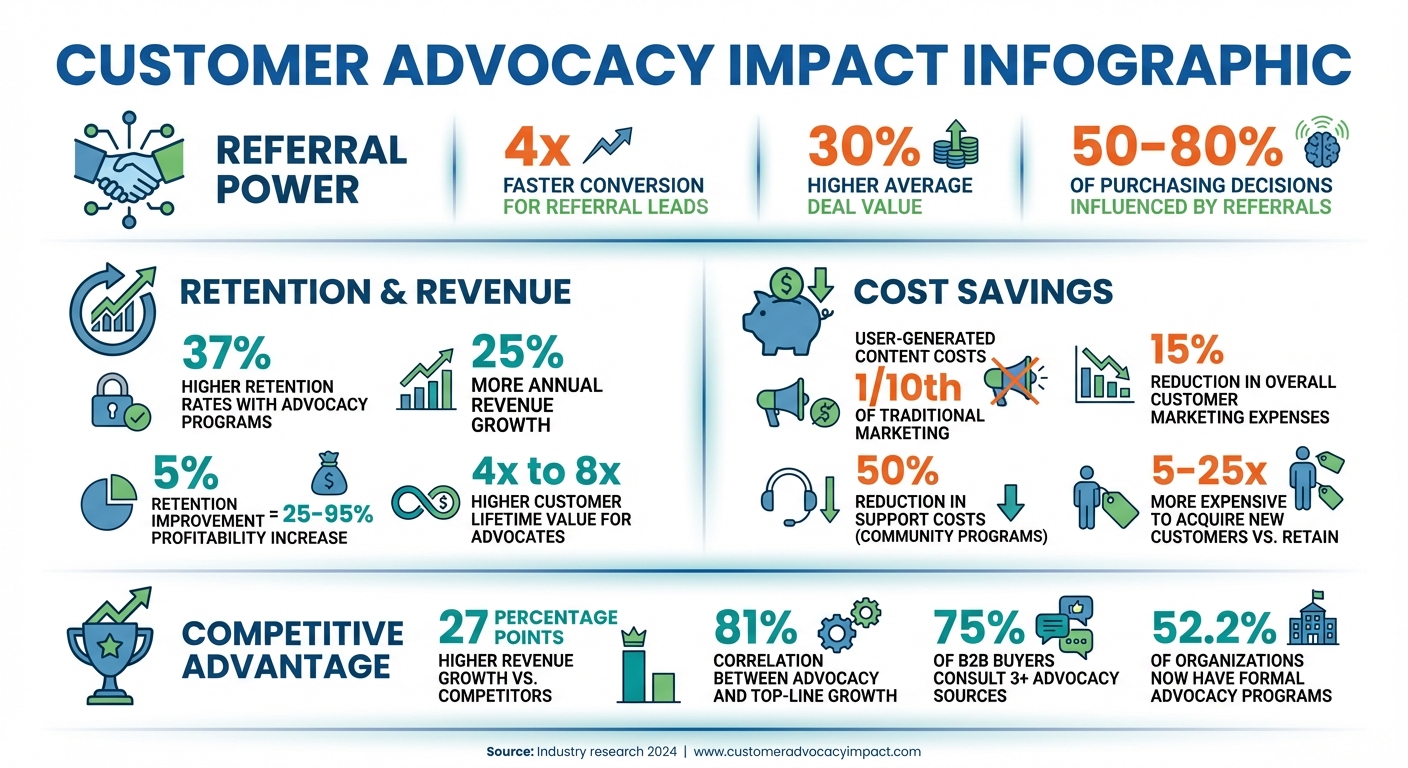
Customer Advocacy Impact on Business Growth: Key Statistics and ROI Metrics
Build Your Customer Advocacy Growth Engine
How Advocacy Affects Funnel Performance and Revenue
Advocacy brings measurable improvements to every stage of the funnel, acting as the driving force behind the customer flywheel mentioned earlier. Research shows an 81% positive correlation between the Brand Advocacy Index and top-line growth - double the correlation of other customer promotion metrics. When customers become advocates, they help speed up sales cycles, improve conversion rates, and lead to higher-value deals.
Advocacy plays a role in every part of the buyer's journey. For instance, 75% of B2B buyers consult at least three advocacy sources - such as reviews, peer recommendations, or case studies - before making a purchase decision. This makes referral-based leads especially impactful, as they convert 4x faster and result in a 30% higher average deal value. The social proof provided by advocates not only reduces buyer hesitation but also shortens the time it takes to close a deal.
Advocates also help reduce marketing costs. Content they generate, like testimonials and reviews, costs about one-tenth of traditional marketing methods. This shift to user-generated content can lower overall customer marketing expenses by up to 15%, freeing resources for other growth initiatives.
Increasing Customer Retention and Lifetime Value
Advocacy shines when it comes to customer retention. It's well-known that acquiring new customers is 5-25 times more expensive than retaining existing ones, and just a 5% improvement in retention can increase profitability by 25-95%.
"Improving customer retention by just 5% can boost profits between 25% and 95%."
– Bain & Company Research
Companies with formal advocacy programs report 37% higher retention rates and 25% higher annual revenue growth compared to those without. Advocates also deliver 4x to 8x higher customer lifetime value than non-advocates. This happens because advocates tend to stay longer, buy more often, and require less support. For example, Adobe's "One-Stop Shop" community program connected experienced customers with newer ones, cutting support costs by 50% while boosting satisfaction scores.
Advocacy programs also help reduce customer churn by 3% and increase SQL-to-win conversion rates by the same percentage. Even small improvements can lead to big results. For instance, Built, a construction finance technology company, automated its referral process in March 2021. By May 2023, they achieved a 363% ROI for closed-won opportunities and a 1,400% ROI for pipeline generation. These retention gains naturally feed into the power of referrals, further fueling organic growth.
Generating Referrals and Organic Leads
Referrals are one of the most effective lead sources, influencing 50–80% of purchasing decisions. They work so well because they’re rooted in trust - 66% of consumers ask friends and family for recommendations before buying, and 50% check online reviews. This kind of peer validation carries more weight than any ad ever could.
Cisco Systems demonstrated the power of advocacy through their "The Gateway" program, launched in January 2017 under Jeremy Bevan, Vice President of Global Segment & Industries Marketing. Over three years, they activated 11,482 advocates who completed 196,933 acts of advocacy, resulting in 657 direct referrals, 969 product reviews, and an ROI of $5,421,760.
"By mobilizing our customers as advocates, we're now able to leverage the authentic voice of our customers, which is far more engaging and relevant to our prospects than our traditional marketing."
– Jeremy Bevan, Vice President, Global Segment & Industries Marketing, Cisco
Sage took a slightly different route in North America, equipping sales teams with data-backed customer stories and testimonials. By integrating advocacy into their sales process, they closed $8 million in deals and expanded their reference pool by 81%. Their strategy focused on making advocacy content easily accessible to sales reps when they needed it most.
Spontaneous advocacy - when customers recommend your brand without being prompted - is especially powerful. These unprompted recommendations carry more weight than prompted ones, and critics tend to share their opinions with twice as many people as satisfied customers. This highlights the importance of managing the customer experience as a whole, not just encouraging positive feedback.
Metrics That Measure Advocacy Performance
While qualitative outcomes are important, advocacy's financial impact can be tracked through specific metrics. Net Promoter Score (NPS) remains a key tool for identifying customers who are most likely to recommend your brand. For example, Built used an NPS score of 67 to segment its advocacy messaging and target the right customers for referrals. Other important metrics include referral conversion rates, the number of reviews generated, social media shares, and participation in activities like case studies or speaking engagements.
Financial metrics are just as telling. Jobber, a home service management platform, found that referred customers had a 5% higher lifetime value and an 18% higher average selling price compared to non-referred ones. Over time, these differences add up, making referred customers significantly more valuable.
B2B and B2C advocacy programs differ in their focus and impact. Here's a comparison:
| Metric | B2B Advocacy Performance | B2C Advocacy Performance |
|---|---|---|
| Primary Drivers | Rational (ROI, performance, service) | Emotional (brand identification, design, lifestyle) |
| Purchase Influence | 75% consult 3+ advocacy sources | 66% consult friends/family |
| Key Advocacy Channels | Case studies, speaking engagements, advisory boards | Social sharing, online reviews, spontaneous word-of-mouth |
| Negative Impact | High in service-oriented sectors (telecom, banking) | High in visible/emotional categories (apparel, smartphones) |
| Conversion Impact | 4x faster conversion for referrals | Spontaneous advocacy drives rapid market share gains |
The rise of AI is also reshaping advocacy efforts. By 2025, 73% of businesses are expected to use AI to enhance their advocacy programs. Companies already using AI for hyper-personalization have seen advocacy scores improve by 22%, as these tools analyze customer behavior and sentiment to identify potential advocates early.
The link between advocacy and growth is clear. Companies with strong advocacy programs outperform their peers by an average of 27 percentage points in top-line growth. As of 2024, 52.2% of organizations have formal customer advocacy programs, and 95% of marketing technology decision-makers agree that these programs are more important than ever. The challenge isn’t proving advocacy’s value - it’s implementing a program fast enough to reap the rewards.
Case Studies: Companies That Grew Through Advocacy
SaaS Companies: Creating a Growth Flywheel
SaaS companies have found a way to turn advocacy into a powerful growth engine. By tapping into their customer base, they've created programs that drive engagement, referrals, and, ultimately, revenue.
Take Cisco Systems, for example. In January 2017, under the leadership of Jeremy Bevan, Vice President of Global Segment & Industries Marketing, Cisco launched "The Gateway." Over three years, this program activated 11,482 advocates who collectively performed 196,933 acts, including 657 referrals and 969 reviews. The result? A remarkable ROI of $5,421,760, along with significant digital engagement.
Another standout is DocuSign, which introduced AdvocatesHQ in December 2012. Ryan Schwartz, Director of Marketing Systems and Operations, aligned the program with the demand generation team to link advocacy efforts directly to revenue. By May 2014, the program had influenced over $3 million in sales pipeline, generated 4,300+ AppExchange reviews, and secured 87 referrals. In one particularly focused eight-week campaign, they added 1,900 new AppExchange reviews.
"Advocate marketing is more than customer engagement: it's customer acceleration."
– Ryan Schwartz, Director of Marketing Systems and Operations, DocuSign
Other SaaS giants like BMC Software, Marketo, and Blackbaud have also embraced advocacy programs. These initiatives have driven millions in revenue, boosted retention rates to nearly 95%, and expanded referral pipelines by as much as 40 times.
These examples demonstrate how advocacy programs, when carefully structured, can convert customer enthusiasm into measurable growth.
Retail Brands: Increasing Referrals and Reducing Costs
Retail brands are proving that advocacy isn't just for SaaS companies. By leaning into customer loyalty and passion, they’ve found ways to lower costs and increase referrals.
Huel, a nutrition brand, teamed up with Mention Me and SAP Emarsys in April 2025 to activate their "Hueligans" community. Using a "Name Share" referral system, customers could simply share their names at checkout. This strategy boosted referral-driven new customers from 10% to almost 20% of their total base. During the launch of their Black Edition Ready-to-Drink product, Huel sent free packs to advocates, leading to a 150% increase in social shares and a 25% referral rate among recipients.
Similarly, Thinx, a period underwear company, revamped their referral program in February 2024 by switching to "stackable credits" on Shopify Plus. This allowed advocates to accumulate rewards and use them all at once, rather than relying on single-use codes. The result? The program doubled in size and became their most efficient acquisition channel, with a cost-per-acquisition (CPA) of under $1.
Prose, a personalized hair care brand, saw a dramatic improvement by tweaking their referral incentives. By increasing the offer from $10 to $20, they boosted conversion rates by 5%. This change resulted in a CPA that was 117 times cheaper than their paid advertising efforts and delivered an 8x return on investment.
Meanwhile, woom, a manufacturer of ergonomic bikes, integrated Friendbuy with Klaviyo in February 2024 to embed referral prompts into post-purchase emails. They also introduced giveaways, like a $1,000 gift card draw, which led to a 30x ROI and accounted for 40% of all new email and SMS subscribers.
Even grocery retailers like Mercadona have embraced advocacy. During a recession, the Spanish chain invited 500,000 women to in-store sessions featuring demonstrations and samples. This effort drove a 5% increase in same-store sales - all without spending on traditional media advertising.
These retail examples highlight how strategic referral programs can turn customer satisfaction into real, measurable growth. By focusing on advocacy, brands are finding smarter, more efficient ways to expand their reach and boost their bottom line.
sbb-itb-a84ebc4
How to Build and Scale an Advocacy Program
Creating Referral Programs with Rewards
Integrating your referral program with your CRM is a game-changer - it ensures you're not reaching out to customers who might still have unresolved issues. Instead of casting a wide net, use data analytics to zero in on your top advocates. These are the customers with high Net Promoter Scores, frequent purchases, and active engagement on social media .
When it comes to rewards, think about both intrinsic motivators like recognition and exclusive perks, as well as extrinsic rewards like discounts or cash. A great example is Happy Mammoth’s tiered system: they offer a free product after five referrals and a $500 credit after ten. Timing is everything, so send referral invitations via post-purchase emails when excitement is at its peak. Use automation to generate tracking URLs and deliver rewards instantly . To fine-tune your strategy, experiment with A/B testing on email copy, visuals, and reward tiers. Double-sided incentives - where both the referrer and the new customer benefit - can also boost participation.
These strategies naturally pave the way for leveraging customer testimonials to further build trust and credibility.
Using Customer Reviews and Testimonials
Customer reviews are a powerful extension of your referral program. They not only build trust but also help you identify your most loyal advocates. For instance, Fatture in Cloud tapped into satisfied customers using Customerly, skyrocketing their Trustpilot reviews from 11 to over 1,700 while improving their average rating from 2.0 to 4.8. Strategically place testimonials in email footers, referral emails, or landing pages. Sage, for example, incorporated authentic customer success stories into its sales channels, leading to $8 million in closed deals across North America and an 81% growth in its reference pool.
Encourage your advocates to share their experiences on third-party review platforms like G2, Capterra, or Trustpilot. Offering incentives such as exclusive feature previews or opportunities to speak at industry events can inspire more detailed testimonials. User-generated content, particularly on social media, is another goldmine - it generates 28% more engagement than branded content and costs about one-tenth as much to produce .
Building Customer Communities and Hosting Events
Turning one-off interactions into thriving communities can significantly boost advocacy. Adobe’s "One-Stop Shop" community, where experienced users acted as peer mentors, is a prime example. This initiative slashed support costs by 50% while increasing customer satisfaction.
Design your community with tiered systems like Bronze, Silver, and Gold levels. Higher tiers could unlock exclusive benefits such as invitations to retreats or participation in customer advisory boards. A standout example comes from February 2024, when Rich Krolikowski, Tonal’s Growth Marketing Manager, launched an advocacy program that engaged 10% of the customer base, achieved a 500% higher conversion rate than other channels, and contributed up to 7% of the company’s monthly revenue.
Interestingly, 90% of brand-related conversations happen offline rather than on social media. Hosting in-store demos, workshops, or customer appreciation events can help create these meaningful, real-world connections. To nurture these relationships further, assign dedicated relationship managers. Another idea is to form Customer Advisory Boards with 10–15 senior executives from client organizations. These boards can provide strategic feedback and shape your product roadmap. Building strong communities not only deepens customer loyalty but also strengthens the advocacy funnel.
For more actionable strategies on marketing funnels, visit the Marketing Funnels Directory at https://topmarketingfunnels.com.
Key Takeaways: Why Advocacy Matters for Long-Term Growth
Advocacy acts as a powerful engine for organic, self-sustaining growth. By making advocacy a core part of your marketing strategy, you can shift away from expensive traditional media and instead rely on authentic, organic customer engagement. The numbers speak for themselves: companies with strong advocacy programs see their top-line growth outpace competitors by an average of 27 percentage points. Plus, there's an 81% correlation between advocacy strength and revenue growth.
On the financial side, referral-based leads not only convert faster but also bring in higher value compared to other channels. Content created by advocates costs just 10% of what traditional marketing methods require, and leveraging community support can reduce customer support tickets by 10–25%. Additionally, over 75% of B2B buyers consult at least three advocacy sources before making a decision, emphasizing the importance of peer recommendations.
To make advocacy truly effective, it needs to be integrated across the entire customer journey - not just as an afterthought once the sale is complete. Use data analytics to identify potential advocates by analyzing their engagement, satisfaction levels, and social activity. And instead of relying solely on monetary incentives, create meaningful value for your advocates. Offer perks like professional development opportunities, early access to product updates, and a sense of belonging within a community.
The data makes it clear: embedding advocacy into your customer journey is a smart move. Start small with a group of 20–30 highly engaged customers, then measure metrics like revenue influence, win rates, and sales cycle efficiency to demonstrate the program's ROI. With 95% of martech decision-makers agreeing that formal advocacy programs are now more critical than ever, the question isn’t whether you should implement one - it’s how soon you can start. When done right, advocacy transforms customer enthusiasm into a long-term growth strategy.
FAQs
How can businesses measure the impact of advocacy on their revenue growth?
To understand how advocacy impacts revenue growth, businesses need to track metrics that directly tie advocacy efforts to financial results. Start by tagging advocacy interactions with unique identifiers and integrating this data into your CRM. Tools like referral codes or UTM parameters make it easier to link advocacy touchpoints to specific deals.
Here are some key metrics to keep an eye on:
- Referral-sourced revenue: This is the total value of deals that come from tracked referral links or codes.
- Win-rate improvement: The percentage increase in deal closures when prospects engage with peer references or testimonials.
- Faster deal cycles: The reduction in the time it takes to close deals that are influenced by advocacy, such as case studies or online reviews.
- Larger deal sizes: The boost in average deal value when advocacy materials, like executive references, are part of the sales process.
For a more accurate analysis, compare these metrics to a control group that hasn’t been exposed to advocacy efforts. This method helps pinpoint the incremental revenue generated by advocacy, offering a clear, data-backed picture of its role in driving business growth.
How can businesses effectively integrate advocacy into the customer journey?
To make advocacy a seamless part of the customer journey, think of it as a core stage in your marketing funnel - not just an afterthought. Align advocacy with the funnel's traditional stages - awareness, consideration, conversion, loyalty, and advocacy itself - and build specific content and touchpoints for each phase. For instance, share real customer stories to establish trust, emphasize social proof and referrals during the conversion phase, and offer exclusive perks to loyal customers to inspire them to advocate for your brand.
A great way to do this is by integrating advocacy into your tools and processes. Use systems like CRMs to track referrals, testimonials, and other advocacy-related data. Measure your success through metrics such as customer referrals or recommendation rates, and set up structured programs that reward customers for spreading the word. Incentives like early access to products, personalized content, or special rewards can go a long way in turning satisfied customers into passionate brand ambassadors.
How does user-generated content compare to traditional marketing in terms of cost and effectiveness?
User-generated content (UGC) offers an affordable alternative to traditional marketing campaigns while often delivering stronger results across the board. Many businesses discover that even a modest investment in advocacy programs can lead to impressive returns. UGC tends to generate higher levels of engagement and trust compared to conventional advertising methods.
Take Cisco, for example. The company reported a staggering $5.4 million return on investment (ROI) from nearly 200,000 customer advocacy actions. Content created by customers proved far more engaging and relevant to potential buyers than traditional marketing approaches. Studies also highlight that word-of-mouth and brand advocacy - key components of UGC - have a stronger impact on sales than most other marketing channels. This makes UGC a powerful strategy for both attracting fresh leads and turning them into loyal customers.
By combining lower costs with increased trust, engagement, and conversion rates, UGC has become a go-to tool for driving business growth.